
What Happens When You Chant a Mantra Every Day? Honest Guide

If you have started chanting a mantra, or are thinking about it, you probably want to know one thing: what will actually change? The honest answer is quieter, and more useful, than most articles online suggest.
This guide keeps three things apart that are often mixed together: what Hindu traditions teach about japa, what practitioners say they experience, and what research has and has not shown. It also answers the practical questions, such as how long to chant, how many repetitions to do, and what to do if you miss a day.
Table of contents
The Short Answer
In a few lines
- Tradition: daily japa is seen as a way to remember the divine, build devotion and keep the mind steady.
- Experience: many people describe a more regular routine, better focus while chanting, and at times a calmer mind. Others feel very little for a long time.
- Research: studies of mantra meditation suggest small to moderate benefits for stress and anxiety, but the evidence is limited and mostly not about devotional japa.
- Not promised: cures, money, career success, protection or fulfilled wishes. No reliable source can guarantee these.
What Does “Chanting a Mantra Every Day” Mean?
A mantra is a sacred word, syllable or verse, such as Om, Om Namah Shivaya or the Gayatri Mantra. Japa is the practice of repeating it, aloud, in a whisper or silently in the mind. Many people count the repetitions on a 108-bead mala.
Naam Jaap is a close cousin. Instead of a longer mantra, you repeat a divine name such as Ram, Krishna, Radha or Shiv. If you are new to it, start with our guide on what Naam Jaap is.
“Every day” can look very different from person to person. For one person it is five quiet minutes after waking. For another it is a mala at sunrise and Naam repeated on the bus. Both are daily practice.
What Hindu Traditions Teach About Daily Japa
These are traditional beliefs. They come from scripture and from devotional lineages, and they are matters of faith rather than scientific findings.
- Japa as an offering. In the Bhagavad Gita (10.25), Krishna says that among sacrifices he is japa-yajna, the offering of repeated chanting. Some commentators, such as Swami Mukundananda, point out that this offering has far fewer rules than ritual sacrifices and can be done anywhere.
- Chanting and remembrance as devotion. In the Bhagavata Purana (7.5.23), Prahlada lists nine forms of bhakti. Kirtana (chanting) and smarana (remembering) are two of them.
- Repetition with meaning. In the Yoga Sutras (1.27–28), Patanjali names Om as the sacred word for Ishvara and advises repeating it while contemplating its meaning. Many teachers read this as a warning against purely mechanical chanting. The next verse (1.29) describes inward realisation and the removal of obstacles. That is a spiritual claim, and it is not something science can measure.
- Steady, unbroken practice. Yoga Sutra 1.14 says practice becomes firmly rooted when it is kept up for a long time, without interruption and with devotion. This is the main traditional reason daily practice is valued.
- Practice without clinging to results. Gita 2.47 teaches that we have a right to our action but not to its fruits. Many devotees apply this to chanting: do the practice sincerely and let go of a fixed expectation.
- The Name in Kali Yuga. Many bhakti traditions hold that in the present age, remembering the divine Name is the most accessible path. A well-known line attributed to Tulsidas in the Ramcharitmanas expresses this idea.
Traditions do not all say the same thing. Yoga and Vedanta lean towards stilling the mind and contemplating meaning. Bhakti traditions lean towards love and remembrance of a personal deity. Some lineages prefer a mantra given by a guru, while many bhakti paths treat the Name as open to everyone. If you belong to a tradition, its guidance comes first.
What Practitioners Commonly Describe
These are personal experiences. They are real to the people who report them, but they are not promises and they will not match every reader’s experience.
- A steady daily routine that gives the day a quiet starting point.
- Better concentration while chanting, because the mind has one thing to hold.
- A calmer or more settled mood, at least for a while after a session.
- A feeling of remembrance or closeness to their chosen deity.
- The Name coming to mind on its own during the day.
People also report the less glamorous side: a wandering mind, restlessness, boredom, and days when nothing seems to happen. This is common, and traditions treat it as part of practice, not as failure.
One honest caution: self-reports are subjective, and what we expect can shape what we notice. That does not make the experience less meaningful, but it is a reason to avoid treating any one story as a guarantee.
What Modern Research Says (and Does Not Say)
Researchers have studied mantra repetition, but mostly as a structured, non-religious meditation programme, not as daily devotional japa. That difference matters when you read the results.
- Mantram Repetition Program. This is a secular programme where people silently repeat a personally chosen sacred word or phrase throughout the day. In randomized trials with US veterans with PTSD, including one published in the American Journal of Psychiatry in 2018, it was linked to reduced symptoms compared with a comparison therapy. The programme does not prescribe a set number of repetitions.
- Frequency. A later analysis of two of those trials found that veterans who repeated their mantram more often tended to show greater benefit. This is an association and does not prove that more repetition causes more benefit.
- Wider reviews. A 2022 systematic review and meta-analysis of trials of mantra-based meditation reported small to moderate reductions in anxiety, depression and stress compared with control groups. An earlier review of mantra meditation in general populations found some evidence of benefit but rated over 90% of the studies as weak in quality, and most of them studied Transcendental Meditation. A large evidence review of meditation programmes had found too few mantra trials to draw firm conclusions.
| Kind of claim | Example | How to read it |
|---|---|---|
| Traditional belief | Japa is an offering that turns the mind towards the divine. | A matter of faith. Science does not test it. |
| Practitioner experience | “I feel more settled after chanting.” | Real for that person. Varies widely. Not a promise. |
| Research | Small to moderate effects on stress and anxiety in some trials of mantra meditation. | Promising but limited. Mostly secular programmes, and many studies are low quality. |
You may also read online that chanting changes “vibrations” or “synchronises the brain hemispheres”. We have not relied on claims like these, because we could not find strong evidence for them.
Should You Expect a Big Change Straight Away?
Probably not, and that is fine. Devotional practice is personal, and no trustworthy source promises a set timeline. You will see numbers like 21 or 40 days online, but traditions do not agree on them and research does not support a fixed number.
It helps to think in three layers:
- During a session. The most immediate experience is a shift in attention. Some people feel calmer or more focused while chanting. Others spend the session bringing a wandering mind back, and that is normal.
- Building the habit. The first real change is often practical: you start showing up at the same time each day. Simple routines, like tying chanting to something you already do, are what usually make the habit stick.
- Long-term practice. Traditions describe the deeper effects, such as devotion, steadiness and remembrance, as slow and unhurried. Yoga Sutra 1.14 speaks of practice kept up for a long time. Whether and how these show up varies from person to person.
What Chanting Does Not Promise
Some websites and videos make big claims. Here is what we cannot honestly promise, and what you should be wary of when you see it promised elsewhere:
- Healing or curing any disease
- Ending anxiety or depression
- Wealth, a job, a promotion or success in exams
- Fixing relationships or removing bad luck
- Guaranteed protection or fulfilled wishes
- Supernatural powers or enlightenment
Some devotees do believe their prayers were answered, and that belief is part of their faith. But a personal belief is not the same as a guarantee, and it should not be sold as one.
How Much Should You Chant Every Day?
There is no single correct amount. The examples below are only starting points, not rules. The old texts we looked at stress steady, sincere practice more than large numbers, and the research programme mentioned above sets no fixed count either.
| Level | Example | Good for |
|---|---|---|
| Light | About 5 minutes, or 11 or 21 repetitions | Beginners, busy days, building the habit |
| Steady | One mala (108 repetitions) | A regular daily practice |
| Extended | Several malas, or a longer timed session | People who enjoy longer practice |
| Through the day | Short bursts while walking, commuting or doing chores | Keeping the Name in mind between sessions |
Is 108 necessary? No. It is a traditional count and a convenient one, because a mala has 108 beads. You can read more in why mantras are chanted 108 times. If it feels like too much, begin smaller. If your teacher or family tradition gives you a number, follow that.
Is consistency better than a big number? For most beginners, yes. A small practice you actually keep is easier to sustain than a large one you drop after a week. If you want a step-by-step routine, see our beginner’s guide to Naam Jaap.
Practical Questions About Daily Chanting
Can I chant silently?
Yes. Japa is commonly described in three modes: aloud, whispered and mental. Choose the one that helps you concentrate. Silent chanting is easy to do almost anywhere.
Do I need a mala? Can I use a counter?
A mala is traditional, but not compulsory. A finger counter or a digital counter works too. If you are unsure which suits you, read mala vs physical counter vs digital jaap counter or can you do Naam Jaap without a mala.
Should I chant the same mantra every day?
Many people do, and it keeps the practice simple. If a guru gave you a mantra, keep to it. If you chose it yourself, you can stay with one or change it as your practice develops. If you want a deity-specific example, our guide to the 21 names of Lord Ganesha shows how names can be used in worship.
Can I do Naam Jaap instead of a specific mantra?
Yes. Repeating a single divine name is a complete practice in many bhakti traditions. Naam Jaap is usually simpler to start with, because there is nothing long to memorise.
What if I miss a day?
Nothing bad happens. None of the sources we reviewed describe a penalty. Traditional texts praise unbroken practice as an ideal, but the practical advice is to begin again the next day without guilt. If you have taken a specific vow, follow your guru or tradition.
When is a good time to chant?
Early morning is widely recommended in tradition, but many teachers say any time is acceptable, and the best time is one you can keep. Doing it at the same time each day makes it easier to remember. More detail is in the best time for Naam Jaap.
Can I chant more than once a day?
Yes. Some people chant in the morning and evening, or use small gaps during the day. There is no general rule against it. If your tradition has set routines, follow those.
Keeping the Habit Going
- Start smaller than you think. A few minutes daily is better than an hour once a week.
- Attach it to something you already do. After brushing your teeth, before breakfast, or before you open your phone at night.
- Keep the same place if you can. A quiet corner or a fixed seat becomes a cue.
- Bring your attention back gently. When the mind wanders, return to the mantra without scolding yourself.
- Do not measure it by feelings. Some sessions will feel flat. Showing up is still the practice.
Counting with the Divya Marg Naam Jaap App
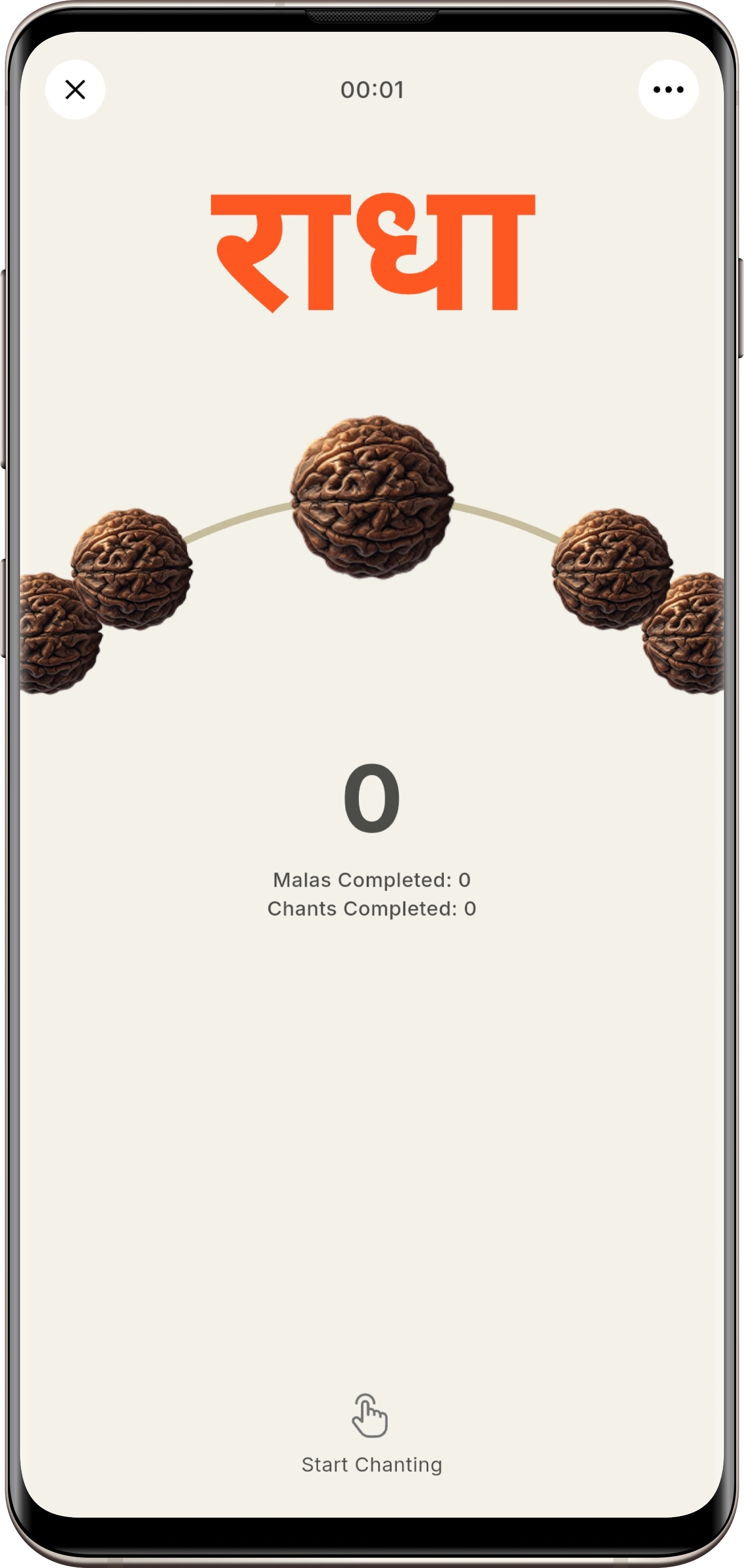
If you prefer not to count on beads, the Divya Marg Naam Jaap app is a free counter that works offline. It counts your chants and malas, lets you set a daily goal, and shows your progress and streak. It is a counting tool that can help you stay regular. It does not promise any spiritual or health outcome.
Choose your Naam or mantra
Set the name or mantra you already chant and begin anytime.
Daily Jaap goal
Set a small target you can actually keep, and change it whenever you like.
Haptic bead counting
Feel each repetition so your attention can stay on the name.
Works fully offline
Chant anywhere, signal or not.
Daily reminders
A gentle nudge at the time you choose.
Simple progress tracking
See your chants, malas and streak without any setup.

Begin your Naam Jaap today
Offline-first and built entirely around one purpose — helping you show up for your practice, every single day.
- Free, always
- Works offline
- No ads

A Note on Mental Health
Many people find chanting comforting, and it can be a helpful part of daily life. But if you are struggling with persistent anxiety, low mood, trauma, sleep problems or any health condition, chanting should not replace care from a doctor or qualified mental health professional. The two can go side by side.
Frequently asked questions
Everything people usually ask before starting their Naam Jaap with Divya Marg.
What happens when you chant a mantra every day?
There is no single answer, because devotional practice is personal. In Hindu traditions, daily japa is seen as a way to remember the divine and build devotion and discipline. Many practitioners say they feel more focused, or calmer during and after chanting. Research on mantra meditation shows modest benefits for stress and anxiety in some studies, but the evidence is limited. Dramatic or guaranteed results are not promised by any reliable source.
Is it good to chant a mantra every day?
For most people, yes. Daily chanting is a common and gentle practice in many Hindu traditions, and a short daily session is easy to keep up. It is a devotional and mental practice, not a medical treatment. If you are dealing with a health or mental health problem, chanting can sit alongside professional care but should not replace it.
How long should I chant a mantra every day?
There is no fixed rule. Beginners often start with 5 minutes, or with a small count like 11 or 21 repetitions, and add more only if it feels natural. Many people settle on one mala (108 repetitions). Regular practice matters more than a long session that is hard to keep up.
Is it necessary to chant a mantra 108 times?
No. 108 is a traditional count, and a standard mala has 108 beads, so it is a convenient round number. But it is not required. Smaller counts are fine, and some traditions use different numbers or a fixed time instead. Follow the guidance of your own family, guru or sampradaya if you have one.
How long does it take to see results from mantra chanting?
No reliable source gives a fixed timeline. Numbers like 21 or 40 days are common online, but they are not agreed on across traditions and are not backed by research. Some people notice a calmer mind during a session within days, while others feel very little for a long time. Deeper devotional changes, if they come, are described as gradual and personal.
Can I chant a mantra silently?
Yes. Japa is traditionally described in three modes: aloud, whispered, and mental. Silent (mental) chanting is fully accepted and is useful when you are in a shared space, travelling or trying to stay focused. Choose whichever mode helps you concentrate.
What happens if I miss a day of mantra chanting?
Nothing bad. None of the sources we reviewed describe a penalty for a missed day. Traditional texts do praise steady, unbroken practice as an ideal, but the practical advice is simply to start again the next day without guilt. If you have taken a specific vow or sankalpa, follow your guru or tradition.
Can I chant the same mantra every day?
Yes, and many people find it helpful. Repeating one mantra or Naam builds familiarity and makes the practice simpler. Some traditions specifically recommend staying with one mantra. Others are relaxed about changing it. If your mantra was given by a guru, keep to it.
Can I chant more than once a day?
Yes. Some people chant in the morning and again in the evening, or use small gaps in the day, such as a commute or a walk. There is no general rule against it. If you follow a particular tradition with set routines, follow those instead.
Is Naam Jaap the same as mantra chanting?
They are closely related. Naam Jaap means repeating a divine name, such as Ram, Krishna, Radha or Shiv. A mantra is usually a sacred word, syllable or verse, such as Om Namah Shivaya. Both are forms of japa (repetition), and many devotees do one or both.
Can I use a mala, a counter or an app to count?
Yes. A 108-bead mala is the traditional tool, but a finger counter or a digital counter works too. What matters is that counting helps you stay steady without pulling your attention away from the mantra. Use whichever feels natural.
Does mantra chanting really work?
It depends on what you mean by work. As a devotional practice, it is meaningful to millions of people and is central to many traditions. As a way to feel more focused or settled, many people find it helpful and some studies support modest effects on stress. As a guaranteed way to achieve specific outcomes like wealth, cures or fulfilled wishes, there is no reliable evidence and no honest source can promise it.
Sources and References
Scriptural verses are paraphrased in our own words. Translations and commentaries vary between traditions, so please read the original verses with a teacher if you can.
Scriptural and traditional sources
- Bhagavad Gita 10.25 (japa-yajna), with commentary by Swami Mukundananda: holy-bhagavad-gita.org
- Bhagavad Gita 10.25 with classical commentaries: bhagavad-gita.us
- Bhagavad Gita 2.47 (right to action, not to its fruits): Samkhya Yoga (Bhagavad Gita), Wikipedia
- Srimad Bhagavatam 7.5.23–24 (nine forms of devotion): vedabase.io
- Yoga Sutras 1.27–29 (Om and its repetition): Wisdom Library
- Yoga Sutra 1.14 (long, unbroken, devoted practice), translation by Swami Veda Bharati: yogasutra195.com
Research
- Bormann JE et al. (2018). Individual treatment of posttraumatic stress disorder using mantram repetition: a randomized clinical trial. American Journal of Psychiatry, 175(10), 979–988. Link
- Higher frequency of mantram repetition practice is associated with enhanced clinical benefits among US veterans with PTSD. European Journal of Psychotraumatology (2022). Link
- Effectiveness of mantra-based meditation on mental health: a systematic review and meta-analysis (2022). PubMed Central
- Mantra meditation for mental health in the general population: a systematic review (2018). ScienceDirect
- Meditation programs for psychological stress and well-being, evidence review (discussion section). NCBI Bookshelf
- Mantram repetition as a portable mindfulness practice. PubMed Central
This article is for general information and devotional understanding. It is not medical or psychological advice.