Why Are Mantras Chanted 108 Times? Meaning of 108 Explained
If you’ve chanted a mantra or done Naam Jaap even a few times, you’ve probably heard that it should be done 108 times. But why 108, and not 100, or 50, or any other round number? The answer isn’t one single fact — it’s a mix of tradition, astrology, scripture, and symbolism that built up over a very long time.
This guide explains the most common traditional explanations for 108 in simple language, and is honest about which ones are well-documented tradition and which are popular but unverified claims.
Table of contents
Key takeaways
- 108 is a traditional chanting count, closely tied to the standard 108-bead japa mala.
- Several explanations exist — astrological, scriptural, and symbolic — and no single one is the “official” answer.
- Some 108 facts (like the nakshatra-pada math) are well documented; others (like planetary distance ratios) are popular online but not reliably proven historically.
- 108 isn’t compulsory — what matters most in chanting is attention and consistency, not hitting an exact number.
Why 108 Comes Up So Often
Once you start paying attention, 108 seems to show up everywhere in Hindu and yogic practice — mala beads, temple steps, lists of divine names, even the number of Sun Salutations done during certain festivals. That repetition isn’t an accident. Over centuries, 108 became a kind of shorthand for completeness — a number used whenever a tradition wanted to represent something whole or full, rather than partial.
Because of that, it’s worth separating two different questions: why 108 became meaningful in Indian tradition at all, and why it specifically became the standard count for chanting a mantra. The two are connected, but they’re not exactly the same question.
The Short Answer
In simple words: 108 is the traditional count for one full round of mantra chanting mainly because the standard japa mala has 108 beads, and the mala itself took its shape from a number that Hindu tradition had already come to see as sacred and complete — through astrology, scripture, and symbolism. There isn’t one original document that says “chant exactly 108 times, here is the reason” — instead, several independent traditions arrived at 108 from different directions, and over time it became the accepted standard.
108 and the Japa Mala
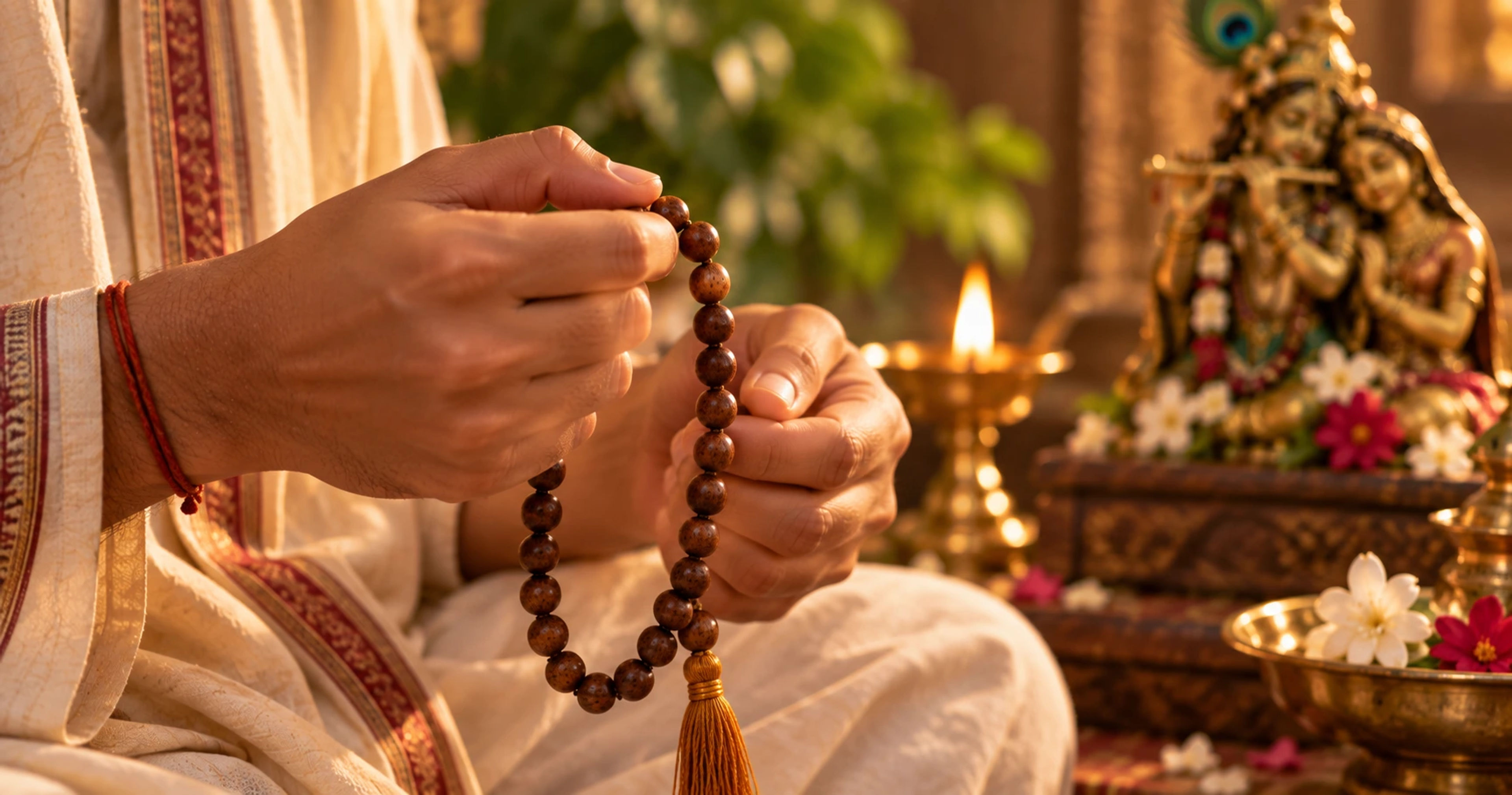
A traditional japa mala has 108 beads plus one extra bead, called the meru or guru bead, which marks the start and end of a round and isn’t counted. As you chant, you move one bead at a time between your fingers, and reaching the meru bead again means you’ve completed one full “mala” of 108 repetitions.
This is the most direct, practical reason 108 feels so tied to chanting: for most people, their first real exposure to the number comes from literally counting beads on a mala, long before they ever hear the astrological or scriptural explanations behind it.
Traditional Explanations for Why 108 Is Sacred
No single explanation below is “the” official reason. They are different traditional and symbolic explanations that have circulated for a long time, often side by side, and different teachers or lineages tend to emphasise different ones.
1. Astrology: 27 Nakshatras x 4 Padas
In Vedic astrology, the sky is divided into 27 nakshatras, or lunar constellations, and each nakshatra is further divided into 4 smaller parts called padas. Multiply 27 by 4 and you get exactly 108. This division is well documented in classical Indian astronomy and astrology, and it’s one of the more historically grounded explanations for why 108 carried cosmic significance.
2. The Sanskrit Alphabet
A commonly cited explanation says the Sanskrit alphabet has 54 letters, and each letter is considered to have a masculine and a feminine form — traditionally linked to Shiva and Shakti. 54 multiplied by 2 gives 108. This explanation is popular in devotional and yogic teaching, and is best understood as a symbolic reading of the alphabet rather than a strictly linguistic fact.
3. Scriptures and Sacred Lists
Hindu tradition also uses 108 as a count in scripture and devotion itself. The Muktika canon lists 108 Upanishads, and many deities have a traditional list of 108 names, called an Ashtottara Shatanamavali, used in devotional recitation. These lists reinforced 108 as a number associated with completeness within religious texts and practice.
4. The Body: Marma Points and Nadi Channels
In Ayurveda and yogic anatomy, the body is described as having 108 marma points, or vital energy points, and some yogic traditions describe 108 important nadis, or subtle energy channels, meeting at the heart centre. These descriptions come from traditional systems of knowledge rather than modern anatomy, and are best understood within that traditional framework.
5. Popular but Unverified: Sun, Moon, and Earth Distances
You’ll often come across the claim that the distance between the Earth and the Sun is about 108 times the Sun’s diameter, and that the Earth-Moon distance follows a similar ratio. These ratios are approximately true, but there’s little reliable historical evidence that ancient Indian astronomers deliberately calculated and encoded them into the number 108. Most careful sources treat this as an interesting coincidence or a modern teaching aid, not a proven ancient fact — so it’s worth enjoying without treating it as settled history.
Belief, Tradition, or Coincidence?
Not all explanations for 108 rest on the same level of evidence. Here’s a simple way to think about how well-documented each one is.
| Explanation | Type | How well-documented |
|---|---|---|
| 27 nakshatras x 4 padas | Astrological | Well-attested in classical Vedic astrology |
| 108 Upanishads (Muktika canon) | Scriptural | Documented in the Muktika canon list |
| 54 Sanskrit letters x 2 | Symbolic | Widely taught, symbolic rather than literal |
| 108 marma points / nadis | Traditional (Ayurveda/yoga) | Part of traditional systems, not modern medicine |
| Sun/Moon distance ratios | Popular / modern | Numerically close, but historically unverified as intentional |
Do You Have to Chant Exactly 108 Times?
No. 108 is a widely used traditional count, but it isn’t a rule that applies to everyone in every situation. Many people, especially beginners, start with a smaller round like 27 or 54 and build up gradually. Others chant for a fixed amount of time instead of counting repetitions at all.
What most teachings agree on is this: the number itself doesn’t create the benefit of chanting. Your attention and sincerity while chanting matter far more than whether you land on exactly 108. The count exists to give your practice structure and consistency, not to turn chanting into an exact target you must hit.
How People Keep Count of 108
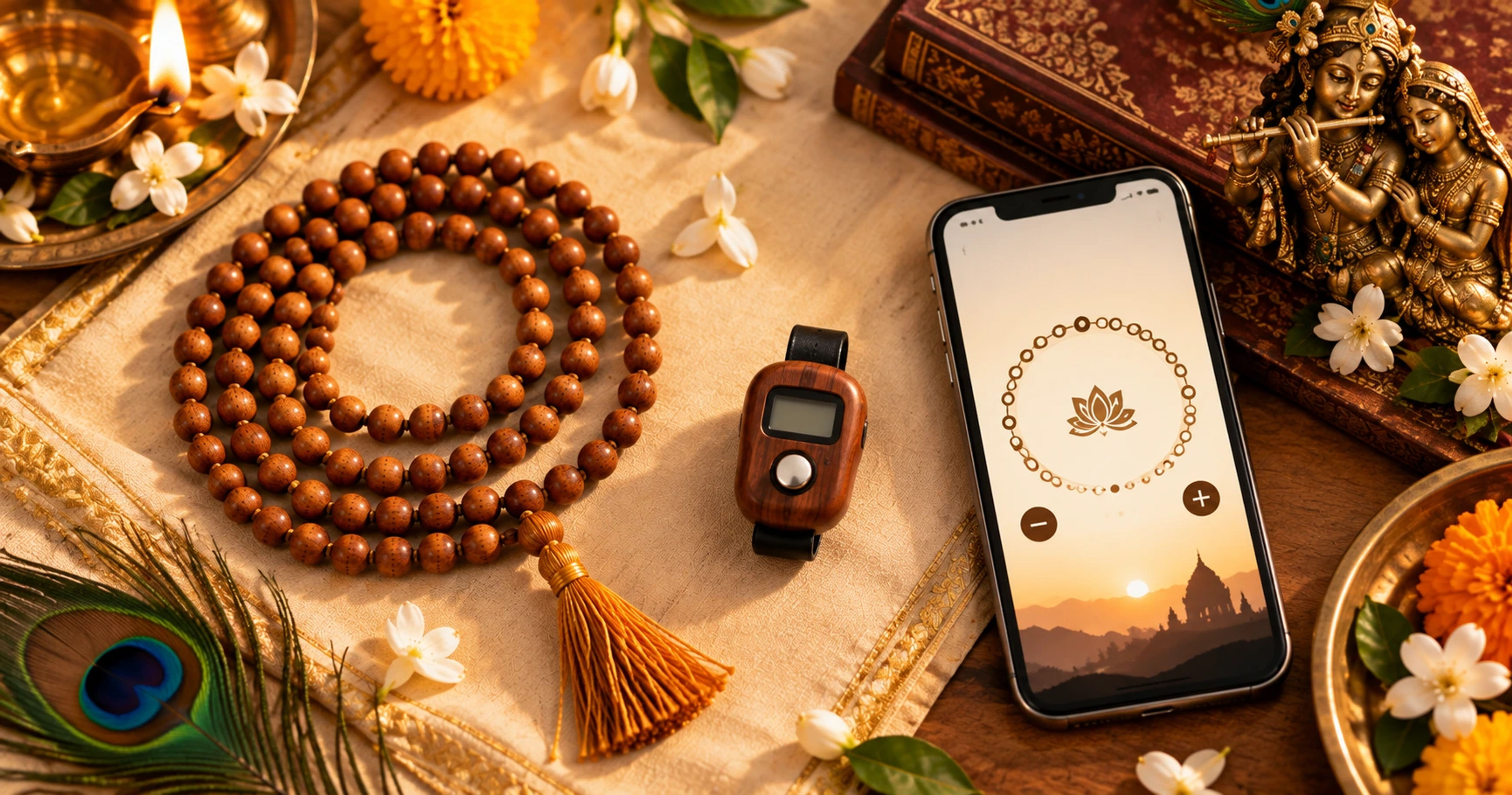
In practice, people track 108 repetitions in a few different ways. A japa mala is the most traditional, moving one bead per repetition. A physical clicker counter, often worn on a finger, adds one with each press and works without a phone. A digital jaap counter app counts each tap automatically and usually completes a “mala” on its own at 108, which removes the mental effort of counting altogether.
If you’re deciding between these, our detailed comparison of mala vs physical counter vs digital jaap counter walks through the pros and cons of each so you can pick what fits how and where you chant.
If you’re completely new to this practice, our guides on what Naam Jaap is and how to practise it and how to do Naam Jaap as a beginner are good places to start before worrying about counts at all.
Divya Marg counts your mala, so you can stay with the Naam
Divya Marg is a free Naam Jaap app that counts each chant automatically, completes a mala at 108 on its own, and keeps a simple daily record — with haptic feedback, volume-button counting, and a privacy mode for chanting anywhere.
Frequently Asked Questions
Why do we chant mantras 108 times?
There's no single, universally agreed reason — 108 is a traditional count that has been explained in several ways over centuries, including its link to a standard 108-bead mala, its recurrence in astrology (27 nakshatras x 4 padas), the Sanskrit alphabet, and the number of Upanishads. Most of these are traditional interpretations built up over time rather than one original documented rule.
Is 108 the only correct number for chanting?
No. 108 is simply the most widely used traditional count, largely because a standard mala has 108 beads. Many people chant 27, 54, or 1008 times, or chant for a set amount of time instead of counting repetitions at all. There's no rule that invalidates other counts.
Why does a mala have 108 beads?
Because 108 became the accepted standard count for a full round of japa over a long period of tradition. Various explanations — astrological, scriptural, and symbolic — have been offered to support this number, but the mala's 108-bead design mainly reflects long-standing custom rather than one single documented origin.
What is the significance of the number 108 in Hinduism?
108 appears repeatedly across Hindu tradition — in astrology, temple architecture, scripture counts, and devotional practice. It's generally understood as a number representing completeness or wholeness, though different texts and traditions explain its significance in different, sometimes conflicting, ways.
Is there scientific proof behind the number 108?
Some of the number relationships behind 108 — like the astrological math of 27 nakshatras times 4 padas — are well documented in classical Indian astronomy and astrology. Other claims, like the Sun-Earth or Moon-Earth distance ratios, are popular online but aren't reliably backed by historical evidence that ancient astronomers intended them. It's best to treat these as interesting coincidences rather than proven facts.
What if I lose count while chanting 108 times?
It happens to almost everyone at some point. Simply continue or restart the round without worrying about it — the attention and sincerity of your chanting matters far more than hitting an exact number. If losing count often breaks your focus, a physical or digital jaap counter can help you count without thinking about it.
Can I chant fewer than 108 times?
Yes. Many people begin with a smaller count like 27 or 54 and build up gradually, especially as beginners. What matters most in Naam Jaap is consistency and attention, not reaching 108 every single time.
In Simple Words
108 became the traditional chanting count through a mix of astrology, scripture, symbolism, and the simple fact that the standard japa mala has 108 beads. Some of the reasons behind it are well documented; others are popular interpretations that have grown around the number over time. Either way, 108 isn’t a magic number that guarantees a result on its own — it’s a traditional structure meant to support focus and consistency. Whether you chant 108 times with a mala, a counter, or an app, what matters most is the attention you bring to each repetition.
Sources and Further Reading
This article draws on common descriptions of the 108-bead japa mala, classical Vedic astrology’s division of 27 nakshatras into 4 padas, the Muktika canon’s list of 108 Upanishads, and general traditional and devotional sources on the number 108 in Hindu practice. Claims that are widely repeated but not historically well-supported, such as certain astronomical distance ratios, are flagged as such rather than presented as settled fact. Specific product features mentioned for Divya Marg reflect what is currently available in the app.
Written and reviewed by the Divya Marg Editorial Team. Last updated 9 September 2026.
More guides
Begin your Naam Jaap today
Offline-first and built entirely around one purpose — helping you show up for your practice, every single day.
- Free, always
- Works offline
- No ads