What Is Naam Jaap? Meaning, Benefits, How to Do It & Daily Practice

Somewhere between a habit and a prayer sits Naam Jaap — the quiet, repeated calling of a sacred name. It doesn’t need an altar, a specific hour, or years of study. It needs only a name you find meaningful and a willingness to say it again, and again, and again. For millions of people, this simple repetition is the most consistent part of their day — more reliable than mood, more accessible than a temple visit, and quietly powerful in a way that’s hard to explain until you’ve tried it yourself.
This guide walks through what Naam Jaap actually means, why people return to it daily, how to begin if you never have, and how to keep it going once the initial motivation fades — which, for almost everyone, it eventually does.
Table of contents
Key takeaways
- Naam Jaap is the repeated, intentional utterance of a sacred name — no equipment or ritual required to begin.
- Consistency matters more than count: a small daily practice outperforms an ambitious one you abandon.
- 108 repetitions (one mala) is the traditional unit, but starting with 27 or 54 is completely valid.
- Brahma Muhurta is the traditionally favoured time, but any consistent time works.
What Is Naam Jaap?
“Naam” means name, and “Jaap” (or japa) means repetition. Put together, Naam Jaap is the repeated utterance of a divine name — Ram, Krishna, Radha, Shiv, Hanuman, or any name that holds meaning for the practitioner — as an act of remembrance and devotion.
It differs from simply saying a word on repeat in one important way: intention. Mechanically repeating a name while the mind wanders elsewhere is still practice, and even that has value, but conscious Naam Jaap asks for a small thread of attention to stay with the name itself — its sound, its meaning, the feeling it brings up. Over time, that thread of attention is really the whole practice.
Across Vedic, Bhakti and yogic traditions, Naam Jaap is considered one of the most direct spiritual practices available, precisely because it requires no external object, no ritual apparatus, and no particular life circumstance. It can be done by anyone, anywhere, in any state of mind.
Why Do People Practice Naam Jaap?
Ask ten different people why they chant and you’ll likely get ten different answers, but most of them circle back to a handful of common threads.
Focus and remembrance
Naam Jaap gives the mind a single point to return to. In a day full of scattered attention, having one name to come back to — even for a few minutes — creates a small anchor of stillness.
A daily spiritual routine
For many practitioners, Naam Jaap is less about a single powerful session and more about showing up daily. It functions as a spiritual routine in the same way exercise or journaling functions as a physical or mental one — the value compounds with consistency, not intensity.
Peace and mindfulness
The repetitive nature of chanting has a naturally calming effect. Many people describe it as similar to the stillness that comes from focused breathing or meditation — the repeated sound gently occupies the mind, leaving less room for restless thought.
Devotional connection
At its core, Naam Jaap is an act of devotion — a way of staying connected to one’s chosen deity or ideal throughout ordinary daily life, not only during formal worship.
It’s worth noting that these are experiential and devotional benefits, described the way practitioners themselves describe them, rather than clinical or medical claims.

How to Do Naam Jaap
There is no single “correct” method, but a simple, traditional structure looks like this:
- Choose your Naam. Pick a name that feels meaningful to you — Ram, Krishna, Radha, Shiv, Hanuman, or any other you’re drawn to. There’s no wrong choice.
- Find a quiet place. It doesn’t need to be silent, just settled enough that you can hold your attention without constant interruption.
- Sit comfortably. Any seated position that you can hold without discomfort or distraction works.
- Begin slowly. Say or think the name at an unhurried pace. Speed isn’t the goal; steady attention is.
- Use a mala or counting method. A physical or digital counter frees your mind from tracking numbers, so it can stay with the name instead.
- Maintain attention. When your mind wanders — and it will — simply notice, and gently bring it back to the name.
- Complete your chosen count. One mala (108), a fraction of one, or several — whatever you set out to do.
- Make it daily. A short practice done every day outperforms a long practice done occasionally.
How Many Times Should You Chant?
This is one of the most common questions from beginners, and the honest answer is: there is no universally “right” number. That said, a few common structures can help:
- 108 repetitions (one mala) is the most traditional unit, tied to the standard 108-bead mala used across Vedic and yogic practice.
- Multiple malas — some practitioners aim for 2, 5, or more malas a day as their practice deepens.
- Time-based practice — rather than counting repetitions, some people simply chant for a fixed duration, such as 10 or 20 minutes.
- Starting small — if 108 feels like too much on day one, even 27 or 54 repetitions (a quarter or half mala) is a completely valid starting point.
What actually matters is picking a number you can realistically repeat every single day, rather than an ambitious number you abandon within a week. Divya Marg’s daily target feature is built specifically around this idea.
Naam Jaap with a Mala
A mala is a string of prayer beads, traditionally 108 beads plus one additional “meru” or guru bead that marks the start and end of a round. Rudraksha and tulsi are among the most commonly used materials, each associated with different deities and traditions.

The mechanics are simple: with each repetition of the Naam, you move one bead between your fingers, working around the strand until you reach the meru bead again — completing one mala. This physical counting does two things at once: it keeps an accurate count without requiring active calculation, and it gives your hands something steady to do, which many practitioners find helps the mind settle faster.
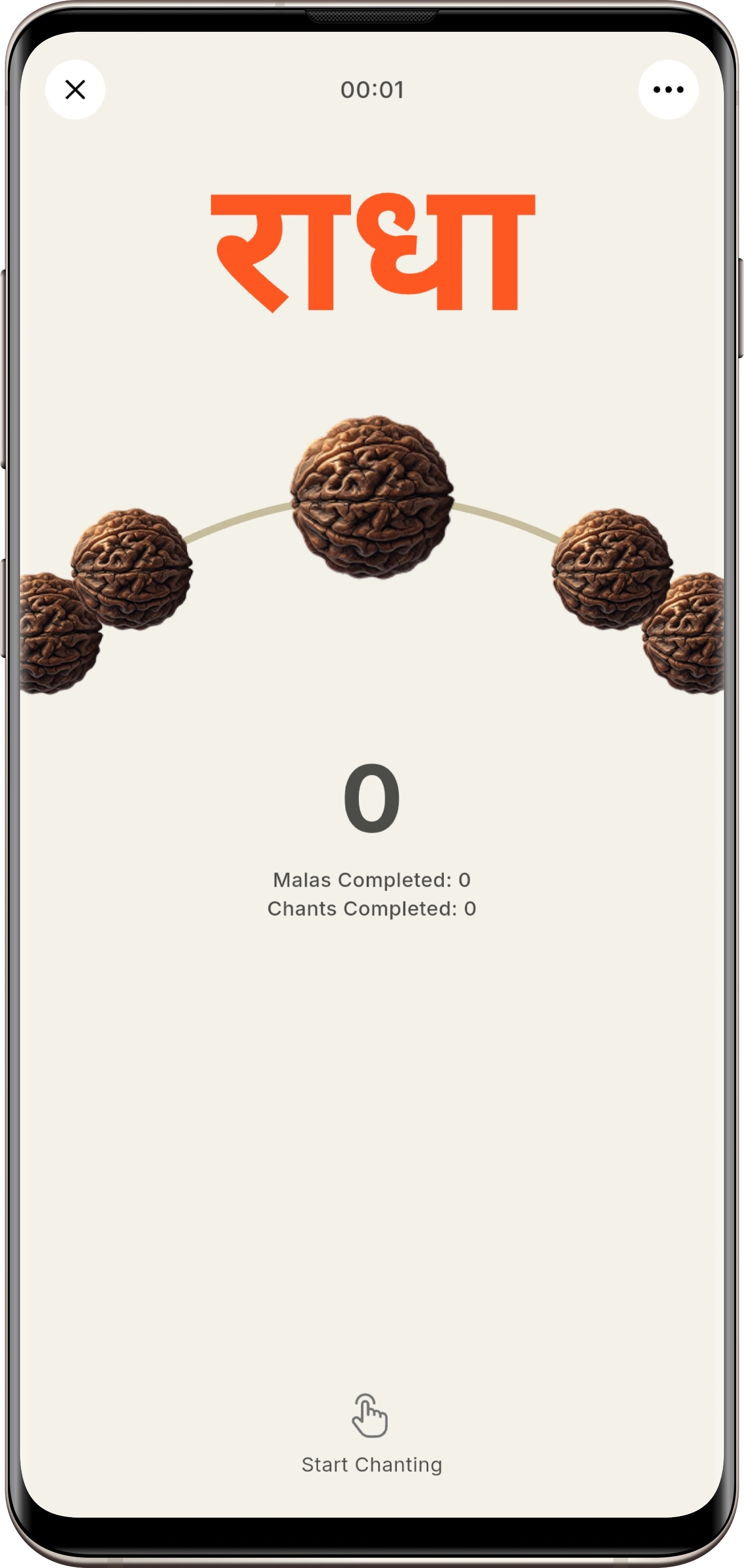
If you find it difficult to keep an accurate count or stay consistent day to day, Divya Marg provides a simple digital way to count your Naam Jaap, complete with haptic feedback on every chant and a daily goal you can track over time.
How to Build a Daily Naam Jaap Habit
Starting Naam Jaap is easy. The real challenge — like most daily practices — is continuing it once the initial enthusiasm fades. A few things genuinely help:
- Start with 5–10 minutes. A small, sustainable commitment beats an ambitious one you can’t keep up.
- Pick a consistent time. Attaching the practice to an existing habit — right after waking up, or right before sleep — makes it far easier to remember.
- Set a daily target. A specific, small goal (like one mala) gives the day a clear finish line.
- Track your progress. Seeing your practice laid out — chants, minutes, malas — turns an abstract intention into something visible and real.
- Build a streak. Consecutive days create their own quiet momentum; most people find they don’t want to break a streak once it’s a few days long.
- Increase gradually. Once a small practice feels automatic, extend it — more repetitions, more minutes, or an additional session later in the day.
Naam Jaap at Brahma Muhurta
Brahma Muhurta refers to the period roughly 96 minutes before sunrise — traditionally considered the most favourable time for spiritual practice. The reasoning offered across various texts is fairly consistent: the surroundings are quiet, the mind hasn’t yet picked up the day’s distractions, and the body is naturally calmer before daily activity begins.
Chanting during Brahma Muhurta is a strong option if your schedule allows it, but it isn’t a requirement. Consistency matters far more than exact timing — a Naam Jaap practice done reliably in the evening will serve you better than a Brahma Muhurta practice attempted twice and then abandoned. A daily reminder set for whatever time actually works for you closes that gap.
Radha Naam Jaap, Krishna Naam Jaap & Other Traditions
Everything above applies broadly, but each Naam carries its own flavour and devotional context. Radha Naam Jaap centres on devotion and surrender; Krishna Naam Jaap and the Hare Krishna Mahamantra are closely tied to Bhakti tradition; Ram Naam Jaap and Hanuman Naam Jaap are widely practiced across households in India, often alongside Shiv Naam Jaap during specific days or months of the year. Each of these deserves its own deeper guide — we’ll be publishing dedicated articles on Radha Naam Jaap, Krishna Naam Jaap, Ram Naam Jaap and Shiv Naam Jaap in the weeks ahead, so keep an eye on the blog.
Every problem above, solved in one app
Losing count, forgetting to chant, and not knowing whether a practice is actually sticking are the three things that most often derail a daily Naam Jaap habit. Divya Marg was built around exactly these three problems.
Haptic bead counting
Feel each chant so you never lose count, eyes open or closed.
Works fully offline
No signal needed — chant on a commute, a flight, or a walk.
Volume-button chanting
Count without looking at your screen, phone in hand or pocket.
Daily reminders
A gentle nudge at the time you choose, so the habit doesn't slip.
Detailed analytics
See chants, malas and minutes by day, week, month and year.
Privacy mode
Hide your chanting screen and stats in shared or public spaces.
Frequently Asked Questions
What is Naam Jaap?
Naam Jaap is the practice of repeating a sacred name or mantra, silently or aloud, as a form of remembrance and devotion. It is one of the simplest and most accessible spiritual practices, requiring no special equipment beyond attention and, traditionally, a mala.
How many times should I do Naam Jaap?
There's no single correct number. Many people begin with one mala of 108 repetitions a day and build up gradually. What matters more than the count is consistency — a smaller number done daily is more valuable than a large number done once.
Can I do Naam Jaap without a mala?
Yes. A mala is a helpful counting tool, not a requirement. You can chant using your fingers, a digital counter, or simply by setting a timer and chanting for a fixed duration instead of a fixed count.
Can I do Naam Jaap silently?
Yes. Naam Jaap can be done aloud (vaikhari), in a whisper (upanshu), or purely mentally (manasik). Mental repetition is considered by many traditions to be just as valid, and is often more practical in public or shared spaces.
What is the best time for Naam Jaap?
Early morning, particularly Brahma Muhurta (roughly 96 minutes before sunrise), is traditionally considered ideal because the mind is quieter and less distracted. That said, the best time is genuinely whichever time you can practice consistently, every day.
Can beginners do Naam Jaap?
Absolutely. Naam Jaap has no prerequisites. Beginners can start with any name that feels meaningful to them, chant for just a few minutes, and build duration and count gradually over time.
Is 108 Jaap necessary?
108 is a traditional and widely used count because of its significance across Vedic and yogic texts, and because a standard mala has 108 beads. It's a useful structure, but it isn't a strict requirement — any consistent count works.
Can I do Naam Jaap while travelling?
Yes. Naam Jaap travels well precisely because it needs so little — mental repetition, a mala, or your fingers all work anywhere, including on a commute, a flight, or a walk, with or without an internet connection.
Starting Small, Staying Consistent
A regular Naam Jaap practice doesn’t have to begin with a large commitment. Start with a few minutes, choose a Naam that’s meaningful to you, and let remembrance become a small but consistent part of your day rather than an occasional, effortful event.
If keeping an accurate count or staying consistent is the part that trips you up, that’s precisely the problem Divya Marg was built to solve — a quiet, offline-friendly companion for exactly this kind of daily practice. For the practical mechanics of getting started, see our beginner’s step-by-step guide, and for help choosing when to practice, our guide on the best time for Naam Jaap.
Related guides
Written and reviewed by the Divya Marg Editorial Team. Last updated 12 August 2026.
More guides
Begin your Naam Jaap today
Offline-first and built entirely around one purpose — helping you show up for your practice, every single day.
- Free, always
- Works offline
- No ads