How to Do Naam Jaap: A Beginner's Step-by-Step Guide

Most people don’t struggle with the idea of Naam Jaap — they struggle with the first five minutes of actually doing it. Which name to say, how fast, whether to count, what to do when the mind wanders off after ten seconds: these small, practical questions are usually what stand between wanting to chant and actually starting.
This guide skips the theory and goes straight to mechanics — a clear, step-by-step way to do Naam Jaap for the first time, and to keep doing it once the novelty wears off. If you want the background on what Naam Jaap means and why people practice it, that’s covered in our complete Naam Jaap guide— this one is focused purely on the how.
Table of contents
Key takeaways
- You need nothing to begin — no mala, no ritual setup, just a name and a few quiet minutes.
- Start with 5–10 minutes or a quarter mala (27 chants), not a full 108.
- A mala or digital counter removes the single biggest beginner frustration: losing count.
- Consistency for two weeks does more for the habit than any single long session.
Before You Start
You don’t need anything special to begin Naam Jaap today. That said, a few small things make the first few sessions noticeably easier:
- A quiet-ish spot. It doesn’t need to be silent — just somewhere you won’t be interrupted every thirty seconds.
- Five to ten minutes. Block out a small window rather than an open-ended one; a defined end point makes it easier to sit down in the first place.
- Something to count with — optional. Your fingers, a mala, or a simple counter app all work. None are required to start.
Choosing Your Naam
Pick a name that feels meaningful to you — Ram, Krishna, Radha, Shiv, or Hanuman are among the most commonly chanted, but there’s no wrong choice. If nothing comes to mind immediately, a simple rule of thumb: pick the name you already say most naturally when something goes right or wrong in your day. That instinctive familiarity is usually a good sign.
It’s also completely fine to try a name for a few days and switch if it doesn’t feel right. There’s no commitment required before you’ve even started.

Naam Jaap Kaise Kare? — Step by Step
Here is the simplest possible version of the practice, broken into steps you can follow the very first time you sit down:
- Sit comfortably. Any position you can hold without fidgeting for a few minutes — a chair, the floor, cross-legged, it doesn’t matter.
- Take a couple of slow breaths. This isn’t a separate meditation step, just a way to settle before you begin.
- Say your Naam slowly. Aloud, in a whisper, or silently — all three are valid. Let each repetition be unhurried rather than rushed.
- Notice when your mind wanders. It will, often within the first minute. When you notice, just return to the name — no need to judge or analyse the distraction.
- Count loosely, or not at all, the first time. Your first session doesn’t need a target. Just chant for your chosen window of time.
- Stop deliberately. When your time is up, consciously end the session rather than trailing off — it helps mark the practice as a distinct part of your day.
Counting with a Mala (108)
Once you’re comfortable with the basic rhythm, adding a mala is a natural next step. A traditional mala has 108 beads plus one meru (guru) bead marking the start and end. With each repetition of your Naam, move one bead between your thumb and middle finger, working around the strand until you reach the meru bead again — that’s one complete mala.

As a beginner, don’t feel pressure to complete a full 108 in your first sitting. A quarter mala (27 beads) or half mala (54 beads) is a perfectly complete session on its own. If you don’t have a mala yet, counting on your fingers in sets of ten, or using a simple digital counter, works just as well while you decide whether to get one.
Start with 5–10 Minutes, Not 108
The most common beginner mistake is aiming too high on day one — a full mala, thirty minutes, or an ambitious daily target — and then feeling discouraged when it’s hard to sustain. A smaller, realistic starting point works far better:
- 5–10 minutes a day, with no strict count attached, for your first week.
- A quarter or half mala (27 or 54) once counting feels natural.
- One full mala (108) only once the smaller version feels easy, not effortful.
Increasing later is simple. Recovering motivation after an abandoned ambitious start is much harder — so start smaller than feels necessary.
This is exactly why Divya Marg’s daily target starts you at a small, realistic goal rather than defaulting to a full mala — you can raise it whenever you’re ready, right from your profile.
Common Beginner Mistakes
- Starting too big. An ambitious first session that isn’t repeated the next day teaches you nothing about consistency.
- Treating a wandering mind as failure. A wandering mind is normal, not a sign you’re “doing it wrong.” Noticing and returning is the practice itself.
- No fixed time. “Whenever I get a moment” usually means never. A rough, repeatable time slot beats an open-ended intention.
- Losing count and giving up on the session. Losing count is a counting problem, not a spiritual one — just continue or restart, it doesn’t undo anything.
- Comparing your practice to others. Someone else’s five malas a day says nothing about whether your five minutes is working for you.
Building Consistency as a Beginner
The first two weeks matter more than any other stretch of a Naam Jaap practice, simply because that’s when it’s easiest to quit. A few things help specifically during this window:
- Anchor it to an existing habit — right after brushing your teeth, or right before checking your phone in the morning.
- Keep the bar low on purpose. A 5-minute practice you complete beats a 20-minute one you skip.
- Track it, even loosely. Seeing two, three, then seven consecutive days builds its own motivation.
- Expect to miss a day eventually — and treat it as a single missed day, not a reason to restart your entire habit-building process from zero.
Built to remove exactly what trips up beginners
Losing count, forgetting to sit down, and not knowing whether a small practice is “enough” are the three things that most often stop a new Naam Jaap habit before it forms. Divya Marg’s goal and counting features exist specifically for this early stage.
Daily target & goal
Set a beginner-friendly goal — even 27 or 54 — and let the app track it for you.
Haptic bead counting
A gentle pulse on every chant means you never have to double back to check your count.
Mala counter on screen
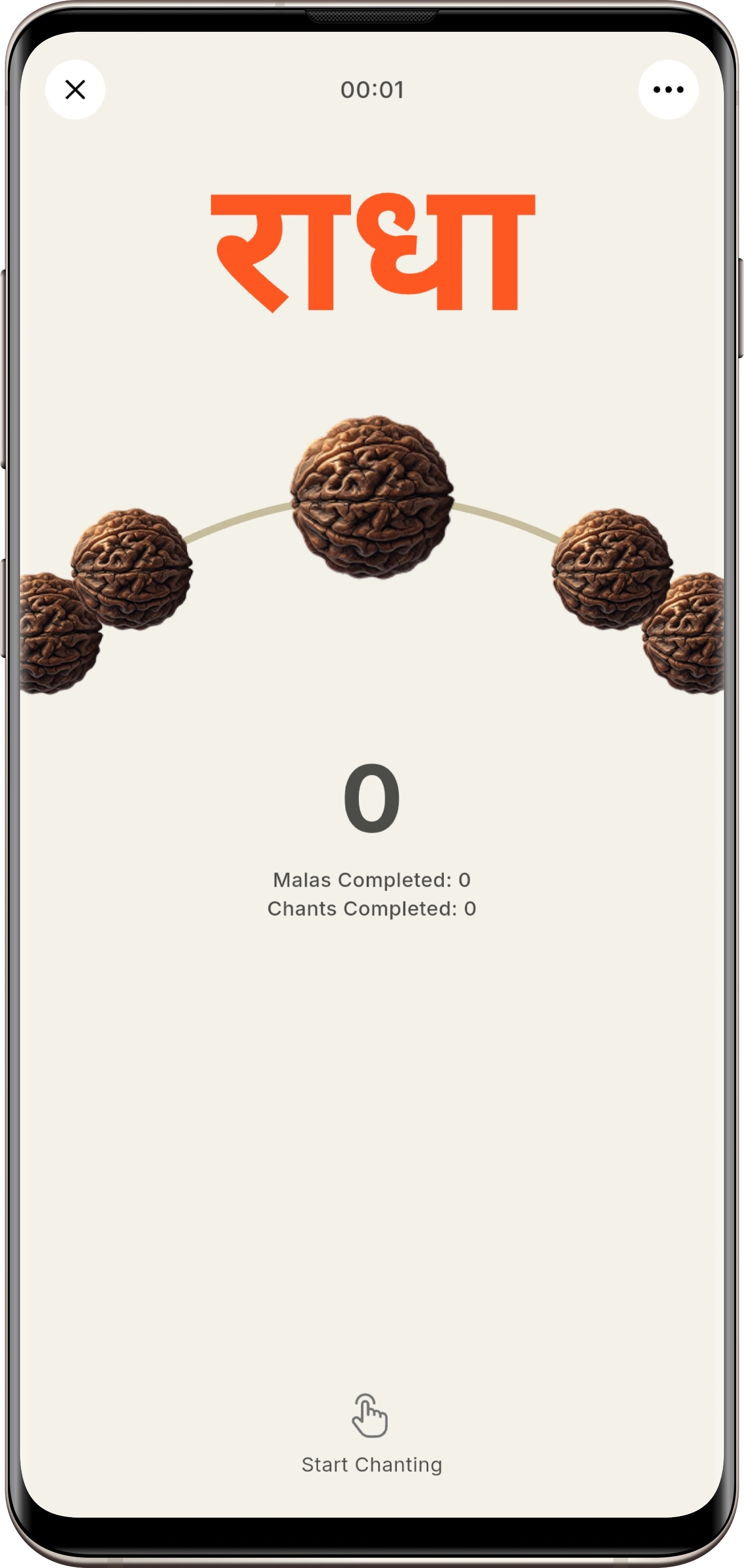
A visual bead moves with each repetition, so counting to 108 needs no mental math.
Volume-button chanting
Count with your eyes closed or your phone in your pocket, no screen-watching required.
Gentle reminders
A daily nudge at the time you choose, while the habit is still new and easy to forget.
Simple session history
See exactly how many minutes and chants you've done each day, without any setup.
Frequently Asked Questions
How do I start Naam Jaap as a complete beginner?
Pick a name that feels meaningful to you, sit somewhere reasonably quiet, and repeat it slowly for 5-10 minutes or a set number of times, like 27 or 54. There's no preparation required beyond choosing to begin.
Naam Jaap kaise kare?
Choose your Naam, sit comfortably, breathe normally, and repeat the name slowly and attentively — aloud, in a whisper, or silently. Use your fingers or a mala to keep count, and don't worry about doing it perfectly; consistency matters far more than technique.
Do I need a mala to begin?
No. A mala is a helpful counting tool once you have one, but you can start today using your fingers, a digital counter, or simply chanting for a fixed number of minutes instead of a fixed count.
How long should a beginner chant each day?
5 to 10 minutes, or a quarter to half mala (27-54 repetitions), is a realistic starting point. It's far better to chant for 5 consistent minutes than to attempt a full mala once and quit.
What if I lose count while chanting?
It happens to almost everyone at first. Simply pick a reasonable point and continue, or restart your count — losing track doesn't undo the value of the repetitions you've already done. A mala or a digital counter largely removes this problem going forward.
Can I chant while walking or doing chores?
Yes. Naam Jaap doesn't require stillness, though sitting quietly is easier for beginners since it's simpler to hold attention without other tasks competing for it. Once the practice feels familiar, chanting during a walk or commute works well.
How soon will Naam Jaap start to feel natural?
Most people find that a couple of weeks of daily practice, even a short one, is enough for it to start feeling automatic rather than effortful. Consistency, not duration, is what builds that familiarity.
Is it okay to switch mantras while learning?
Yes. Many beginners try a couple of names before settling on one that feels right. There's no penalty for switching — what matters is finding a Naam you'll actually want to return to daily.
Your First Week
You don’t need a mala, a perfect mantra, or a full understanding of the tradition to start today. Sit down, choose a name, chant slowly for five minutes, and repeat it tomorrow. That’s the entire beginning of a Naam Jaap practice — everything else, including counting to 108 and choosing a mala, can be figured out along the way.
If keeping count is the part you’re dreading most, Divya Marg was built to take that worry off your plate, so the only thing left to do is sit down and chant. For the fuller picture on timing your practice, see our guide on the best time for Naam Jaap.
Written and reviewed by the Divya Marg Editorial Team. Last updated 14 August 2026.
More guides
Begin your Naam Jaap today
Offline-first and built entirely around one purpose — helping you show up for your practice, every single day.
- Free, always
- Works offline
- No ads