21 Names of Lord Ganesha: Meaning, Mantra & Significance
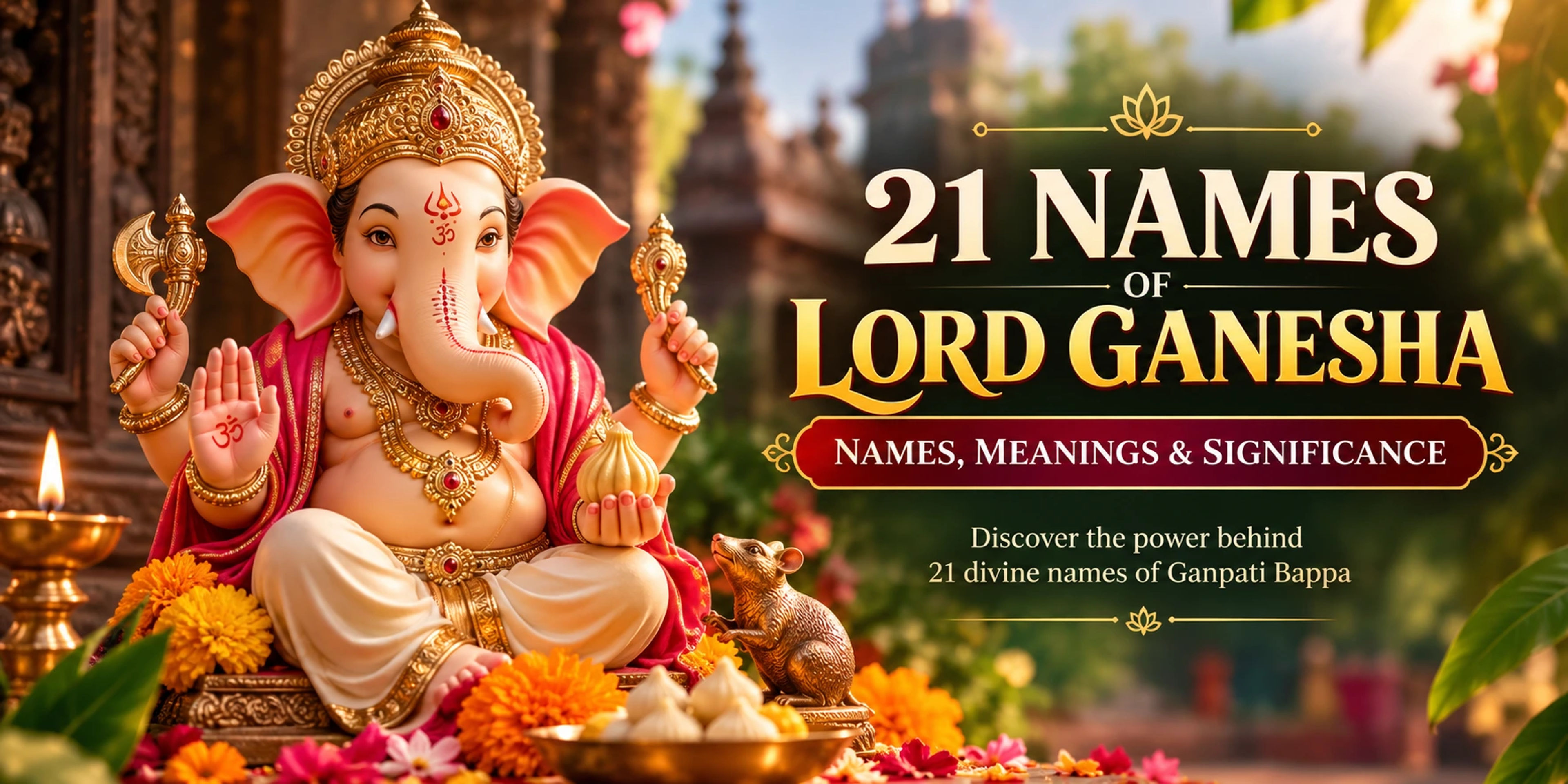
Lord Ganesha, also called Ganpati or Ganesh Ji, is known by many names. One well-known list is the 21 names of Lord Ganesha, called the Ekavimshati Namavali. Each name is short and easy to understand once you know what it means.
In this article, you will find all 21 names in Devanagari, simple transliteration and easy English meaning. You will also learn why the number 21 matters in Ganesha worship, how to chant the names, and how this list connects to Ganesh Chaturthi.
Table of contents
Who Is Lord Ganesha?
Lord Ganesha is the son of Lord Shiva and Goddess Parvati. He has the head of an elephant and is loved across India as the remover of obstacles. Most Hindus pray to Ganesha before starting anything new, like a business, a wedding, or a house move. He is also called Ganpati, Vinayaka, and Ganesh Ji.
Why Does Ganesha Have Many Names?
In Hindu tradition, a god is rarely called by just one name. Many names help devotees think about different sides of the same god. For Ganesha, some names talk about how he looks (like his elephant face or big belly). Other names talk about his family (like being Shiva’s son) or his power (like being the lord of all). Saying many names is a simple way to remember all of this at once.
What Is Ekavimshati Namavali?
The word breaks down easily. Ekavimshati is the Sanskrit word for “21.” Namavali means a list or string of names. So Ekavimshati Namavali simply means “a list of 21 names.” It is used along with the well-known 108 names (Ashtottara Shatanamavali) as one of the traditional ways to worship Ganesha.
A note on this list
You may also see other “21 names of Ganesha” lists online that use more familiar titles like Vinayaka, Vighnaharta, Gajanana and Ganapati. Those are general listicles, not one fixed traditional set. This article instead follows the older Ekavimshati Namavali, the list traditionally recited with the 21-leaf (patra) offering during Ganesh puja, cross-checked across independent devotional sources. A few names below (marked interpretive) have less certain meanings in the sources we checked, so the meaning given is a careful, reasonable reading rather than a fixed translation.
सुमुख
Sumukha
One with a beautiful, pleasant face
गणाधीश
Ganadhisha
Lord of the Ganas, Shiva's attendants
उमापुत्र
Umaputra
Son of Goddess Uma (Parvati)
गजमुख
Gajamukha
One who has the face of an elephant
लम्बोदर
Lambodara
One with a large, round belly
हरसूनु
Harasuna
Son of Hara (Lord Shiva)(interpretive)
शूर्पकर्ण
Shurpakarna
One with large, fan-shaped ears
वक्रतुण्ड
Vakratunda
One with a curved trunk
गुहाग्रज
Guhagraja
Elder brother of Guha (Lord Kartikeya)
एकदन्त
Ekadanta
One with a single tusk
हेरम्ब
Heramba
Beloved son of his mother; protector of the weak
चतुर्होत्र
Chaturhotra
One linked to the four sacred Vedic rites(interpretive)
सर्वेश्वर
Sarveshwara
Lord of all
विकट
Vikata
The mighty one; unusual or formidable in form
हेमतुण्ड
Hematunda
One with a golden trunk(interpretive)
विनायक
Vinayaka
The great leader; one without a master
कपिल
Kapila
One of a reddish-brown (tawny) colour
वटवे
Vatave
Associated with the sacred banyan tree(interpretive)
भालचन्द्र
Bhalachandra
One who wears the crescent moon on his forehead
सुरग्रज
Suragraja
Foremost among the Devas (gods)
सिद्धि विनायक
Siddhi Vinayaka
The one who grants success and fulfilment
What Do the 21 Names Represent?
- His look. Names like Gajamukha, Lambodara and Ekadanta describe his elephant face, big belly and single tusk.
- His family. Umaputra and Harasuna both point to Ganesha as the son of Parvati (Uma) and Shiva (Hara).
- His power and position. Names like Sarveshwara (lord of all) and Siddhi Vinayaka (giver of success) speak to his strength and blessings.
- His nature. Sumukha (pleasant face) and Heramba (protector of the weak) point to his gentle, caring side.
Not every name fits neatly into one group, and that is normal for a list built up over a long tradition.
Why Is the Number 21 Important?
The number 21 shows up again and again in Ganesha worship — 21 leaves in the patra puja, 21 blades of durva grass, and 21 modaks offered as prasad. There are a few common explanations for this:
- The 21 tattvas. Some traditions count 21 elements of the body and mind (the five senses, five organs of action, five elements, five subtle senses, and the mind) that are symbolically offered to Ganesha.
- 3 × 7. Twenty-one is also read as three times seven, and both numbers carry their own meaning in Hindu thought.
- Devotional tradition. Odd numbers like 21 are seen as connected to divine energy, which is one reason durva and leaves are offered in odd counts.
No single explanation is treated as the only correct one — different sources describe it differently, and all are accepted within their own tradition.
Can You Chant the 21 Names of Ganesha?
Yes. A few simple ways people do this:
- Reciting the full list — aloud or quietly, in one sitting.
- Reading slowly — pausing on each name to think about its meaning.
- During puja — saying each name while offering a leaf, a durva blade, or a modak.
- Following your own tradition — if your family or priest follows a specific method, that takes priority over any general guide.
The 21 Names and Ganesh Chaturthi
During Ganesh Chaturthi, the Ekavimshati Patra Puja (21-leaf worship) is a well-known part of the celebration. Each of the 21 leaves is offered along with one name from this list. This article focuses only on the 21 names and their meaning. For the full step-by-step Ganpati Sthapana procedure, samagri list, and puja timings, see our separate guide: Ganesh Chaturthi 2026: Ganpati Sthapana Guide.
Ganesha Naam Jaap
Along with reciting full name lists like this one, many devotees also keep it simple by repeating just one name — “Ganpati” or “Ganesha” — again and again as a short daily practice. This is called Naam Jaap. It does not replace the 21 names or 108 names; it is a simpler, shorter habit that fits into daily life. If you’re new to the idea, our guide on what Naam Jaap is, its benefits, and how to start walks through it step by step.
From learning the names to a daily habit
Learning Ganesha’s names can naturally lead to wanting a simple daily practice. Divya Marg helps you turn that interest into a real Naam Jaap habit — choose your Naam, set a realistic goal, and stay consistent with gentle reminders.
Choose your Ganpati Naam
Set 'Ganpati' or 'Ganesha' as your active Naam and begin anytime.
Daily Jaap goal
Set a realistic target and let the app track it for you.
Haptic bead counting
Feel each repetition so your attention can stay on the name.
Works fully offline
Chant anywhere, signal or not.
Daily reminders
A gentle nudge at whatever time you choose to practice.
Simple progress tracking
See your chants, malas and streak without any setup.
Conclusion
The 21 names of Lord Ganesha are more than a list to memorise. Each name is a small door into a different part of who Ganesha is — his look, his family, and his blessings. Reading them slowly, one at a time, is itself a simple form of devotion.
You don’t need to learn all 21 in one day. Start with a few, and if it inspires a daily habit, Naam Jaap — with or without Divya Marg to help — is a simple next step.
Frequently Asked Questions
What are the 21 names of Lord Ganesha?
The 21 names of Lord Ganesha, known as the Ekavimshati Namavali, are a traditional list of names used in Ganesha worship. Each name points to a different quality or form of Ganesha. The full list with meanings is given above.
What is the meaning of the 21 names of Lord Ganesha?
Each name is a simple Sanskrit word or phrase. Some describe how Ganesha looks, like his elephant face or big belly. Others describe his family, like being the son of Shiva and Parvati. The meaning of each name is given next to it above.
Why does Lord Ganesha have 21 names?
A list of 21 names lets devotees praise Ganesha's different qualities one by one, instead of using just one word for him. This kind of 21-name list is traditionally recited or offered along with 21 leaves during Ganesh puja.
Why is the number 21 important for Ganesha?
The number 21 appears often in Ganesha worship, such as 21 leaves (patra), 21 blades of durva grass, and 21 modaks. Different sources explain 21 in different ways, including as the 21 tattvas (elements) of the body and mind. There is no single explanation that everyone agrees on.
What is Ekavimshati Namavali?
"Ekavimshati" is the Sanskrit word for 21, and "Namavali" means a list of names. So Ekavimshati Namavali simply means "list of 21 names." It is one of the traditional ways Ganesha is worshipped, along with the 108-name Ashtottara Shatanamavali.
Are there different versions of the 21 names of Ganesha?
Yes. Some websites list 21 popular titles of Ganesha, like Vinayaka, Vighnaharta and Gajanana, as a general introduction to his names. This article instead follows the older Ekavimshati Namavali used in the 21-leaf puja, which is more consistent across traditional sources.
Can beginners chant the 21 names of Ganesha?
Yes. No special training is needed. Beginners can start by reading a few names and meanings at a time, and slowly learn the full list.
What is the difference between the 21 names and the 108 names of Ganesha?
The 21 names (Ekavimshati Namavali) are a shorter list, often used with the 21-leaf puja. The 108 names (Ashtottara Shatanamavali) are a longer list covering many more qualities and forms of Ganesha. Both are valid ways to worship him.
Is chanting the 21 names connected to Ganesh Chaturthi?
Yes. During Ganesh Chaturthi, many devotees offer 21 leaves, 21 durva blades or 21 modaks while saying these 21 names, one name for each offering.
Related guides
What Is Naam Jaap? Meaning, Benefits & How to Do It
The complete background on Naam Jaap as a practice.
Ganesh Chaturthi 2026: Ganpati Sthapana Guide
Step-by-step Sthapana, samagri and puja timings.
How to Do Naam Jaap: A Beginner’s Step-by-Step Guide
Choosing your Naam, counting to 108, and starting small.
Written and reviewed by the Divya Marg Editorial Team. Last updated 6 September 2026.
More guides
Begin your Naam Jaap today
Offline-first and built entirely around one purpose — helping you show up for your practice, every single day.
- Free, always
- Works offline
- No ads