Premanand Ji Maharaj: Life, Teachings, Radha Naam Jaap & Spiritual Journey
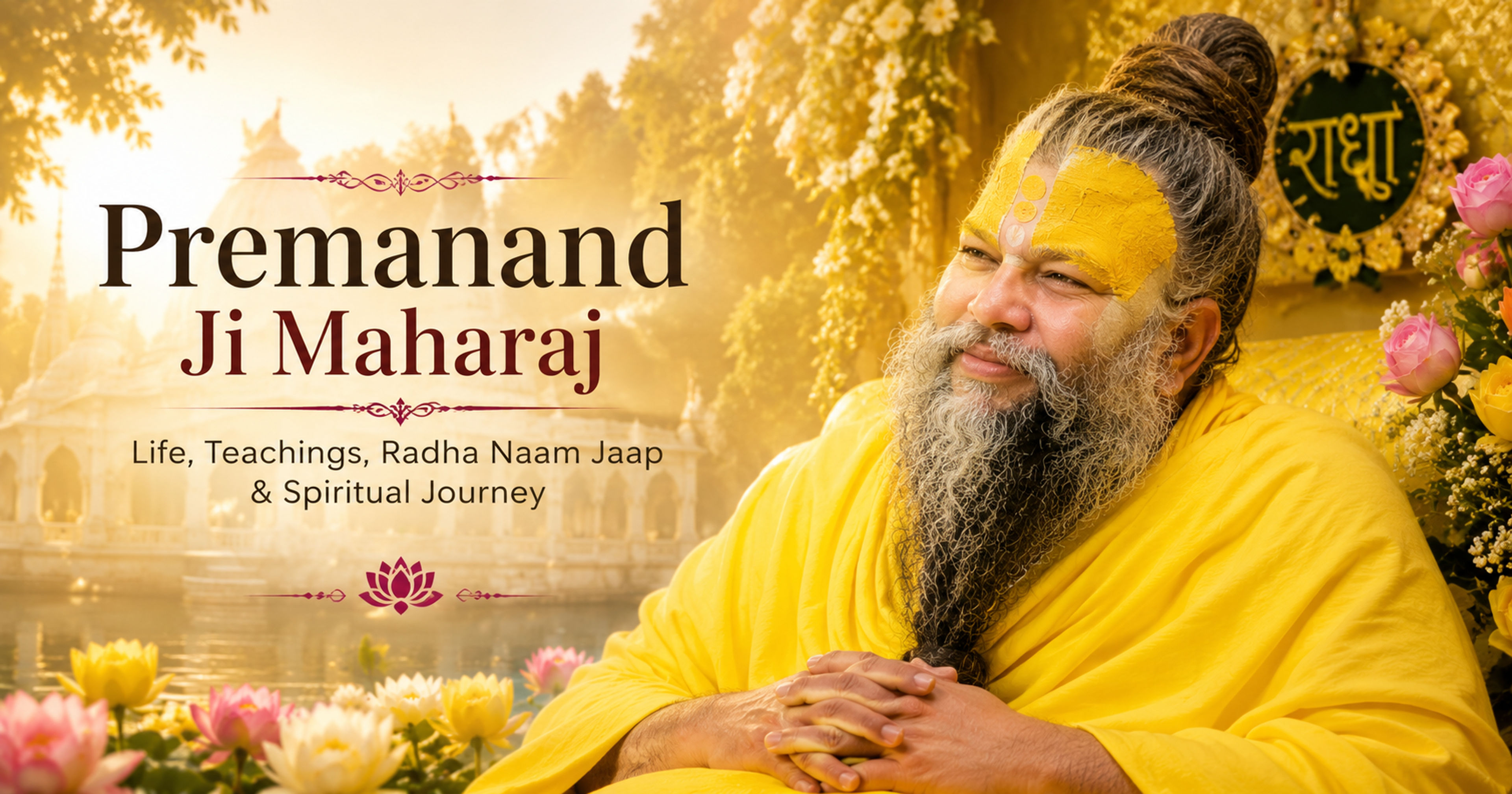
Every morning in Vrindavan, before most of India has woken up, a hall at Shri Hit Radha Keli Kunj fills with devotees who arrived the previous day just to register their name for a token. What draws them — and, increasingly, millions more watching from their phones — is Premanand Ji Maharaj: a Vrindavan-based saint whose satsangs on devotion, surrender and Radha-Krishna bhakti have, in recent years, reached far beyond the walls of his ashram.
For newcomers encountering his name for the first time — through a YouTube clip, a friend's recommendation, or a social media post — a few questions come up naturally: Who is Premanand Ji Maharaj? What does he actually teach? And what can a beginner take from his emphasis on Naam and devotional practice?
This article works through his life, his teachings, the spiritual tradition he belongs to, and — in practical terms — what Radha Naam Jaap is and how someone might begin their own practice.
Table of contents
Key takeaways
- Premanand Ji Maharaj is a Vrindavan-based saint of the Radha Vallabh Sampradaya, based at Shri Hit Radha Keli Kunj ashram.
- His satsangs address both everyday struggles — anger, greed, lust — and deeper devotional themes of surrender and divine love.
- Radha Naam Jaap needs no elaborate ritual to begin — a few quiet minutes and sincere attention are enough.
- His tradition, Hitopasana, frames remembrance of the Naam as something to return to constantly, not occasionally.
Who Is Premanand Ji Maharaj?
Premanand Ji Maharaj — formally titled Shri Hit Premanand Govind Sharan Ji Maharaj by his ashram, and widely known simply as Premanand Maharaj or Maharaj Ji — was born Aniruddh Kumar Pandey in Akhri village, Sarsaul block, near Kanpur, Uttar Pradesh. Sources place his birth in the early 1970s, with the exact year given variously as 1971 or 1972 across different accounts.
According to his ashram's own account, he was born into a modest, devout Brahmin family: his grandfather had taken sannyasa, his father Shri Shambhu Pandey was himself deeply devotional and later took sannyasa in later life, and his mother Rama Devi was known for her regard for saints and her engagement in seva. His elder brother would recite verses from the Shrimad Bhagavatam at home, which the family listened to together — an early devotional atmosphere that, by the ashram's account, shaped him from childhood.
At some point in his youth, he left home to pursue a spiritual life. Accounts differ on the exact age — some describe this happening in his early teens, others place it closer to his late teens or early twenties — but the consistent thread across sources is that the decision came quietly, without a planned departure, and that he arrived in Vrindavan without contacts or a fixed plan, beginning with a daily routine of Vrindavan Parikrama (circumambulation) and darshan at the Shri Banke Bihari temple.
A turning point, as his ashram describes it, came when a saint at the Banke Bihari temple advised him to also visit Shri RadhaVallabh Mandir. He began spending long hours there, drawn to the deity of RadhaVallabh Ji, and this devotion was noticed by the temple's Goswamis. One of them, Pujya Shri Hit Mohit Maral Goswami Ji, recited a verse from the Radha Ras Sudha Nidhi to him — a moment his ashram describes as significant in deepening his path. He was later formally initiated into the Radha Vallabh Sampradaya through the Sharanagati Mantra, and his guru, Shri Hit Gaurangi Sharan Ji Maharaj, subsequently gave him the Nij Mantra — initiating him into Sahachari Bhava and Nitya Vihar Rasa, the devotional orientation that now defines his teaching.
Premanand Ji Maharaj and Vrindavan
Vrindavan is not incidental to Premanand Ji Maharaj's teaching — it's foundational to it. In Hindu tradition, Vrindavan (part of the wider Braj region) is revered as the land where Krishna spent his youth alongside Radha and the gopis, and it has drawn devotees, poets and renunciates for centuries as a living center of Radha-Krishna devotion.
Within the tradition he teaches, taking shelter of Vrindavan Dham — either directly, by residing there, or indirectly, by mentally holding it as one's spiritual home even while living elsewhere — is described as an assured way to draw closer to the divine love of Radha and Krishna, referred to in this tradition as Priya-Priyatam. In plain terms: Maharaj Ji teaches that a devotee's connection to Vrindavan doesn't require physically living there, though many devotees do travel to be near him at his ashram, Shri Hit Radha Keli Kunj, located on Parikrama Marg near Varah Ghat in Vrindavan.

What Does Premanand Ji Maharaj Teach?
His daily satsangs, delivered in Hindi and explained through accessible stories and scripture, cover ground at two very different levels — from the most basic struggles of ordinary life to the deepest currents of devotional philosophy. A few recurring themes stand out.
Love and Prem
Divine love — prem — sits at the center of his teaching. His ashram describes a state beyond even Self-Realization, termed Premanand, as the highest attainment within this path: a love for the divine couple that, in this framework, surpasses other forms of spiritual accomplishment.
Surrender
Complete surrender to Priya-Priyatam (Radha and Krishna, understood together) is presented as more effective than even rigorous, austere spiritual practice on its own — the idea being that surrender opens a door that effort alone cannot.
Seva
Selfless service runs throughout both his teaching and his ashram's activities — the Shri Hit Radha Keli Kunj Trust, which he founded in 2016, supports other saints and devotees in Vrindavan with food, shelter and medical care.
Bhakti as a lived practice
Devotion, in his framing, is not primarily intellectual. It is meant to be practiced daily — through remembrance, service and conduct — rather than understood only as a philosophical concept.
Self-discipline
His satsangs directly address anger, greed and lust as the basic, ground-level obstacles nearly everyone faces, and he emphasizes principles such as brahmacharya (self-restraint) and vairagya (renunciation) as necessary foundations — arguing that a mind still deeply attached to worldly gratification struggles to grasp deeper devotional experience.
Remembrance of God
Constant remembrance of the divine names is treated as a practice for every spare moment, not an occasional ritual — a theme that connects directly to the importance of Naam and Radha Naam Jaap, covered later in this article.
It's worth noting: these themes are drawn from his ashram's published philosophy and widely reported descriptions of his satsangs, not from a single formal doctrinal text, and they are presented here as teachings within his specific tradition rather than universal prescriptions.
What Is Premanand Ji Maharaj's Spiritual Path?
Premanand Ji Maharaj belongs to the Radha Vallabh Sampradaya, a Vaishnav devotional tradition founded by Shri Hit Harivansh Mahaprabhu. A few terms from this tradition come up often in connection with his teaching — each is explained below in plain language rather than assumed knowledge.
Rasopasana
The underlying philosophy of the Radha Vallabh Sampradaya. It centers on contemplating the purest, most transcendent form of divine love between Radha and Krishna — referred to together as Priya-Priyatam or Shyama-Shyam — including the divine pastimes (lilas) traditionally associated with them in Vrindavan.
Hitopasana
The specific devotional path taught at Shri Hit Radha Keli Kunj. “Hit” means “pure love,” and Hitopasana is the practice of that pure, selfless love as the foundation of devotion — the term devotees use for the spiritual approach Maharaj Ji teaches and embodies.
Sahchari Bhav / Sakhi Bhav
A devotional orientation in which the devotee's spiritual identity is understood as a companion (sahchari or sakhi) to Radha, wholly absorbed in her joy and service rather than seeking anything for themselves. His ashram describes Maharaj Ji as embodying this orientation, following the path originally taught by Shri Hit Harivansh Mahaprabhu.
Tat-Sukh Bhav
Literally, orienting one's actions toward “their joy” rather than one's own — the opposite of Swa-Sukh Bhav, or self-centered pleasure-seeking. Within this tradition, Tat-Sukh Bhav means every devotional act is aimed at the joy of Radha and Krishna, not personal gain, even spiritual gain.
Priya-Priyatam
A devotional term referring to Radha and Krishna together, as the beloved (Priya) and the lover (Priyatam) — used throughout this tradition to emphasize that devotion is directed at the divine couple as one inseparable focus, rather than to either alone.
These are concepts specific to the Radha Vallabh Sampradaya and the Hitopasana tradition as taught at Radha Keli Kunj — related to, but not identical with, terminology used in other Vaishnav or bhakti traditions.
Why Is Radha Naam Important?
“Naam” means name; repeating and remembering a sacred name is one of the oldest and most accessible forms of devotional practice across Hindu bhakti traditions. Within Premanand Ji Maharaj's tradition specifically, remembrance of the Naam is treated as something to fill ordinary time with — a way of orienting the mind toward the divine throughout the day, not reserving devotion for formal prayer alone.
Radha Naam — the repeated remembrance of Radha's name — holds particular significance here because of the tradition's emphasis on Radha as the embodiment of pure, selfless devotion to Krishna. Chanting Radha's name is understood as an act of aligning oneself with that same quality of devotion. Radha Naam Sankirtan (congregational chanting of Radha's name) is a regular part of the devotional life at Shri Hit Radha Keli Kunj, alongside daily satsang and kirtan.
For a deeper look at Radha Naam as a practice in its own right — its meaning, its significance across Radha-Krishna devotion, and how to begin — see our complete guide to Radha Naam Jaap and our list of the 108 names of Radha Rani with meanings.
It's worth being direct about what this practice is not claimed to do: chanting Radha Naam is not presented, here or by the tradition, as a guarantee of any specific worldly outcome, nor as a medical or psychological treatment. What is consistently emphasized is remembrance itself — and the difference between mechanical repetition and repetition done with genuine attention and sincerity, which the tradition treats as the actual substance of the practice.
What Is Radha Naam Jaap?
“Jaap” (japa) means repetition. Radha Naam Jaap, then, is the repeated, attentive utterance of Radha's name — the same underlying practice as Naam Jaap generally, applied to this specific name. For the fuller background on Naam Jaap as a practice, see our complete guide to Naam Jaap; this section focuses on Radha Naam specifically.
The name can be repeated in a few different ways:
- Aloud — clear, audible chanting.
- Whispered — quiet enough that only the practitioner can hear.
- Mental repetition — silent, internal repetition.
All three are considered valid. What matters is maintaining attention on the name itself and approaching the practice with sincerity, rather than letting it become an unattended, mechanical habit. And, importantly, no elaborate ritual or formal initiation is required simply to begin.
How to Do Radha Naam Jaap: A Beginner's Practice
A practical way to start:
- Choose a quiet place. It doesn't need to be silent — just somewhere you won't be constantly interrupted.
- Sit comfortably. Any position you can hold without fidgeting works.
- Settle the mind. A few slow breaths before you begin is enough.
- Begin repeating the Naam. “Radha Naam,” unhurried, whether aloud, whispered, or silent.
- Keep attention on the Naam. When your mind wanders, simply notice and return, without judgment.
- Use a mala if desired. Helpful for counting, but not required to start.
- Set a manageable daily goal. A few minutes or a quarter mala is a complete first target.
- Finish calmly. Bring the session to a deliberate close.
- Return to the practice consistently. The same small session, repeated daily, matters more than any single long one.
There's no expectation that a beginner should immediately perform thousands of repetitions. Our beginner's step-by-step guide to Naam Jaap covers this starting-small approach in more depth.
How Many Times Should You Chant Radha Naam?
Different approaches work for different people:
- A few minutes — a simple time-based session, especially when starting out.
- One mala (108 repetitions) — a common traditional unit tied to the standard mala.
- Multiple malas — built up gradually as a practice deepens.
- A fixed daily target — whatever number or duration you can realistically repeat every day.
No single number is universally mandatory — different practitioners and traditions approach this differently. What matters more than the size of any one session is showing up for it daily.
Can You Do Naam Jaap Without a Mala?
Yes. A mala is not required simply to begin a Radha Naam Jaap practice. It's a traditional counting tool — a string of beads, typically 108 plus one meru bead, moved one at a time with each repetition — and many practitioners find it helps structure a session and keep an accurate count without needing to actively track numbers mentally.
But it isn't the only way to count. Some people prefer counting repetitions by other means; others simply practice for a fixed amount of time instead of counting at all. If you're just starting out and don't yet have a mala, that's not a reason to wait — you can begin today with either approach. Our guide on how to do Naam Jaap as a beginner covers both counting methods in more detail.
Premanand Ji Maharaj's Message for Modern Life
Without claiming to know exactly how Maharaj Ji himself intends every teaching to apply to modern circumstances, a few of his recurring themes translate fairly directly for someone living an ordinary, busy life.
One way a modern reader can understand his emphasis on self-discipline is as a call to notice small, daily patterns — reactive anger, the pull toward acquiring more, unchecked craving — rather than treating them as fixed personality traits. His teaching on surrender can similarly be understood as a counterweight to the modern instinct to control every outcome: trusting a process rather than gripping every result tightly. And his emphasis on remembrance suggests that spiritual practice doesn't need to be confined to a designated hour — a few minutes of attentive Naam repetition, fit into an otherwise ordinary day, is itself a complete practice rather than a compromise.
Seva, humility and simplicity — all present throughout his teaching and his ashram's own charitable work — offer a similarly direct translation: that spiritual life and everyday responsibility toward others are not separate tracks.
Starting is simple. Remembering daily is the real work.
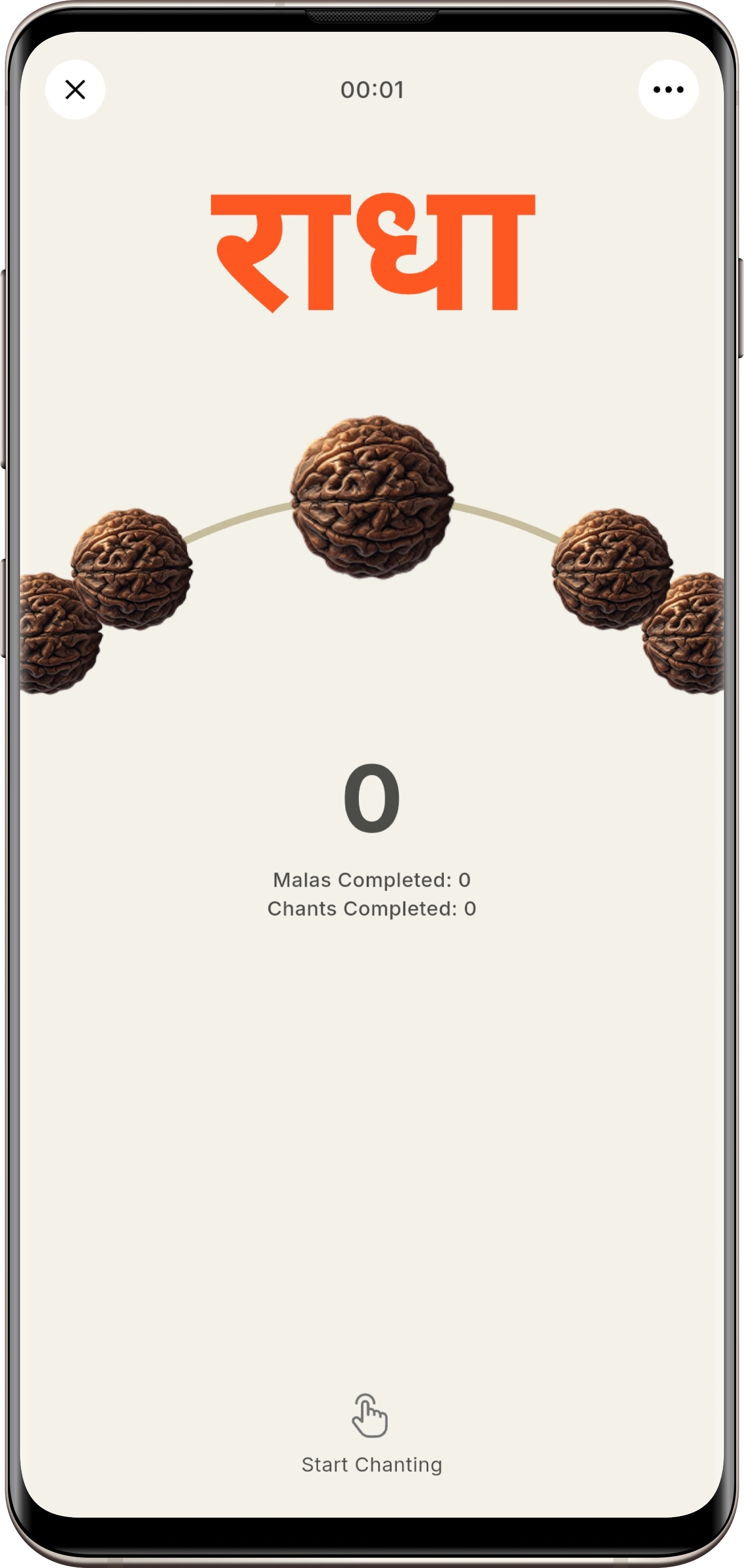
Starting a Naam Jaap practice can be simple, but remembering to practice every day, and keeping an accurate count while you do, can be harder. If Premanand Ji Maharaj's emphasis on Naam and devotion has inspired you to begin your own practice, Divya Marg can help you turn that intention into a simple daily Naam Jaap routine.
Choose Radha Naam as your Naam
Set it as your active mantra and begin whenever you're ready.
Daily Jaap goal
Set a realistic target — even a quarter mala — and let the app track it.
Haptic bead counting
Feel each repetition so your attention can stay on the name, not the number.
Works fully offline
Chant at the ashram, at home, or anywhere signal doesn't reach.
Daily reminders
A gentle nudge at whatever time you choose to practice.
Simple progress tracking
See your chants, malas and streak without any setup.
Divya Marg is an independent app and is not affiliated with, and does not claim any endorsement from, Premanand Ji Maharaj, Shri Hit Radha Keli Kunj, or any related organization.
Starting Your Own Radha Naam Practice
If you've just discovered Premanand Ji Maharaj and want to begin your own practice, a simple, unhurried starting point works better than an ambitious one:
- Day one: five minutes. That's the entire goal — not a number of repetitions, just five minutes of attentive chanting.
- The first week: focus purely on consistency — showing up daily, even if some sessions feel distracted or short.
- After that: increase gradually, if and when it feels natural — more minutes, a mala, a specific daily count.
This isn't a mandatory spiritual prescription, and no single pace is required of everyone. The underlying idea is simply: start small, practice consistently, and let remembrance develop from there.
What Can We Learn From Premanand Ji Maharaj?
Drawing together the themes covered above, a few practical lessons stand out: devotion as a daily practice rather than an occasional feeling; surrender as a counterbalance to the need for control; self-discipline applied to ordinary struggles like anger and craving; seva as inseparable from spiritual life; and consistent remembrance — Naam — as something available in any spare moment, not reserved for formal prayer.
A useful distinction worth carrying forward: watching or listening to satsang can genuinely inspire a person, but it is regular practice that turns that inspiration into an actual daily spiritual habit. That's not a teaching directly attributed to Maharaj Ji here — it's simply the practical takeaway that connects his emphasis on consistency to anyone building their own Naam Jaap practice today.
Frequently Asked Questions
Who is Premanand Ji Maharaj?
Premanand Ji Maharaj, formally Shri Hit Premanand Govind Sharan Ji Maharaj, is a Vaishnava saint based at the Shri Hit Radha Keli Kunj ashram in Vrindavan. Born Aniruddh Kumar Pandey in the early 1970s near Kanpur, he belongs to the Radha Vallabh Sampradaya and is known for his daily satsangs on Radha-Krishna devotion.
What is Premanand Ji Maharaj known for?
He is known for daily discourses (satsangs) explaining scripture in simple, accessible language, his emphasis on devotion, surrender and self-discipline, and — in recent years — for widely viewed satsang videos on YouTube and social media that have introduced him to a global audience.
Where does Premanand Ji Maharaj live?
He resides at Shri Hit Radha Keli Kunj, his ashram on Parikrama Marg near Varah Ghat in Vrindavan, Uttar Pradesh, where he gives daily darshan and satsang.
What does Premanand Ji Maharaj teach?
His satsangs cover both foundational challenges — anger, greed and lust — and deeper devotional themes: love (prem), complete surrender to Radha-Krishna, selfless service (seva), self-discipline, and constant remembrance of the divine names.
What is Radha Naam according to Premanand Ji Maharaj's tradition?
Radha Naam is the repeated, devotional remembrance of Radha's name. Within the Radha Vallabh Sampradaya and Hitopasana tradition he follows, remembering the divine names of the Yugal Sarkar (the divine couple) is treated as a central, daily practice — not a one-time ritual.
What is Naam Jaap?
Naam Jaap is the practice of repeating a sacred name with attention, aloud, whispered or silently, as a form of devotional remembrance. It requires no elaborate ritual to begin.
How do you do Radha Naam Jaap?
Sit comfortably in a quiet space, settle your attention, and repeat 'Radha Naam' slowly and attentively. A mala can help with counting, but isn't required, especially when starting out.
How many times should I chant Radha Naam?
There's no single mandatory number. A common starting point is a few minutes or one mala (108 repetitions), but even a quarter mala is a valid way to begin. Consistency matters more than the count.
Can I do Radha Naam Jaap without a mala?
Yes. A mala is a helpful counting tool once you have one, but you can begin today by chanting for a set number of minutes or using your fingers to count.
What is Radha Keli Kunj?
Shri Hit Radha Keli Kunj is Premanand Ji Maharaj's ashram in Vrindavan, and also the name of the trust he founded in 2016, which supports saints and devotees in Vrindavan with food, lodging and medical care alongside its devotional activities.
Conclusion
Premanand Ji Maharaj's life traces a clear line: from a quiet departure from home, to Vrindavan, to a spiritual path centered on Radha and Krishna, to daily satsangs that now reach devotees far beyond his ashram. Across the themes he returns to — surrender, seva, self-discipline, and constant remembrance — one thread stays consistent: devotion is something to practice daily, not something to consume occasionally.
Radha Naam Jaap sits at the practical center of that practice. It asks for very little to begin — a few quiet minutes and sincere attention — and asks for consistency rather than intensity to continue.
If Maharaj Ji's satsangs have inspired you to begin your own practice, Divya Marg offers a simple, offline-friendly way to keep it going, whichever Naam you choose to chant.
Related guides
What Is Naam Jaap? Meaning, Benefits & How to Do It
The complete background on Naam Jaap as a practice.
How to Do Naam Jaap: A Beginner’s Step-by-Step Guide
Choosing your Naam, counting to 108, and starting small.
What Is the Best Time for Naam Jaap?
Brahma Muhurta, morning vs. evening, and building a routine.
Neem Karoli Baba: His Life & the Significance of Sita Ram
Another devotional path centered on Naam and remembrance.
108 Names of Radha Rani: Complete List & Meanings
Radha Ashtottara Shatanamavali in Devanagari with English meanings.
Sources & Further Reading
- Shri Hit Radha Keli Kunj — official website: About Maharaj Ji, Philosophy, and Hitopasana pages (radhakelikunj.com)
- Wikipedia, “Premanand Govind Sharan”
- Simple English Wikipedia, “Premanand Ji Maharaj”
Written and reviewed by the Divya Marg Editorial Team. Last updated 25 August 2026.
More guides
Begin your Naam Jaap today
Offline-first and built entirely around one purpose — helping you show up for your practice, every single day.
- Free, always
- Works offline
- No ads