Neem Karoli Baba: Life, Teachings, Miracle Stories & Sita Ram Jaap

Decades after his passing, Neem Karoli Baba continues to draw interest from spiritual seekers, curious newcomers, and longtime devotees alike. His ashram at Kainchi Dham, tucked into the hills of Uttarakhand, still fills with visitors every year. Books compiling devotee accounts remain in print. And in 2026, renewed attention has come partly from Shree Baba Neeb Karori Maharaj, a Hindi biographical film released that May tracing his life from his early years as Lakshman Narayan Sharma to the founding of Kainchi Dham — one of more than one dramatized retelling of his life to reach audiences this year.
For many people encountering his name for the first time — through a film, a friend, or a social media post — the questions are simple: Who was Neem Karoli Baba? What are the miracles devotees describe? What did he actually teach? And why does the phrase “Sita Ram” come up so often in connection with him?
This article works through each of those questions in turn — his life, the accounts devotees call miracles, his teachings, the meaning of Sita Ram, and how someone today might begin a simple Sita Ram Naam Jaap practice of their own.
Table of contents
Key takeaways
- Neem Karoli Baba (c. 1900–1973) was a Hindu saint and devotee of Hanuman, best known for the Kainchi Dham ashram in Uttarakhand.
- Accounts of his miracles come from devotees and books like Ram Dass's Miracle of Love — understood by devotees as grace, not treated here as independently verified fact.
- “Sita Ram” is widely chanted across his ashrams and by his devotees, reflecting his Hanuman devotion and the broader Ram-bhakti tradition.
- Sita Ram Naam Jaap needs no elaborate ritual to begin — a few quiet minutes and sincere attention are enough.
Who Was Neem Karoli Baba?
Neem Karoli Baba — also spelled Neeb Karori Baba or Neem Karori Baba, and known affectionately to his devotees as Maharaj-ji — was a Hindu saint born Lakshman Narayan Sharma around 1900, in the village of Akbarpur in Uttar Pradesh, India. Married young, as was customary at the time, he later left home to live as a wandering sadhu, travelling across Northern India for much of his life under a number of different names before he became widely known.
He was, above all, a devotee of Hanuman, and his teachings and ashrams reflect that devotion throughout. In 1964, he established what would become his most well-known ashram, Kainchi Dham, near Nainital in Uttarakhand, built around a Hanuman temple. A second major ashram was established in Vrindavan, where his samadhi (shrine) now stands. Over time, more than a hundred temples came to be associated with his name.
Neem Karoli Baba died on 11 September 1973 in Vrindavan. He left behind no formal scripture or organized doctrine — by most accounts, he gave no lengthy discourses, teaching instead through short exchanges, simple instructions, and the way he treated the people who came to him.

Why Is Neem Karoli Baba So Famous?
Several threads come together to explain his continued reach, well beyond what might be expected of a saint who gave no formal teachings and left no written works of his own.
Kainchi Dham itself
The ashram remains an active pilgrimage site. Every June, the Kainchi Mela draws well over a hundred thousand devotees for the anniversary of the ashram's founding, and the site sees a steady flow of visitors, Indian and foreign, throughout the year.
His Western devotees
In the late 1960s and early 1970s, a number of Americans travelled to India and became his devotees, several of whom later became well-known teachers and authors in their own right — Ram Dass (Richard Alpert), Krishna Das, Jai Uttal, Bhagavan Das, and public-health pioneer Larry Brilliant among them. Ram Dass's 1971 book Be Here Now introduced Neem Karoli Baba to a wide Western audience and remains in print today.
Notable visitors, carefully stated
Kainchi Dham's visitor list is often summarized online with claims about various public figures. Two are reasonably well documented: Steve Jobs travelled to India in 1974 hoping to meet Neem Karoli Baba, arriving after his death the previous year — an episode widely reported in accounts of Jobs's life. Mark Zuckerberg's visit to Kainchi Dham, which he has spoken about publicly, was widely covered in the press at the time. Beyond these, many circulating claims about specific celebrities visiting are difficult to verify and are best treated as unconfirmed until a reliable primary source is available.
Stories, not doctrine
Perhaps most simply: he is remembered through stories. Compilations of devotee accounts, rather than a fixed body of teachings, are what continue to circulate, get translated, and get passed on — which keeps his presence alive in a very personal, word-of-mouth way.
Neem Karoli Baba's Miracles: Stories Shared by Devotees
Many of the stories associated with Neem Karoli Baba are described by devotees as miracles. The most extensive written collection is Miracle of Love: Stories About Neem Karoli Baba, compiled by Ram Dass from more than two thousand accounts gathered from over a hundred devotees. Ram Dass himself was candid about the nature of this material, writing that facts about his guru were few and stories many, and noting that he had no way to verify the factual accuracy of any single account — only that the devotees telling them struck him as credible.
That framing matters. These are devotee accounts and oral tradition, not independently documented historical events, and they're presented here in that spirit.
The story behind his name
The most widely repeated account explains how he came to be known as “Neem Karoli Baba” in the first place. According to this story, while travelling by train without a ticket, he was made to get off at a station near the village of Neem Karoli (also written Neeb Karori). The train, the story goes, would not move again until he was asked to reboard. Devotees regard this as an early sign of his spiritual stature; a station later built near the site came to bear the name associated with him.
Accounts of extraordinary presence
Devotee writings describe him as being spoken of, in parts of northern India, as the “Miracle Baba,” with accounts describing him appearing in more than one place within a short span of time, or devotees entering a deep, still state of awareness simply through his presence or touch. These are recounted by devotees as direct experiences and are understood within the tradition as expressions of his spiritual state, rather than claims that have been independently tested or verified.
Whether one understands these accounts as miracles, experiences of grace, or expressions of deep faith, they point toward a recurring theme in Neem Karoli Baba's tradition: remembrance of God.
What Did Neem Karoli Baba Teach?
Because he left no formal writings, his teachings are known mainly through the accounts of devotees and the patterns they describe in how he lived and instructed. Several themes recur consistently across these accounts:
- Love. Devotees repeatedly describe unconditional love as the center of his presence and teaching — often summarized in the phrase associated with his tradition, “love everyone, serve everyone.”
- Seva (service). Selfless service to others was treated as a genuine spiritual practice in its own right, not a secondary activity to devotion.
- Devotion and remembrance of God. Repeating and remembering the divine name was encouraged as something that could be woven into ordinary daily life.
- Humility and simplicity. He is consistently described as living simply, avoiding elaborate ritual or status, regardless of who came to see him.
- Compassion. Devotee accounts describe him receiving people from every background — wealthy and poor, Indian and foreign — without distinction.
- Surrender. Trusting in a larger order of things, rather than gripping tightly to outcomes, appears throughout devotee recollections of his guidance.
Precise, verified direct quotations from him are genuinely rare in reliable sources — most of what's passed down comes filtered through devotees' memories and writing, which is worth keeping in mind when encountering quotations attributed to him online.
Why Is Sita Ram Significant?
To understand why “Sita Ram” matters so much within this tradition, it helps to start with who Sita and Ram are.
In Hindu tradition, Ram (Rama) is revered as an avatar of Vishnu and the central figure of the Ramayana — an embodiment of dharma, or righteous conduct, admired for his integrity, patience and devotion to duty even at great personal cost. Sita, his wife, is honored as an embodiment of steadfastness, purity and devotion, and is central to the Ramayana in her own right rather than a secondary figure. Together, Sita and Ram are traditionally understood as inseparable — devotion to one is understood as devotion to both.
Chanting the combined name “Sita Ram” — rather than “Ram” alone — reflects this. It's also, simply, one of the most widely used devotional greetings and chants in North Indian Vaishnav and Ram-bhakti traditions, used both as remembrance and as a greeting between devotees.
It's worth being clear that there isn't a single official or universally agreed interpretation of why the combined name carries the weight it does — different lineages and teachers explain it somewhat differently. What's consistent across explanations is the idea of Naam as a doorway to remembrance: repeating the name is understood less as a request and more as a way of keeping attention turned toward the divine throughout the day.

Why Is Sita Ram Associated With Neem Karoli Baba?
Neem Karoli Baba's devotion centered on Hanuman — and in Hindu tradition, Hanuman is himself understood as the supreme devotee and servant of Ram and Sita. Devotion to Hanuman and devotion to Sita Ram are, in that sense, part of the same current rather than separate paths. Kainchi Dham itself is built around a Hanuman temple, and the Hanuman Chalisa — a hymn in praise of Hanuman that repeatedly affirms his devotion to Ram — holds a central place in the devotional life of his ashrams.
“Sita Ram” is used today as a greeting and a chant throughout his ashrams and among his devotees — it appears, for instance, in how devotees sign off writings about their time at Kainchi Dham and in devotional music associated with his tradition. What historical sources do not establish is a single definitive account of Neem Karoli Baba explaining, in his own words, exactly why this particular name held the place it did for him. Rather than invent that explanation, it's more accurate to say that Sita Ram sits naturally within the Ram-bhakti and Hanuman devotion that defined his life and his ashrams, and that his devotees have carried that association forward as a living part of his tradition.
What Is Sita Ram Naam Jaap?
“Naam” means name, and “Jaap” (japa) means repetition. Sita Ram Naam Jaap, then, is simply the repeated, attentive utterance of “Sita Ram” — the same underlying practice as Naam Jaap in general, applied to this specific name. If you'd like the fuller background on the practice itself, our complete guide to Naam Jaap covers it in depth; this section focuses on Sita Ram specifically.
The name can be chanted in a few different ways, all considered valid:
- Spoken aloud (vaikhari) — clear, audible repetition.
- Whispered (upanshu) — quiet enough that only the practitioner can hear.
- Mental repetition (manasik) — silent, internal repetition, often considered the most subtle form.
What matters across all three is concentration and sincerity — keeping attention on the name itself, rather than letting it become mechanical. And, importantly, no elaborate ritual, initiation or special knowledge is required to begin. A quiet moment and the willingness to repeat the name is a complete starting point.
How to Chant Sita Ram: A Simple Beginner's Practice
For readers inspired to begin, here is a practical, step-by-step way to start:
- Choose a quiet place. It doesn't need to be silent — just somewhere you won't be constantly interrupted.
- Sit comfortably. Any position you can hold without fidgeting works.
- Settle your attention. A few slow breaths before you begin is enough.
- Begin chanting “Sita Ram.” Aloud, in a whisper, or silently — unhurried rather than rushed.
- Keep your attention on the Naam. When your mind wanders, simply notice and return, without judgment.
- Use a mala if you'd like. It helps with counting, but isn't required to start.
- Choose a manageable daily target. A few minutes or a quarter mala is a complete first goal.
- Finish calmly. Bring the session to a deliberate close rather than trailing off.
- Return to it consistently. The same small practice, repeated daily, matters more than any single long session.
For a beginner, there's no need to feel that a large number of repetitions is required from day one — our beginner's step-by-step guide to Naam Jaap covers this starting-small approach in more detail.
How Many Times Should You Chant Sita Ram?
As with Naam Jaap generally, there's no single number that applies to everyone:
- 108 repetitions (one mala) is a common traditional unit, tied to the standard 108-bead mala.
- Multiple malas — some practitioners build up to two, five or more a day over time.
- Time-based practice — chanting for a fixed number of minutes instead of counting repetitions works just as well.
- Starting small — a quarter mala (27) or half mala (54) is a complete, valid session for a beginner.
Unless a specific teacher or lineage has instructed you otherwise, no particular number is mandatory. Consistency — showing up daily — matters far more than the size of any single session.
Sita Ram Naam Jaap With a Mala
A mala is a string of prayer beads, traditionally 108 beads, with one additional meru (or guru) bead marking the start and end of a round. With each repetition of “Sita Ram,” a practitioner commonly moves one bead between the thumb and middle finger, working around the strand until reaching the meru bead again — completing one mala.
A mala isn't mandatory — chanting on your fingers or simply by the clock works too — but many practitioners find it helps in two ways: it removes the need to mentally track a count, and it gives the hands something steady to do while attention stays on the name. Our guide to Naam Jaap with a mala covers the mechanics in more detail if you're choosing your first one.
Beginning is simple. Staying consistent is the real work.
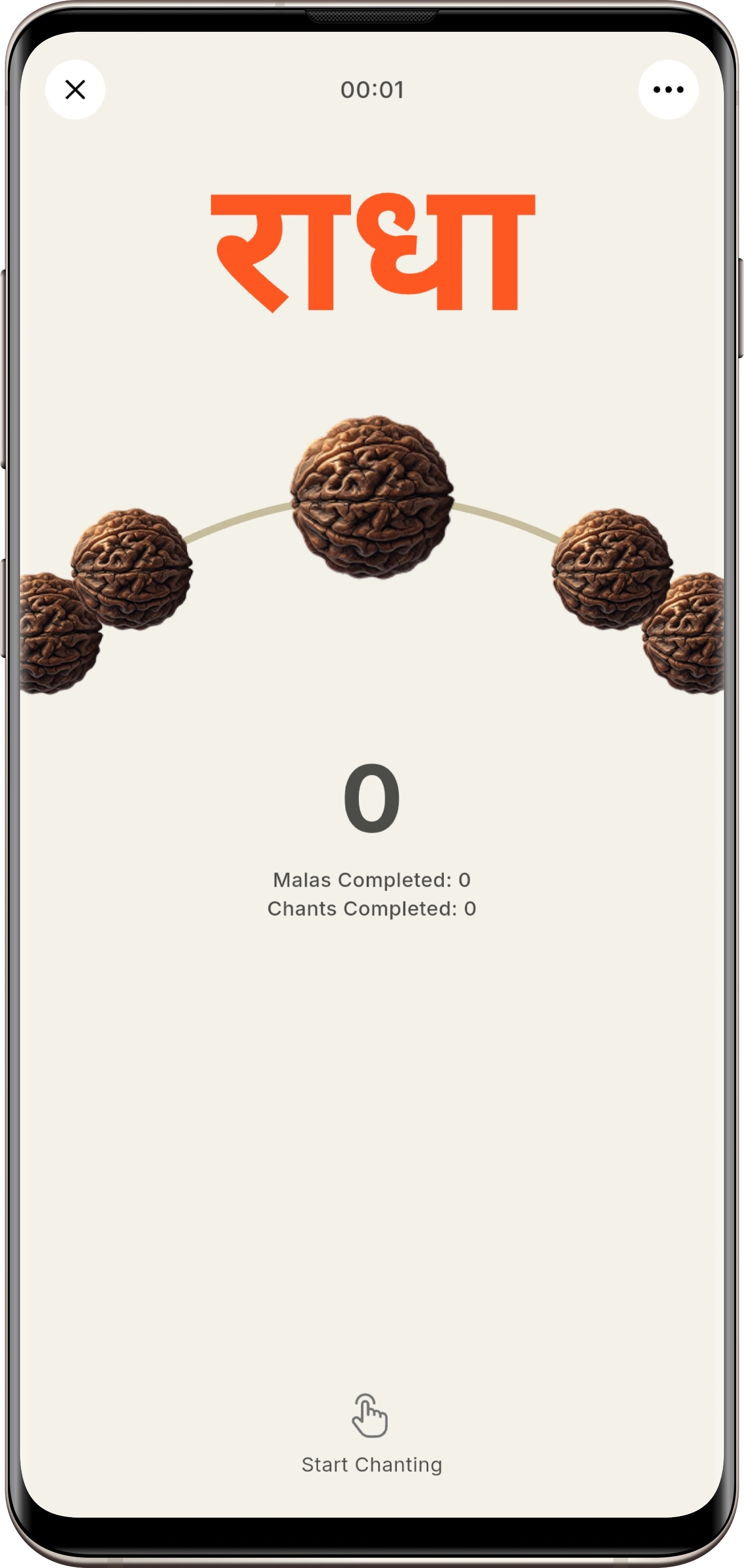
If Neem Karoli Baba's devotion to Sita Ram has inspired you to begin your own Naam Jaap practice, Divya Marg gives you a simple way to make that practice part of your daily routine — without turning it into another thing to manage.
Choose Sita Ram as your Naam
Set it as your active mantra and begin whenever you're ready.
Daily Jaap goal
Set a realistic target — even a quarter mala — and let the app track it.
Haptic bead counting
Feel each repetition so your attention can stay on the name, not the number.
Works fully offline
Chant at the ashram, at home, or anywhere signal doesn't reach.
Daily reminders
A gentle nudge at whatever time you choose to practice.
Simple progress tracking
See your chants, malas and streak without any setup.
What We Can Learn From Neem Karoli Baba Today
Without claiming to speak for him, a few threads from his life seem worth carrying forward. Devotion, in his story, didn't require withdrawal from ordinary life — it lived alongside a wooden bench, a plaid blanket, food shared with visitors, and a lot of laughter. Seva and compassion were treated as inseparable from spiritual practice, not optional extras. And remembrance — keeping a name present in the mind through the ordinary hours of a day — was offered as something genuinely available to anyone, not reserved for renunciates or scholars.
Consistency, more than intensity, is the thread that runs through nearly every account of his teaching. A small practice, returned to daily, was treated as more valuable than an ambitious one attempted once.
Frequently Asked Questions
What is Neem Karoli Baba famous for?
Neem Karoli Baba was a 20th-century Hindu saint and devotee of Hanuman, best known for the Kainchi Dham ashram in Uttarakhand, his teachings on love and selfless service, and the many accounts of miracles shared by devotees. He is also known in the West as the guru of Ram Dass, author of Be Here Now.
What mantra did Neem Karoli Baba chant?
Devotee accounts and the ashrams associated with him consistently describe remembrance of Ram, including the Hanuman Chalisa and the name 'Sita Ram,' as central to his devotional life. No single source claims he prescribed one exclusive mantra for all devotees.
Why is Neem Karoli Baba associated with Sita Ram?
He was a devotee of Hanuman, who in Hindu tradition is himself the foremost devotee of Ram and Sita. 'Sita Ram' is widely used as a devotional greeting and chant across his ashrams and by his devotees today, reflecting this Ram-centered devotional lineage.
What does Sita Ram mean?
Sita Ram combines the names of Sita and Ram, the central couple of the Ramayana, revered as embodiments of devotion, righteousness and steadfastness. Chanting the combined name is a way of remembering both together, rather than invoking one without the other.
How do you chant Sita Ram?
Sit comfortably, settle your attention, and repeat 'Sita Ram' slowly and attentively — aloud, in a whisper, or silently. A mala can help with counting, but isn't required, especially when starting out.
How many times should I chant Sita Ram?
There's no single mandatory number. 108 repetitions (one mala) is a common traditional unit, but starting with a few minutes or a quarter mala is a completely valid way to begin. Consistency matters more than the count.
Can I chant Sita Ram without a mala?
Yes. A mala is a helpful counting tool once you have one, but you can begin today using your fingers, a digital counter, or simply chanting for a set number of minutes.
What is Sita Ram Naam Jaap?
Sita Ram Naam Jaap is the practice of repeating 'Sita Ram' as a form of devotional remembrance — the same underlying practice as Naam Jaap generally, applied to this specific, Ram-centered name.
Where is Neem Karoli Baba's ashram?
His best-known ashram, Kainchi Dham, is near Nainital in Uttarakhand, India, built around a Hanuman temple in 1964. He also established an ashram in Vrindavan, where his samadhi (shrine) is located.
Who was Neem Karoli Baba's devotee Ram Dass?
Ram Dass, born Richard Alpert, was a Harvard psychologist who travelled to India in 1967 and became a devotee of Neem Karoli Baba, who gave him his name. He later wrote Be Here Now and compiled Miracle of Love, a collection of devotee stories about his guru.
Conclusion
Neem Karoli Baba's life resists a tidy summary — by his own devotees' account, facts are few and stories many. What does come through clearly, across the accounts, the books, and the ashrams that still welcome visitors today, is a life organized around devotion: to Hanuman, to Ram, and to the people who came to him regardless of who they were.
Sita Ram sits at the center of that devotion — not as a formula, but as a name devotees have returned to for decades as a way of staying turned toward the divine through ordinary days. Beginning a Sita Ram Naam Jaap practice doesn't require a pilgrimage to Kainchi Dham or years of study. A few quiet minutes, repeated daily, is a genuine starting point.
If you'd like a simple way to keep that practice going, Divya Marg was built for exactly this — a quiet, offline-friendly companion for a daily Naam Jaap practice, whichever name you choose to chant.
Related guides
What Is Naam Jaap? Meaning, Benefits & How to Do It
The complete background on Naam Jaap as a practice.
How to Do Naam Jaap: A Beginner’s Step-by-Step Guide
Choosing your Naam, counting to 108, and starting small.
What Is the Best Time for Naam Jaap?
Brahma Muhurta, morning vs. evening, and building a routine.
Sources & Further Reading
- Ram Dass, Miracle of Love: Stories About Neem Karoli Baba (Hanuman Foundation)
- Ram Dass, Be Here Now (Lama Foundation, 1971)
- Wikipedia, “Neem Karoli Baba”
- ramdass.org — biographical materials on Ram Dass and Neem Karoli Baba
- Shree Baba Neeb Karori Maharaj (2026 film) — public release and cast information
Written and reviewed by the Divya Marg Editorial Team. Last updated 26 August 2026.
More guides
Begin your Naam Jaap today
Offline-first and built entirely around one purpose — helping you show up for your practice, every single day.
- Free, always
- Works offline
- No ads