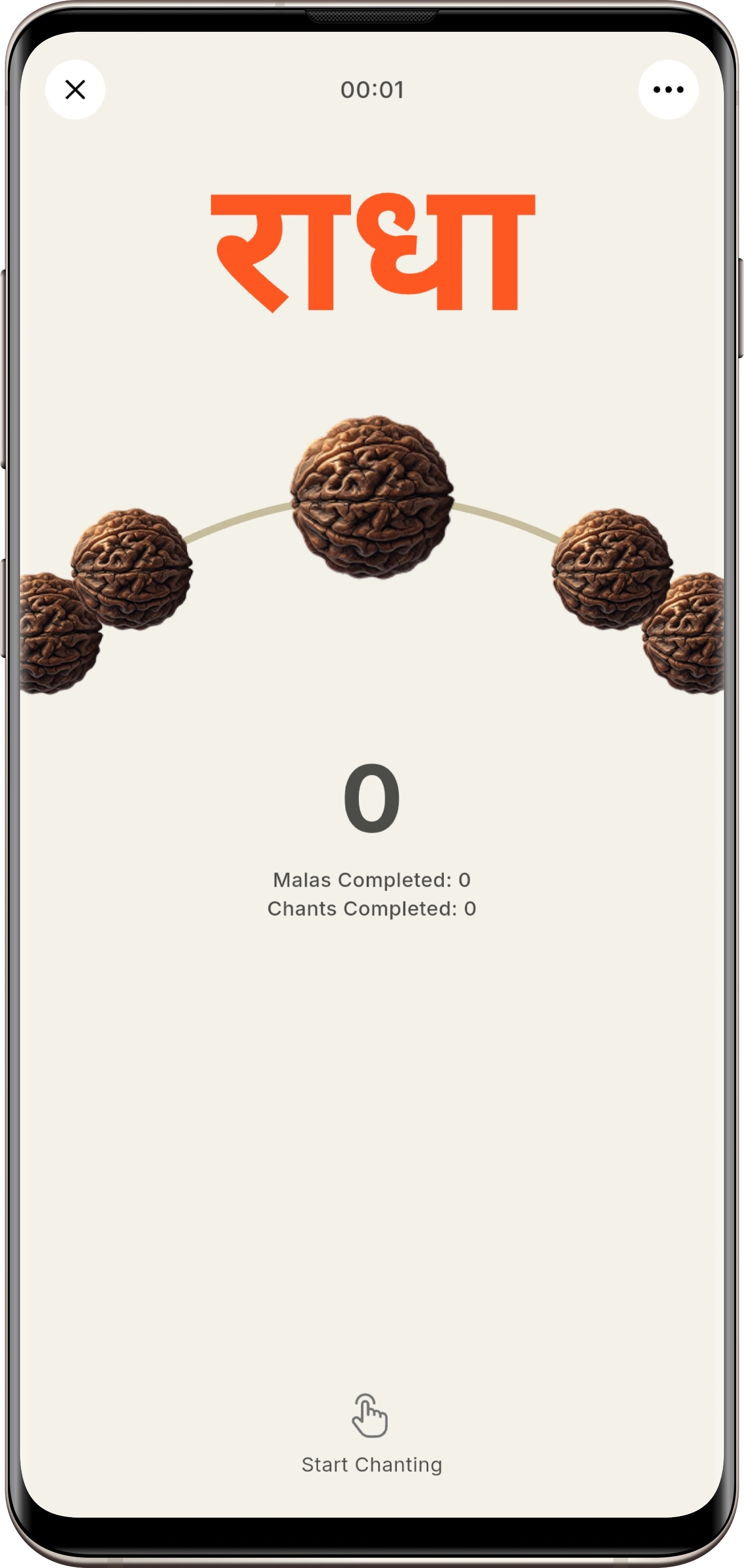
What Is Radha Naam Jaap? Meaning, Significance & How to Practice

Radha Naam Jaap is the practice of repeating Radha’s name with sincere attention, as an act of devotion and remembrance. It sits within the wider tradition of Naam Jaap — chanting a divine name — but carries its own devotional character, rooted in Radha’s place at the heart of Radha-Krishna bhakti.
For someone drawn specifically to Radha’s name — often after encountering Radha-Krishna devotion through a satsang, a temple visit, or a teacher’s guidance — it becomes a natural, personal choice for a daily chanting practice. This article explains what Radha Naam means, why devotees chant it, and walks through exactly how to begin, whether or not you have a mala.
Table of contents
Key takeaways
- Radha Naam Jaap is the attentive, repeated remembrance of Radha's name — no elaborate ritual is required to begin.
- Different Vaishnava traditions understand Radha's significance somewhat differently; this article doesn't present one interpretation as the only one.
- 108 repetitions (one mala) is a common unit, but starting with a few minutes or a quarter mala is equally valid.
- A mala helps with counting but isn't required — mental counting, a digital counter, or a timed session all work.
What Does “Radha Naam” Mean?
In Hindu devotional tradition, Radha is revered as the foremost devotee and beloved of Krishna — an embodiment of pure, selfless love within Radha-Krishna bhakti. Different Vaishnava traditions describe her significance somewhat differently: some emphasize her as Krishna’s eternal consort, others frame devotion to her as devotion to divine love itself. This article doesn’t treat any single interpretation as the one accepted across all of Hinduism — where a specific tradition’s view is described, it is identified as such.
“Naam” simply means name. Across bhakti traditions broadly, the Divine Name is treated as especially significant — a way of holding the divine in mind that doesn’t require a temple, a ritual object, or a particular occasion. Radha Naam, then, is Radha’s name specifically, chanted as a personal, daily act of remembrance.
What Is Radha Naam Jaap?
“Jaap” (japa) means repetition. Radha Naam Jaap is the repeated, attentive utterance of Radha’s name — aloud, in a whisper, or silently. The word “attentive” matters here: repeating a name while the mind is entirely elsewhere is still practice, and has its own value, but Naam Jaap as a devotional discipline asks for a thread of attention to stay with the name — its sound, its meaning, the feeling it carries.
It’s worth being direct about how simple the starting point actually is. Radha Naam Jaap doesn’t require initiation, a guru, specific Sanskrit pronunciation, or any equipment. A quiet moment and a sincere intention to repeat the name is a complete beginning.
Why Do Devotees Chant Radha Naam?
Reasons vary from person to person, but a few themes come up consistently among practitioners:
- Remembrance. Keeping Radha present in the mind through an ordinary day, not only during formal worship.
- Devotion and love. Chanting as an expression of reverence and affection toward Radha, within the wider Radha-Krishna devotional relationship.
- Cultivating attention. The repetition gives the mind a single point to return to, which many practitioners describe as calming and focusing.
- A daily devotional routine. For many, Naam Jaap is less about any single session and more about the discipline of showing up daily.
- Surrender. Some practitioners describe repeating the name as a way of setting aside personal effort and control in favor of trust and devotion.
These are devotional and experiential reasons, described the way practitioners themselves describe them — not claims that chanting guarantees a specific worldly outcome.
The Spiritual Significance of Radha Naam
Within Radha-Krishna devotion broadly, Radha is understood as representing the height of devoted love — a model for how a devotee might orient themselves toward the divine: completely, without calculation, and without seeking anything in return. Some Vaishnava traditions go further, treating devotion to Radha as inseparable from devotion to Krishna himself, since the two are understood together rather than as separate objects of worship.
Specific devotional lineages within this broader tradition — for instance, the Radha Vallabh Sampradaya, a Vaishnava tradition centered in Vrindavan — place Radha’s name and remembrance of her at the very center of daily practice, treating constant remembrance of the Divine Name as a central discipline rather than an occasional devotional act. Other Vaishnava traditions honour Radha within a somewhat different theological framework. This article doesn’t claim to speak for every tradition, and readers exploring a specific lineage’s teaching in depth should look to that tradition’s own sources.
What’s consistent across these variations is the underlying idea: the Name is treated as meaningful in itself, not merely as a label — repeating it is understood as a way of drawing closer to what it represents.

Radha Naam Jaap and Bhakti
Bhakti — devotion — is best understood as something practiced rather than only thought about, and Naam Jaap is one of its most direct expressions. A few qualities traditionally associated with bhakti apply directly to how Radha Naam Jaap is approached:
- Love — chanting as an expression of affection, not obligation.
- Surrender — releasing the need to control outcomes while practicing.
- Humility — approaching the practice without ego or performance.
- Consistency — returning to the practice daily, rather than intensely and rarely.
- Seva — for many practitioners, devotional practice and service to others are understood as connected, not separate pursuits.
- Devotional attention — staying present with the name rather than letting repetition become automatic.
It’s worth making one distinction clearly: Naam Jaap is not simply about reaching a large numerical count. A short, genuinely attentive session reflects the practice more fully than a long session repeated mechanically while the mind is elsewhere. Many practitioners treat the quality of attention as being just as important as the number of repetitions.
Premanand Ji Maharaj and Radha Naam
For readers who’ve recently discovered Radha Naam through a contemporary teacher, Premanand Ji Maharaj is often the context. He is a Vrindavan-based saint whose daily satsangs on Radha-Krishna devotion, delivered from his ashram Shri Hit Radha Keli Kunj, have reached a wide audience in recent years. Within his tradition, constant remembrance of the Divine Name is treated as a central, daily discipline rather than an occasional act — a theme that connects directly to Radha Naam Jaap as described in this article.
If you’d like the fuller picture — his life, his teachings on devotion and surrender, and the specific devotional tradition he belongs to — read our complete guide to Premanand Ji Maharaj, his teachings and Radha Naam Jaap. To be clear, Divya Marg is an independent app; it has no affiliation with, and does not claim any endorsement from, Premanand Ji Maharaj or Shri Hit Radha Keli Kunj.
How to Do Radha Naam Jaap: A Beginner’s Step-by-Step Guide
- Choose a quiet place. A calmer environment makes it easier to focus, though it doesn’t need to be silent.
- Sit comfortably. No particular posture is required for a beginner unless a specific tradition you follow calls for one.
- Settle your attention. A few slow breaths before beginning is enough to become still.
- Begin repeating Radha Naam. Aloud, softly, or mentally — whichever suits your setting.
- Keep your attention on the Naam. When your mind wanders, gently notice and bring it back, without frustration.
- Use a mala if desired. It's optional, and helpful mainly for counting.
- Choose a manageable daily target. Start realistically rather than ambitiously.
- Finish calmly. Bring the session to a deliberate close rather than trailing off.
- Practice consistently. A realistic routine, repeated daily, is more sustainable than an ambitious one attempted once.
Should You Use a Mala for Radha Naam Jaap?
A mala is a string of prayer beads, traditionally 108 beads plus one additional meru (or guru) bead marking the start and end of a round. With each repetition, a practitioner commonly moves one bead between the thumb and middle finger, working around the strand until reaching the meru bead again — completing one mala.
Many practitioners find a mala useful for two reasons: it removes the need to mentally track a count, freeing attention to stay on the name, and it gives the hands something steady to do while chanting. That said, a mala is not necessarily required for every form of Naam Jaap — see our beginner’s guide to Naam Jaap for more on counting methods, with or without one.
How Many Times Should You Chant Radha Naam?
A few common approaches:
- A few minutes — a simple time-based session, especially useful when starting out.
- One mala (108 repetitions) — a widely used traditional unit.
- Multiple malas — built up gradually as a practice deepens.
- A fixed daily target — whatever number or duration you can realistically repeat every day.
No single number is universally mandatory — different traditions and practitioners follow different approaches. Start with something sustainable, and build consistency before worrying about the count.
Radha Naam Jaap 108 Times
108 is one of the most widely used counts in Hindu devotional practice, and its significance is explained a few different ways depending on the source: some point to 108 Upanishads, others to the traditional 108 names associated with various deities — including the 108 names of Radha Rani (Radha Ashtottara Shatanamavali) — and others to numerological or cosmological explanations. Rather than treat any single explanation as definitive, it’s more accurate to say the number carries layered, traditional significance rather than one fixed origin.
Practically, 108 is significant mainly because it’s the standard count of a mala — one full round of beads equals 108 repetitions, which is why “one mala” and “108 repetitions” are often used interchangeably. A beginner structuring a 108-repetition session can simply move through a mala once, at an unhurried pace, with attention on the name rather than the count — and if 108 feels like too much at first, a quarter mala (27) or half mala (54) is an equally valid session. A deeper look at why 108 specifically holds this place across Hindu practice is a topic we plan to cover in a dedicated article.
When Is the Best Time to Do Radha Naam Jaap?
Early morning, and Brahma Muhurta specifically — roughly 96 minutes before sunrise — is traditionally considered favourable, largely because the mind tends to be quieter and less distracted before the day begins. Evening practice, or a short session before sleeping, works well for many people too, often simply because it’s the time they can realistically protect.
A consistent time helps build a routine, but Naam Jaap isn’t invalid outside any particular window. For a full look at Brahma Muhurta, morning versus evening practice, and how to choose a time that fits your actual schedule, see our guide on the best time for Naam Jaap.
How to Build a Daily Radha Naam Jaap Habit
- Start small. A few minutes is a complete beginning, not a compromise.
- Choose a consistent time. Attaching the practice to an existing habit makes it easier to remember.
- Set a realistic goal. Something you can genuinely repeat daily, not an ambitious target you'll abandon.
- Keep the practice simple. Complexity is often what causes a new habit to lapse.
- Track your progress. Seeing chants, malas and streaks laid out turns intention into something visible.
- Don't give up after missing a day. One missed day isn't a failed practice — simply continue the next day.
- Increase gradually, if desired. Once a small practice feels automatic, extend it.
What If My Mind Keeps Wandering During Naam Jaap?
This is genuinely common, not a sign you're doing it wrong. Any focused practice invites distraction, especially at first. A few things help:
- Gently return attention to the Naam each time you notice it's wandered, without frustration or self-criticism.
- Slow down — a hurried pace makes wandering more likely.
- Shorten the session if a long one consistently feels unfocused; a short, attentive session is more valuable than a long, distracted one.
- Choose a quieter environment if your current setting is genuinely too distracting.
- Focus on the sound and pronunciation of the name itself as an anchor for attention.
This is a normal part of building any attention-based practice, not a medical or psychological concern to self-diagnose.
Can I Do Radha Naam Jaap Without a Mala?
Yes. A mala is a helpful tool once you have one, but it isn't a requirement to begin. Practical alternatives include:
- Counting mentally — simply keeping track in your head.
- Using a digital counter — an app-based counter that tracks repetitions for you.
- Setting a time duration — chanting for a fixed number of minutes instead of counting.
- Using a daily repetition goal — a target you work toward across the day rather than in one sitting.
Starting is simple. Staying consistent is the real work.
Starting Naam Jaap can be simple. Maintaining consistency and keeping track of repetitions can be harder. If Radha Naam has inspired you to begin a daily Naam Jaap practice, Divya Marg gives you a simple way to start, count your Jaap, and stay consistent.
Choose Radha Naam as your Naam
Set it as your active mantra and begin whenever you're ready.
Daily Jaap goal
Set a realistic target — even a quarter mala — and let the app track it.
Haptic bead counting
Feel each repetition so your attention can stay on the name, not the number.
Works fully offline
Chant at home, at a temple, or anywhere signal doesn't reach.
Daily reminders
A gentle nudge at whatever time you choose to practice.
Simple progress tracking
See your chants, malas and streak without any setup.
A Simple Radha Naam Jaap Routine for Beginners
One way to structure a first week, purely as an example — not a mandatory spiritual prescription:
- Morning: 5–10 minutes of Radha Naam Jaap, seated quietly.
- During the day: a brief moment of remembrance whenever it naturally comes to mind — no formal session required.
- Evening: another short session if desired, or simply the morning practice alone.
Adjust freely. The structure exists to make starting easier, not to add pressure.
Conclusion
Radha Naam Jaap doesn’t need to be complicated to be genuine. At its core, it’s the repeated, attentive remembrance of Radha’s name — an expression of bhakti that asks for sincerity and consistency far more than elaborate ritual or a large count.
Whether you arrived here through Premanand Ji Maharaj’s satsangs, a personal devotion to Radha, or simple curiosity about Naam Jaap, the practice itself starts the same way: a few quiet minutes, repeated daily.
If you'd like a simple way to keep that practice going, Divya Marg offers a quiet, offline-friendly companion for daily Naam Jaap — including Radha Naam.
Frequently Asked Questions
What is Radha Naam Jaap?
Radha Naam Jaap is the practice of repeating Radha's name with attention, as a form of devotional remembrance. It's the same underlying practice as Naam Jaap generally, applied specifically to Radha's name.
What does Radha Naam mean?
“Naam” means name, so Radha Naam literally means the name of Radha. Within Radha-Krishna devotional traditions, repeating her name is understood as a way of turning the mind toward divine love and devotion.
Why do devotees chant Radha Naam?
Devotees describe reasons ranging from cultivating remembrance and spiritual attention to expressing love and surrender within a Radha-Krishna bhakti practice. These are devotional and experiential reasons rather than claims of a guaranteed outcome.
How do you do Radha Naam Jaap?
Sit comfortably in a quiet space, settle your attention, and repeat “Radha Naam” slowly and attentively — aloud, in a whisper, or silently. A mala can help with counting but isn't required to begin.
How many times should I chant Radha Naam?
There's no single mandatory number. 108 repetitions (one mala) is a common traditional unit, but a few minutes or a quarter mala is a completely valid way to start. Consistency matters more than the count.
Is 108 Radha Naam Jaap enough?
Yes — 108 repetitions (one mala) is a complete, traditional session used by many practitioners daily. More isn't inherently better; a sincerely attentive round of 108 is a genuine, sufficient practice.
Can I chant Radha Naam without a mala?
Yes. A mala is a helpful counting tool once you have one, but you can begin today using your fingers, a digital counter, or simply chanting for a set number of minutes instead of counting repetitions.
What is the best time for Radha Naam Jaap?
Early morning, particularly Brahma Muhurta, is traditionally considered favourable because the mind is quieter. That said, any time you can practice consistently — morning, evening, or both — is a valid time.
Can beginners do Radha Naam Jaap?
Absolutely. Radha Naam Jaap has no prerequisites. Beginners can start with just a few minutes a day and build gradually from there.
Can Radha Naam Jaap be done silently?
Yes. Radha Naam can be chanted aloud, whispered, or repeated silently and mentally — all three are considered valid, and silent repetition is often more practical in shared or public spaces.
Related guides
What Is Naam Jaap? Meaning, Benefits & How to Do It
The complete background on Naam Jaap as a practice.
How to Do Naam Jaap: A Beginner’s Step-by-Step Guide
Choosing your Naam, counting to 108, and starting small.
What Is the Best Time for Naam Jaap?
Brahma Muhurta, morning vs. evening, and building a routine.
Premanand Ji Maharaj: Life, Teachings & Radha Naam Jaap
His life in Vrindavan and why Radha Naam is central to his path.
108 Names of Radha Rani: Complete List & Meanings
Radha Ashtottara Shatanamavali in Devanagari with English meanings.
Sources & Further Reading
- Shri Hit Radha Keli Kunj — official website: Philosophy and Hitopasana pages (radhakelikunj.com)
- General references on the traditional significance of 108 in Hindu mala practice
Written and reviewed by the Divya Marg Editorial Team. Last updated 30 August 2026.
More guides
Begin your Naam Jaap today
Offline-first and built entirely around one purpose — helping you show up for your practice, every single day.
- Free, always
- Works offline
- No ads