Om Namah Shivaya: Meaning, Benefits, Significance & How to Chant
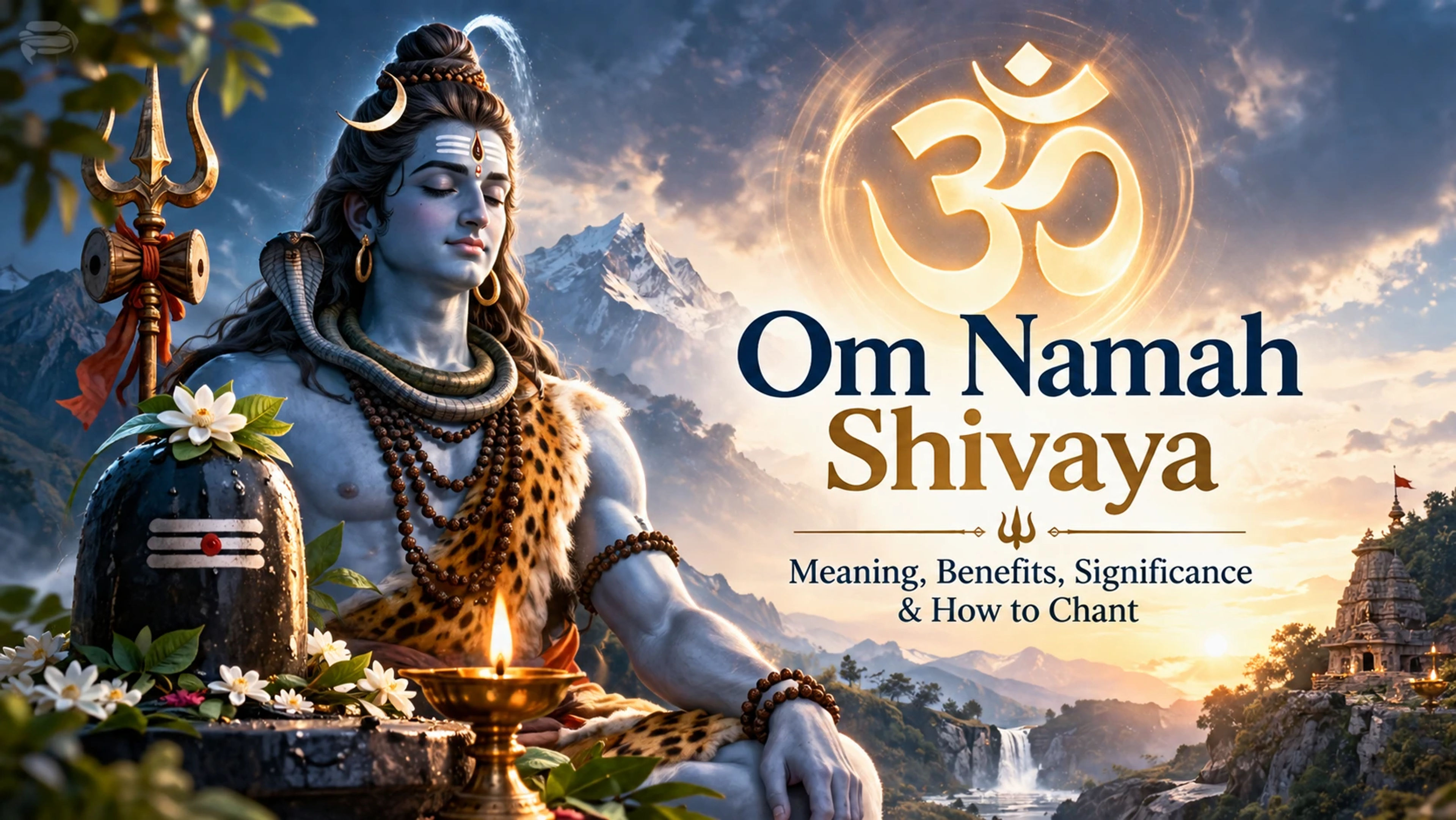
Om Namah Shivaya (ॐ नमः शिवाय) is one of the most widely chanted mantras in Hindu tradition, dedicated to Lord Shiva. It is short, easy to pronounce, and needs no special initiation to begin — which is part of why it is often the first mantra people learn.
This guide explains what the mantra means, why it is called the Panchakshara Mantra, what each of its five syllables is traditionally said to represent, and how a complete beginner can start chanting it — with or without a mala.
Table of contents
What Is Om Namah Shivaya?
Om Namah Shivaya is a Sanskrit mantra of salutation to Lord Shiva, one of the principal deities of Hinduism. Its roots go back to the Sri Rudram, an ancient hymn to Shiva found in the Yajurveda — one of the oldest layers of Hindu scripture. Because of this Vedic connection, the mantra is treated with particular reverence in Shaiva (Shiva-centred) traditions, and it is recited at Shiva temples across India and Nepal, especially during festivals like Maha Shivratri.
In its short form, the mantra is just five syllables: Na-Ma-Shi-Va-Ya. With the syllable Om placed in front, it becomes the six-syllable form most people know today — Om Namah Shivaya.
The Panchakshara Mantra Explained
Panchakshara literally means “five syllables” (“pancha” = five, “akshara” = syllable or letter). It is the traditional name for Namah Shivaya, referring to its five sound units: Na, Ma, Shi, Va and Ya.
When Om is added at the beginning, some traditional texts call it the Shadakshara (six-syllable) mantra. In everyday devotional use, however, “Om Namah Shivaya” and “the Panchakshara Mantra” are generally used to mean the same thing. Some classical texts describe distinctions in who traditionally recited the five-syllable versus six-syllable form; in practice today, Om Namah Shivaya is chanted freely by devotees of all backgrounds.
A note on interpretation
Hindu and Shaiva traditions do not always agree on a single “correct” explanation for every syllable of this mantra. Where sources differ, this article presents more than one traditional reading rather than treating one as the only right answer.
Om Namah Shivaya Meaning, Word by Word
Broken into its three parts, the mantra reads simply:
- Om — the primordial sound, often described as the sound of the universe itself or of pure consciousness. It is added before many Hindu mantras as a mark of reverence.
- Namah — “salutation,” “bowing down,” or “surrender.” A traditional subtler reading takes Namah as “not mine,” pointing to letting go of ego and personal claim.
- Shivaya — “to Shiva,” the auspicious one.
Put together in simple English, Om Namah Shivaya can be understood as: “I bow to Shiva” or “Salutations to the auspicious one.”
Meaning of the Five Syllables: Na-Ma-Shi-Va-Ya
Beyond the plain-English meaning, Shaiva tradition offers deeper, symbolic readings of the five syllables. Two common ones appear across devotional and philosophical sources:
| Syllable | Element (Pancha Bhuta) | Shiva’s function (Pancha Kritya) |
|---|---|---|
| Na | Prithvi (Earth) | Srishti — creation |
| Ma | Jala (Water) | Sthiti — preservation |
| Shi | Agni (Fire) | Samhara — dissolution |
| Va | Vayu (Air) | Tirobhava — concealment |
| Ya | Akasha (Space) | Anugraha — grace |
The first reading — the five elements, or Pancha Bhutas — is the most commonly repeated across devotional sources. It holds that each syllable corresponds to one of the building blocks of the physical world: earth, water, fire, air and space.
The second reading, used more in Shaiva philosophical texts, connects each syllable to one of Shiva’s five cosmic functions (Pancha Kritya): creation, preservation, dissolution, concealment and grace. Not every source frames the syllables this way, and both readings are accepted within their respective traditions.
The Shiva Panchakshara Stotram, a five-verse hymn traditionally attributed to the 8th-century philosopher Adi Shankaracharya, is built around these five syllables, with each verse beginning with one of them.
Why Is It Connected to Lord Shiva?
Shivaya, the closing part of the mantra, directly names Shiva. In the Shaiva tradition, Shiva is understood as the supreme, formless reality behind creation, and this mantra is considered one of the most direct ways to address him by name. Its presence in the Sri Rudram — one of the oldest surviving hymns to Shiva — is a large part of why it carries such weight within Shaiva worship, alongside more visual forms of devotion like the Shiva linga.
Traditional Benefits of Chanting
Within Hindu and Shaiva tradition, regular chanting of Om Namah Shivaya is associated with:
- Devotion. A direct way to express love and surrender toward Shiva.
- Spiritual discipline. A consistent practice (japa) that trains attention and regularity.
- Remembrance. Keeping the mind turned toward the divine through the day.
- Inner focus. Repetition of a single sound is traditionally used to steady a wandering mind.
- Purification. Traditional teachings describe repeated chanting as a way to gradually purify thought and intention.
These are religious and devotional beliefs, not medical or scientific claims. Separately, general research on meditation and repetitive chanting practices suggests they can support relaxation and focused attention for many people — but that is a different, evidence-based observation about repetitive practice in general, not a guarantee tied specifically to this mantra. Chanting Om Namah Shivaya is not a substitute for medical care, and it is not traditionally presented as a guaranteed cure for illness or a shortcut to wealth or success.
How to Chant Om Namah Shivaya
There is no single “correct” method — if your family or a teacher has taught you a specific way, that takes priority. For everyone else, Hindu tradition generally recognises a few forms of japa (repetition), moving from more audible to more internal:
- Vaikhari (aloud). Chanting the full mantra out loud, with clear pronunciation. Often recommended for beginners because the sound itself helps hold attention.
- Upanshu (whispered). A soft, near-silent chant, moving the lips without projecting the voice.
- Manasika (mental). Repeating the mantra silently in the mind, with no lip movement. Traditionally considered a more advanced stage that many practitioners grow into over time.
For pronunciation, each syllable is said clearly and evenly: Om — Na-mah — Shi-vaa-ya. There is no need to rush; a steady, unhurried pace is generally preferred over speed.
Some traditions favour the early morning (Brahma Muhurta, roughly before sunrise) or dusk for focused chanting, since the mind is considered calmer at these times. This is a traditional preference, not a strict rule — chanting at any time that fits your day is acceptable.
How Many Times Should You Chant It?
There is no universal number that applies to everyone. A widely followed traditional count is 108 repetitions, usually counted on a 108-bead mala, with each bead marking one repetition of the mantra. Some practitioners do multiples of this — such as 2 or 10 rounds — while others keep it much simpler.
Beginners are generally encouraged to start small — even 11 or 21 repetitions a day — and build up gradually rather than starting with a large count and giving up. Consistency over time matters more than hitting a specific number on any single day. See our separate guide on why mantras are traditionally chanted 108 times for more on where this number comes from.
Can You Chant It Without a Mala?
Yes. A mala (a string of beads, traditionally 108 plus one “guru bead”) is a counting tool, not a requirement for the mantra itself. It helps keep count without needing to think about numbers, which frees the mind to focus on the chanting. Without a mala, people commonly keep count on their fingers, use a simple physical clicker, or use a digital jaap counter. Our guide on chanting without a mala covers this in more detail, and our comparison of mala vs. physical counter vs. digital jaap counter can help you pick what suits you.
Can Beginners Chant It Daily?
Yes. Om Namah Shivaya is one of the more approachable mantras for a daily practice precisely because it is short, does not require initiation, and can be chanted anywhere — at home, while commuting, or during a short break. Many people treat it as a form of Naam Jaap, repeating “Shivaya” or the full mantra as a simple daily habit. If you are just starting out, our beginner’s step-by-step guide to Naam Jaap walks through the basics of building the habit.
How Divya Marg Can Help
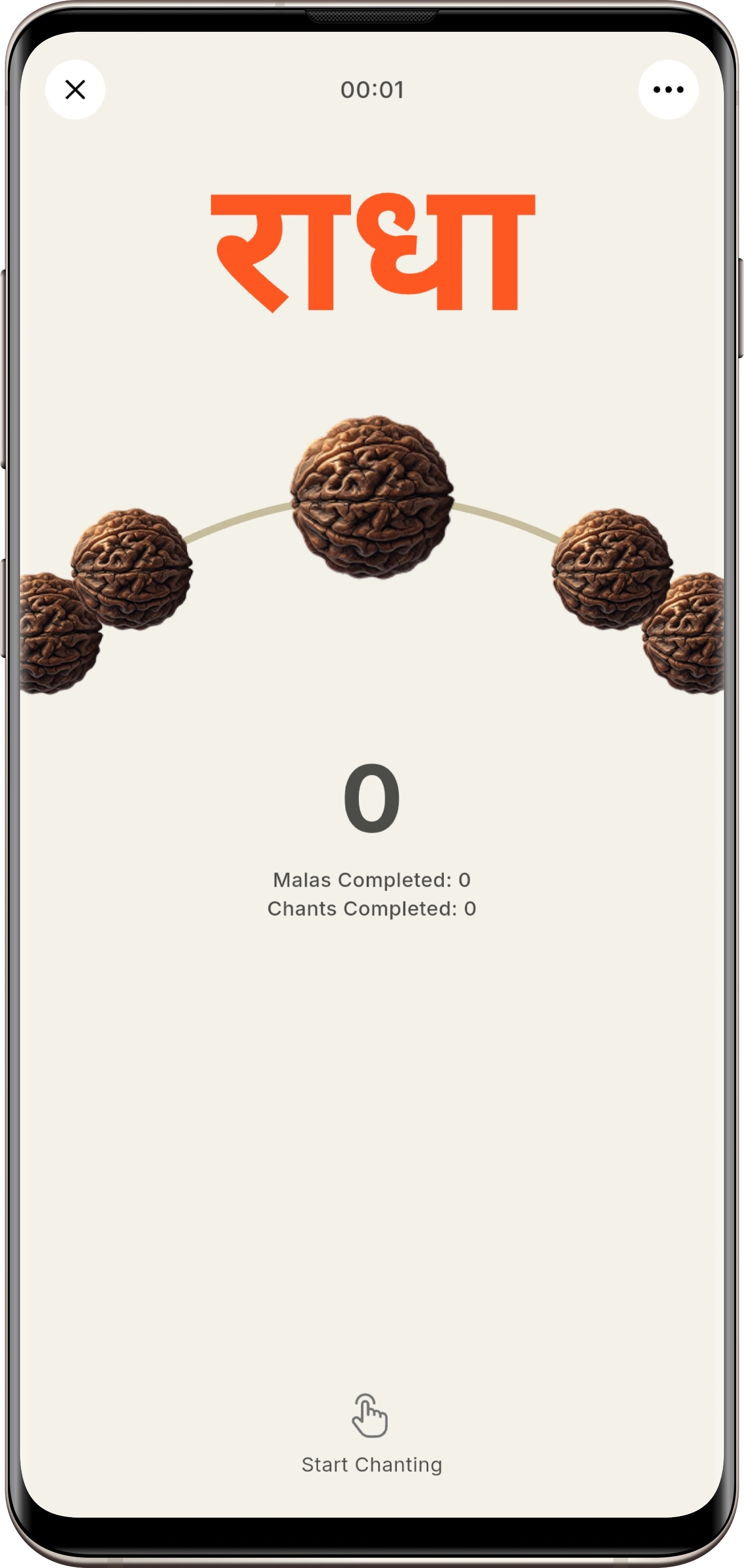
Once you know how you want to chant, keeping count is the practical part that often gets dropped first. The Divya Marg app is built for exactly that:
Choose Om Namah Shivaya as your Naam
Set it as your active mantra and start a session anytime.
Daily Jaap goal
Set a realistic repetition target and let the app track it for you.
Haptic bead counting
Feel each repetition so your attention can stay on the mantra, not the count.
Works fully offline
Chant anywhere, signal or not.
Daily reminders
A gentle nudge at whatever time you choose to practice.
Simple progress tracking
See your chants, malas and streak without any setup.

Begin your Naam Jaap today
Offline-first and built entirely around one purpose — helping you show up for your practice, every single day.
- Free, always
- Works offline
- No ads

Frequently Asked Questions
What does Om Namah Shivaya mean?
In simple terms, Om Namah Shivaya means "I bow to Shiva" or "salutations to the auspicious one." Om is the primordial sound, Namah means bowing down or surrender, and Shivaya refers to Lord Shiva. Some traditional readings also take Namah as "not mine," pointing to the idea of letting go of ego.
What is the Panchakshara Mantra?
Panchakshara means "five syllables." It refers to Namah Shivaya, which is made up of the five sound units Na, Ma, Shi, Va and Ya. When the syllable Om is added at the start, it becomes a six-syllable form, sometimes called Shadakshara.
What is the meaning of Na-Ma-Shi-Va-Ya?
Traditional sources connect these five syllables to the five elements — Na to earth, Ma to water, Shi to fire, Va to air, and Ya to space (akasha). Some Shaiva texts also connect them to five functions attributed to Shiva: creation, preservation, dissolution, concealment and grace. Different schools explain the syllables somewhat differently, and both readings are respected within their own traditions.
How should a beginner chant Om Namah Shivaya?
A beginner can start by simply saying the mantra slowly and clearly a few times a day, either aloud or quietly. There is no complicated ritual required to begin — sitting comfortably, chanting with attention, and being consistent matters more than getting every detail perfect from day one.
How many times should Om Namah Shivaya be chanted?
There is no single fixed number that everyone must follow. A common traditional count is 108 repetitions, usually counted on a mala, but many people start with a smaller number like 11 or 21 and build up gradually.
Is chanting it 108 times necessary?
No. Repeating the mantra 108 times is a widely followed tradition and a convenient count because that is how many beads are on a standard mala, but it is not a strict requirement. Chanting fewer times consistently is generally considered more valuable than chanting 108 times occasionally.
Can I chant Om Namah Shivaya without a mala?
Yes. A mala is a counting tool, not a requirement for the mantra to be effective. You can chant while walking, doing chores, or simply keeping count on your fingers or with a digital counter.
Can Om Namah Shivaya be chanted daily?
Yes, many devotees chant it as part of a daily practice. Some traditions favour the early morning or dusk for focused chanting, but there is no rule against chanting it at other times of day when that fits your routine better.
What are the traditional benefits of chanting Om Namah Shivaya?
Within Shaiva and broader Hindu tradition, regular chanting is associated with devotion to Shiva, inner discipline, remembrance of the divine, and a calmer, more focused mind. These are traditional and devotional associations rather than guaranteed or medically proven outcomes.
Can beginners with no Sanskrit knowledge chant this mantra?
Yes. No Sanskrit background is needed. Learning the correct pronunciation of the five syllables is enough to begin, and understanding gradually deepens with practice.