Why Is Krishna Blue? The Meaning Behind Krishna's Dark and Blue Complexion
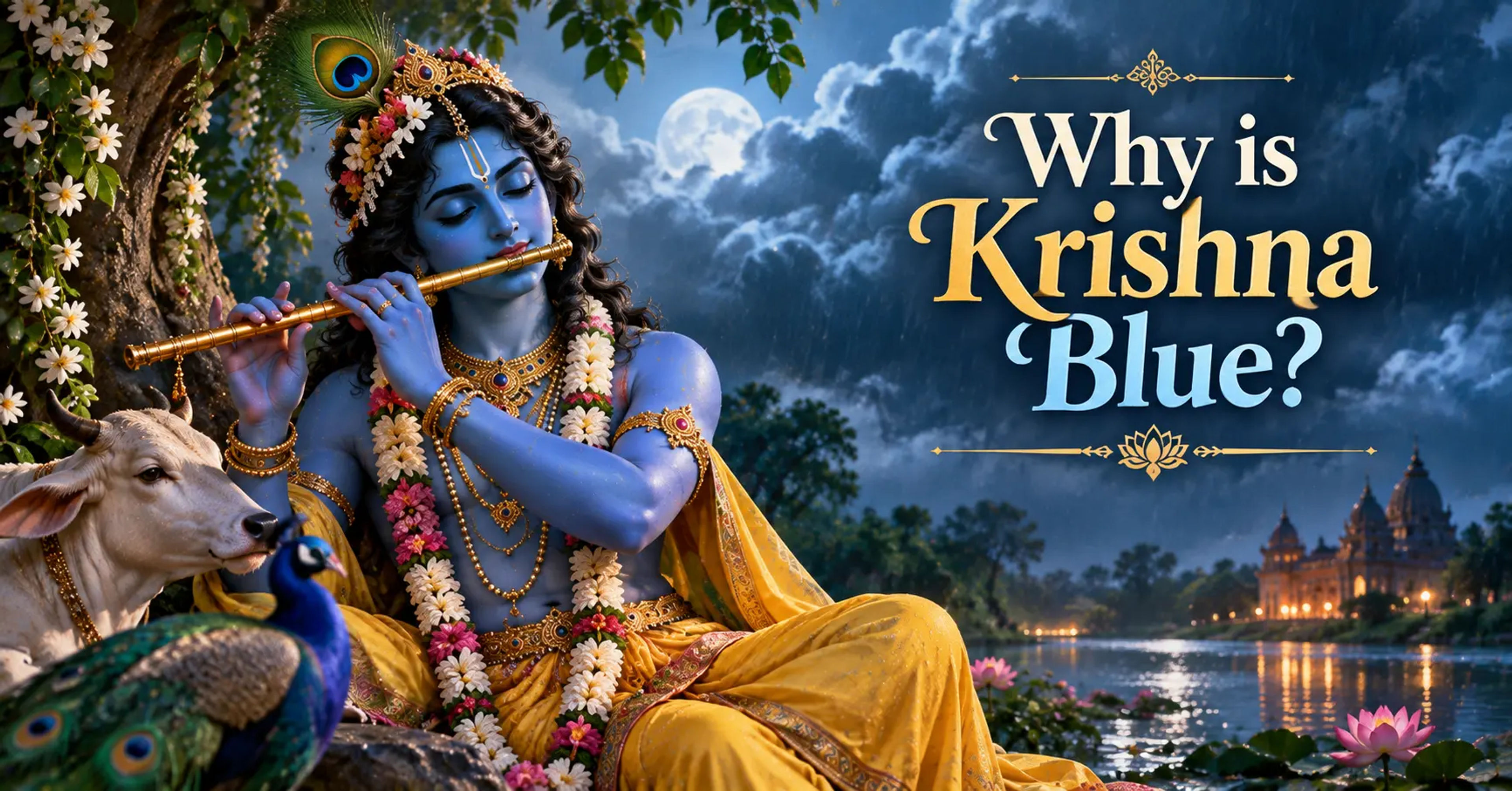
Open any calendar, temple wall, or phone wallpaper and Krishna is almost always the same striking colour: a deep, glowing blue. Yet if you read the older Sanskrit descriptions of him, you won’t actually find the word “blue” used the way we use it today. So where does the blue come from, and is it accurate to say Krishna was “black” instead?
This article looks at what the scriptures actually say about Krishna’s complexion, what the key Sanskrit word for it really means, and how that description turned into the blue we see in art today — without treating any one explanation as the final word.
Table of contents
Key takeaways
- Scriptures describe Krishna’s complexion as shyama — a deep, dark colour with a blue-black tone, often compared to a monsoon rain cloud.
- Shyama doesn’t map neatly onto one modern colour word, which is why translators use dark, dusky, blackish, and blue almost interchangeably.
- “Black or blue” is a bit of a false choice — both are imperfect modern translations of the same traditional description.
- The bright, solid blue seen in most art today is largely an artistic and devotional convention that developed over centuries, not a line copied word-for-word from scripture.
The Quick Answer
Krishna is not described in scripture as having flat, sky-blue skin the way he is often painted. He is described as shyama-varna — of a dark complexion with a blue-black quality, resembling a fresh rain cloud. Artists over many centuries chose to render that cloud-dark description using blue pigments, and that convention is now the most recognisable way Krishna is shown. So the short version is: dark by scripture, blue mostly by artistic tradition.
What Scriptures Actually Say
Krishna’s own name is a clue. In Sanskrit, kṛṣṇa itself is a colour word meaning dark or black, used for the deep colour of night or a dark, fertile field. Texts such as the Mahabharata and the Srimad Bhagavatam describe Krishna using terms like shyama-varna (of a shyama complexion) and ghana-shyama (dark like a dense cloud).
The Srimad Bhagavatam also compares his complexion to nilotpala-dala — the petals of a blue lotus — and other Vaishnava texts, including the Brahma-samhita, describe him in relation to a bluish rain cloud. None of these are casual, throwaway lines; they recur across different texts and periods, which is part of why this description became so central to how Krishna is understood and later depicted.
It’s worth being precise here: these are traditional textual descriptions, not a modern clinical description of skin tone. Ancient Sanskrit colour vocabulary worked differently from the fixed colour categories we use today, which is exactly why this topic needs a careful look at the actual words used, rather than a straight translation.
What Does Shyama Mean?
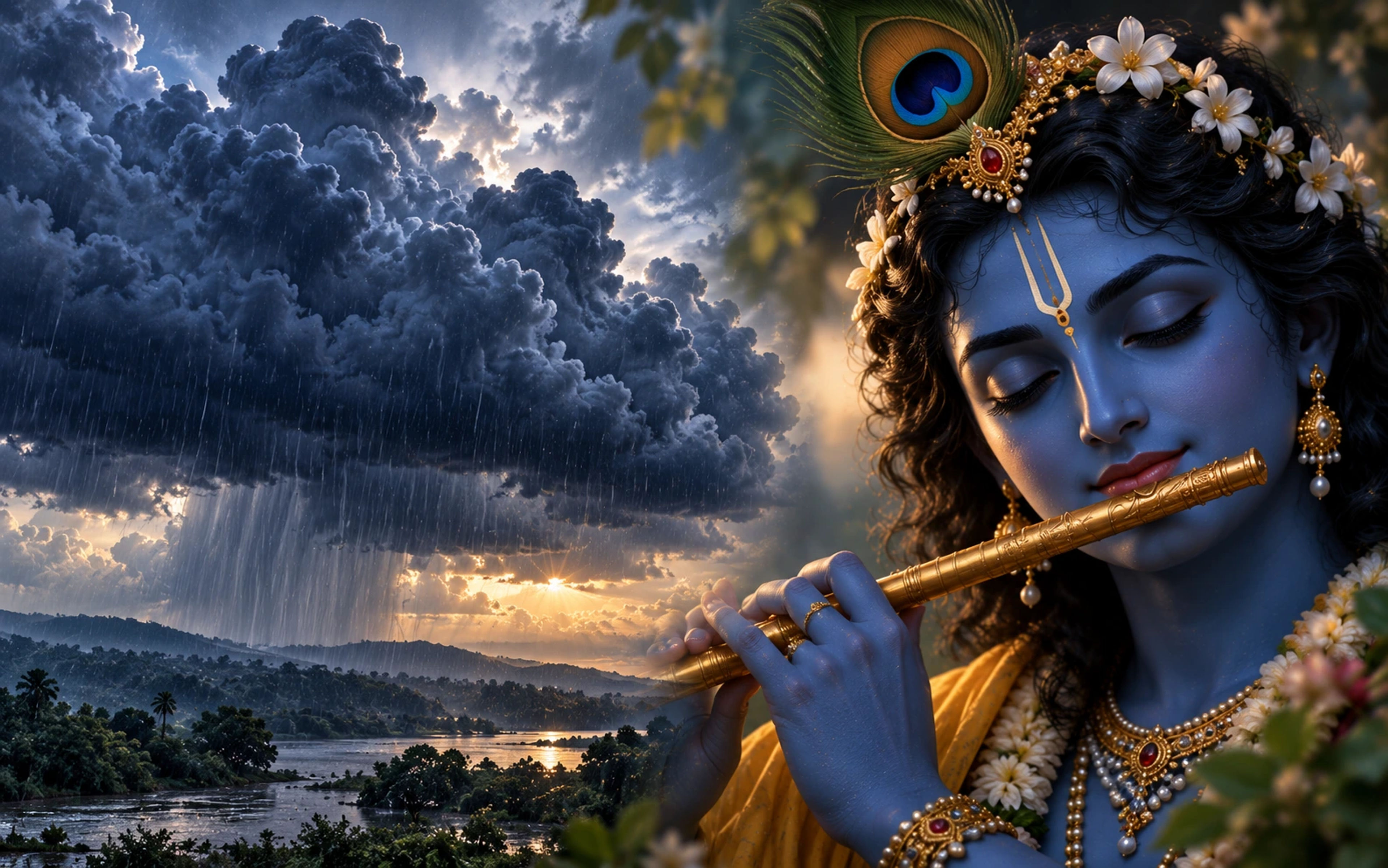
Shyama (श्याम) is the Sanskrit word doing most of the work in this discussion, so it deserves a closer look. It generally refers to a deep, dark colour with a bluish or blackish cast — the kind of colour you see in a heavy rain cloud, deep water, or the night sky. Some classical Sanskrit lexicons even list shyama alongside both green and krishna (dark/dark-blue) as related shades, which shows the word was never meant to point to one narrow, fixed colour.
Because of this, English translations of shyama vary quite a bit depending on the translator and the context: dark, dusky, blackish, dark-blue, and blue all appear in different translations of the same texts. None of these English words is a perfect match; each one is simply an attempt to carry across a colour concept that Sanskrit described differently from how English does.
This is also where the popular epithet Ghanshyam (or Ghana-shyama) comes from — literally “dense shyama,” used to mean dark and dense like a rain cloud. It’s one of Krishna’s well-known names and reinforces the same rain-cloud imagery found across the scriptures.
Why Compare Krishna to a Rain Cloud?
The rain-cloud comparison isn’t just about colour. In many parts of India, especially in Krishna’s own pastoral region of Braj, the monsoon cloud is a welcome, life-giving sight after a long dry season — it brings relief, water, and renewal. Comparing Krishna to a rain cloud carries that same sense: he is described as dark and beautiful, but also as someone whose presence is nourishing and longed-for, much like the monsoon itself.
Some traditional accounts also connect Krishna’s birth to the monsoon season, adding another layer to why the cloud comparison felt natural to the people who first told and retold these stories. Read this way, the rain-cloud imagery works on two levels at once — a description of colour, and a symbol of Krishna as a source of comfort and abundance.
So Was Krishna Black or Blue?
This is one of the most commonly asked questions about Krishna, and the honest answer is that it isn’t a clean either/or. “Black” and “blue” are both modern English words being used to translate shyama, a Sanskrit colour concept that already blended dark and blue-black together. Choosing one word over the other says more about translation than about a firm, agreed physical description.
Some devotional writers lean toward “blackish-blue” to keep both aspects of shyama intact, while others simply say “dark” to avoid picking a specific hue at all. What most traditional sources agree on is the underlying idea: a deep, striking, cloud-like darkness, not a plain black and not the flat, bright blue often seen in mass-printed images.
It’s also worth resisting the urge to force this ancient description into a modern racial or skin-tone category. Sanskrit colour words like shyama were built around natural references — clouds, lotuses, night sky — not around a fixed chart of human skin shades, so reading them as a literal, photograph-style description misses how the language actually worked.
Why Artists Paint Krishna Blue
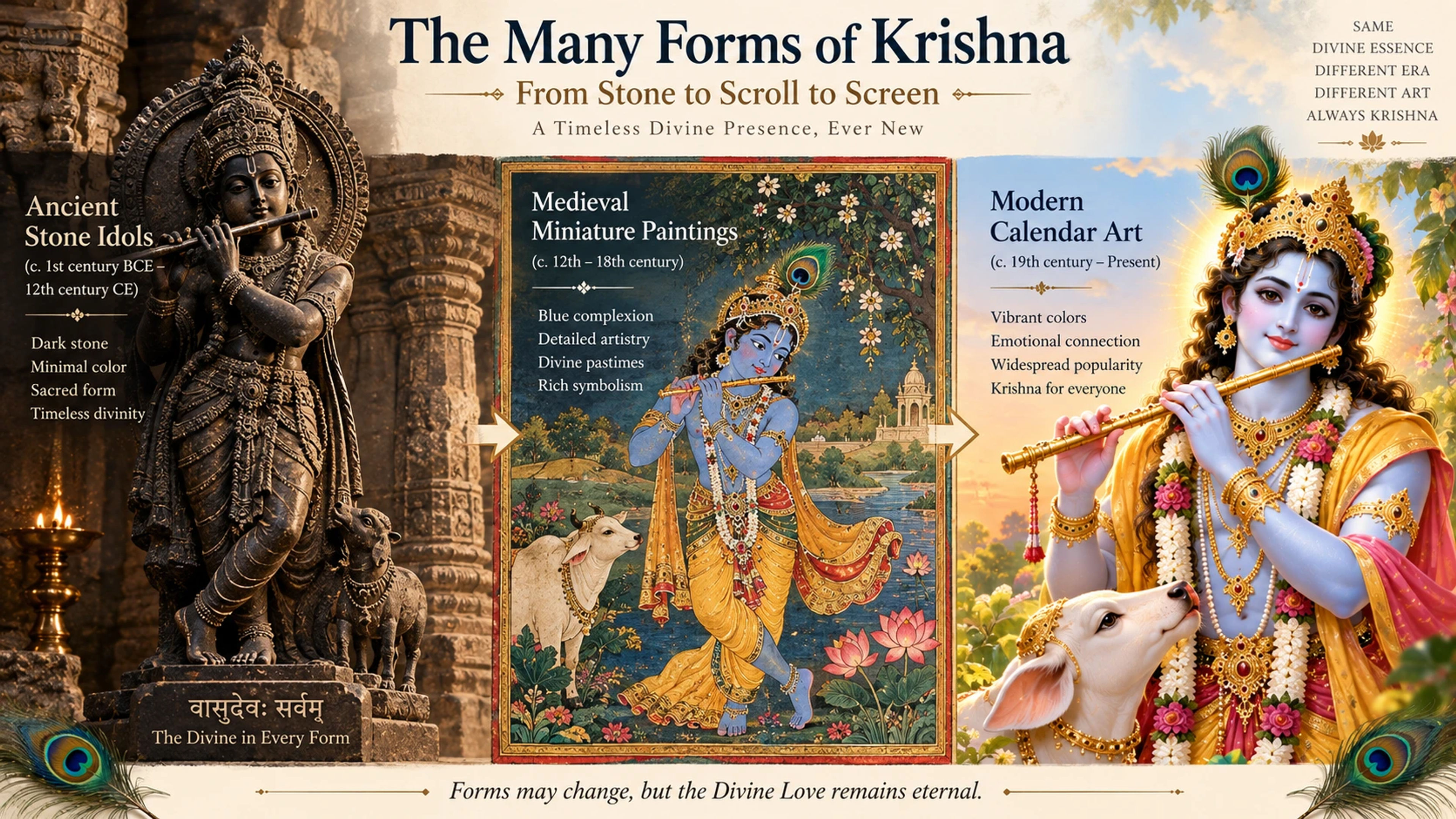
The earliest Krishna imagery, including temple sculpture from around the Gupta period onward, generally used dark stone, so Krishna appeared visually black rather than blue. Some very old traditions continue this: the deity at the Jagannath Temple in Puri, for instance, is still shown in black to this day.
The shift many art historians point to happened later, roughly from around the 10th–11th century onward, as Krishna began appearing in Jain and then Hindu miniature paintings, and later in Pahari and Mughal-era art. A few practical and symbolic reasons are commonly discussed for why blue became the preferred pigment over plain black:
- Flat black pigment can flatten facial detail and mood in a painting, while blue allowed artists to suggest depth, form, and a glowing quality.
- Blue was already strongly associated in Indian thought with the sky and the ocean — both vast, deep, and hard to fully take in, which suited a deity considered limitless.
- Painters were working from the same textual imagery of “dark rain clouds” and “blue lotus petals,” and blue pigment was a natural way to render that description on paper or cloth.
Over centuries, this became such a consistent convention across regional painting schools that it eventually stood on its own as devotional imagery — and it was later reinforced further by the widely circulated calendar art and oleograph prints of the 19th and 20th centuries, which standardised the blue Krishna many people picture today.
It’s important to be clear that this artistic development, however meaningful, is a later interpretive layer on top of the scriptural description — not a line lifted directly from any scripture itself.
What the Blue Is Believed to Symbolise
Beyond the historical explanation, many devotees and teachers within Vaishnava tradition also read symbolic meaning into Krishna’s dark-blue complexion. These are devotional interpretations rather than direct scriptural statements, and different teachers emphasise different aspects:
- The infinite sky and ocean — both appear blue at a distance despite having no real colour of their own, which some see as a fitting comparison for a deity described as limitless.
- Depth and mystery — a dark, deep colour is often used to suggest something that can’t be fully measured or fully seen, matching how Krishna is described in Vedantic thought.
- All colours combined — some Gaudiya Vaishnava commentators describe shyama as a composite colour formed when all colours blend together, symbolising that Krishna contains every attractive quality within himself.
- Life-giving abundance — carried over from the rain-cloud comparison, the colour also evokes relief, nourishment, and renewal.
These interpretations are worth knowing, but they sit clearly in the category of devotional symbolism and commentary — not as claims that a specific verse spells out each of these meanings in so many words.
Scripture vs Interpretation vs Art, at a Glance
Because this topic mixes several different kinds of sources, it helps to see them laid out separately rather than blended together.
| Layer | What it says | Example |
|---|---|---|
| Scriptural description | Krishna has a shyama complexion, compared to a rain cloud or a blue lotus | Srimad Bhagavatam, Mahabharata |
| Translation | Shyama rendered as dark, dusky, blackish, or blue depending on the translator | English editions of Vaishnava texts |
| Devotional symbolism | Dark/blue linked to infinity, depth, and abundance | Commentaries and teachings within Vaishnava tradition |
| Artistic convention | Bright, solid blue pigment used to depict Krishna’s form | Miniature paintings, calendar art, modern illustrations |
Krishna’s Colour and Krishna Naam
Understanding this background can actually make chanting Krishna’s names feel richer. When devotees do Krishna Naam Jaap, many find it natural to hold an image of his form in mind — his dark, cloud-like beauty, his flute, his gentle smile — as a way of staying connected to the name being repeated. The exact shade isn’t the point; what matters is the sincerity of remembrance behind each repetition.
If you’re exploring Krishna Naam as part of a regular practice, it can help to read a bit more on what Naam Jaap actually means and its benefits and how to begin a simple daily Naam Jaap practice as a beginner. Many devotees who chant Krishna Naam also explore Radha Naam Jaap alongside it, since Radha and Krishna are worshipped together in much of Vaishnava devotion.
In Short
Krishna’s traditional complexion, as described in scripture, is shyama — a deep, dark colour with a blue-black quality, most often compared to a monsoon rain cloud. Neither “black” nor “blue” alone fully captures that word, which is why both appear in different translations. The bright blue seen across Hindu art today grew out of centuries of artistic and devotional tradition built on that description, rather than a single, literal scriptural line. Held together, these layers point to the same idea Krishna’s devotees have carried for centuries: a form as deep, boundless, and beautiful as a monsoon sky.
A note on sources
This article draws on descriptions found in the Srimad Bhagavatam and Mahabharata, traditional Sanskrit lexicons, Vaishnava commentarial tradition, and published art-historical research on Indian miniature and temple painting. Where a point reflects devotional interpretation rather than a direct scriptural statement, it has been described as such above.
Frequently Asked Questions
Was Krishna black or blue?
Neither word fits perfectly on its own. Sanskrit texts describe Krishna's complexion as shyama, a dark hue with a blue-black cast, often compared to a monsoon rain cloud. Depending on the translator, shyama has been rendered as dark, dusky, blackish, or blue — all are attempts to describe the same rain-cloud colour, not four different appearances.
Is Krishna's blue skin mentioned in scripture, or is it only in paintings?
Scriptures such as the Srimad Bhagavatam describe Krishna's complexion using words like shyama and compare it to a fresh rain cloud or a blue lotus. They do not use a modern phrase equivalent to 'blue skin.' The bright, uniform blue seen in calendar art and idols developed later, as artists and devotees found ways to paint that cloud-dark description.
What does the word Shyama mean?
Shyama is a Sanskrit word for a deep, dark colour with a bluish or blackish tone, often used for the colour of rain-laden clouds, the night sky, or deep water. It is not identical to any single modern colour word, which is why English translations of it vary between dark, dusky, dark-blue, and blue.
Why is Krishna compared to a rain cloud?
The comparison, often expressed as megha-shyama or ghana-shyama ('cloud-dark'), points to the deep, saturated colour of a monsoon cloud heavy with rain. In many parts of India, monsoon rain is associated with relief, abundance, and life, so comparing Krishna to a rain cloud also carries a devotional sense of him as nourishing and life-giving, alongside the simple visual comparison of colour.
Why do artists paint Krishna blue instead of black?
There isn't one single confirmed reason, but a few factors are commonly discussed by art historians. Plain black pigment can flatten detail and mood in a painting, while blue pigments could suggest depth and luminosity. Blue is also strongly linked in Indian thought to the sky and ocean, both seen as vast and boundless, which suited a deity considered infinite. Over centuries of miniature and temple art, this artistic choice became the widely recognised convention.
Does this mean Krishna's real complexion is unknown?
Traditional texts don't offer a modern, photograph-like description of complexion, and colour words in Sanskrit don't map neatly onto modern colour categories. What the texts consistently agree on is that Krishna's complexion was strikingly dark and beautiful, compared often to a rain cloud — how exactly to render that in paint has been left to artistic and devotional tradition.
Is there a connection between Krishna's colour and Krishna Naam or chanting?
Devotees often hold an image of Krishna's form in mind while doing Krishna Naam Jaap, and the traditional description of his dark, cloud-like beauty is part of that mental picture in many bhakti traditions. The colour itself isn't a requirement for chanting — what matters in Naam Jaap is sincere remembrance of Krishna, in whatever way his form comes to mind.

Begin your Naam Jaap today
Offline-first and built entirely around one purpose — helping you show up for your practice, every single day.
- Free, always
- Works offline
- No ads