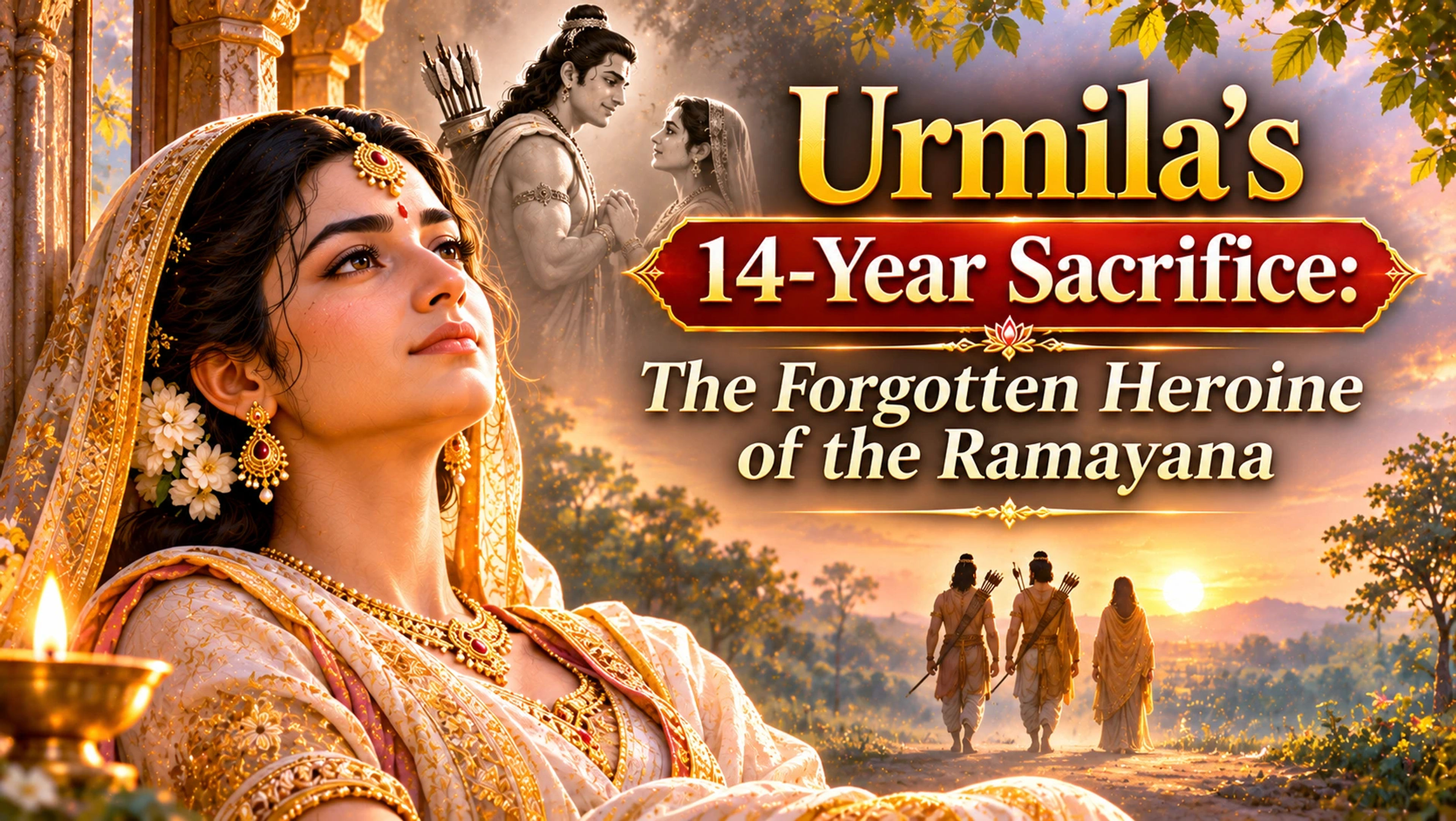
Urmila's 14-Year Sacrifice: The Forgotten Heroine of the Ramayana
Everyone knows that Lakshman left the comforts of Ayodhya to follow Ram into the forest. We praise his loyalty, his strength and his service. But there is a question we rarely ask: who did Lakshman leave behind?
Her name was Urmila. She was a newly married bride when her husband walked away for fourteen years. She did not fight demons or cross oceans. Her sacrifice was quieter, and that is exactly why it is so often forgotten.
Table of contents
Key takeaways
- Urmila was King Janaka's daughter, Sita's younger sister and Lakshman's wife.
- She stayed behind in Ayodhya for 14 years while Lakshman served Ram and Sita in exile.
- The legend of her 14-year sleep comes from folk tradition, not Valmiki's Ramayana.
- Modern writers like Maithili Sharan Gupt gave her a voice in works such as Saket.
Who Was Urmila?
Urmila was the daughter of King Janaka of Mithila and the younger sister of Mata Sita. When Ram broke Shiva's bow and won Sita's hand, Janaka arranged for all four sons of Dasharatha to marry into his family. Urmila was married to Lakshman, on the same day that Sita married Ram.
So the two sisters left Mithila together as new brides and arrived in Ayodhya together. They expected to build their lives side by side. Within a short time, that dream was gone.
The Morning Everything Changed
When Ram was sent into exile for fourteen years, Sita insisted on going with him. Lakshman, who could never bear to be separated from Ram, decided to go too.
Sita went with her husband. Urmila stayed behind without hers. Think about that for a moment. She was a young bride, married only a short while. Her sister was leaving. Her husband was leaving. And she would not see either of them for fourteen years.
Valmiki's Ramayana says very little about Urmila in this moment. But in the many retellings and folk traditions of India, her side of the story has been told with great love.
Why Urmila Stayed Behind
In popular tradition, Urmila wanted to go to the forest too. Lakshman asked her to stay. His reason was simple and painful: in the forest he wanted to serve Ram and Sita day and night, without distraction. If Urmila came, his attention would be divided.
There was also a family to care for. Ayodhya had just lost its king. Three grieving queens were left in the palace. Someone had to be there for them, and Urmila stayed.
The tears she held back
In some tellings, Lakshman asked Urmila not to cry when he left, so that her tears would not weaken his resolve. She let him go with a calm face and wept only after he was gone.
The Legend of Urmila's 14-Year Sleep
The most famous story about Urmila is not found in Valmiki's Ramayana. It comes from later folk traditions and is especially loved in parts of North and South India.
On the first night of exile, as Lakshman stood guard outside the hut, Nidra Devi, the goddess of sleep, appeared before him. Lakshman asked her for a boon: to stay awake for all fourteen years so that he could protect Ram and Sita every night.
Nidra Devi said the law of nature could not be broken. Someone would have to carry his share of sleep. Lakshman asked her to go to Ayodhya and give it to his wife. When Nidra Devi reached Urmila and explained, Urmila agreed at once. And so, the story goes, she slept for fourteen years so that her husband could stay awake.
Some versions add one more beautiful detail. Meghnad, Ravana's mighty son, had a boon that he could only be defeated by someone who had not slept for fourteen years. So Lakshman's victory over Meghnad was made possible by Urmila's sacrifice.
| Aspect | Valmiki Ramayana | Folk and later traditions |
|---|---|---|
| Her marriage to Lakshman | Mentioned | Mentioned |
| Her feelings during the exile | Not described | Told in detail |
| The 14-year sleep | Not found | Central to her story |
| Link to Meghnad's defeat | Not found | Found in some versions |
The Forgotten Heroine
For centuries, Urmila was barely noticed. Poets sang of Ram's dharma, Sita's courage, Lakshman's loyalty and Bharat's love. Urmila, who lost as much as any of them, was hardly mentioned.
In modern times, writers began to ask why. Rabindranath Tagore wrote about how poets had neglected her. The Hindi poet Maithili Sharan Gupt later wrote the epic poem Saket, which tells the Ramayana from inside the palace of Ayodhya and gives Urmila's longing and strength a voice of its own.
Today, many devotees see Urmila as one of the greatest examples of quiet sacrifice in the whole epic.
What Urmila's Sacrifice Teaches Us
- Not every sacrifice is visible. Lakshman's service is famous. The person who made it possible is often forgotten.
- Staying can be as brave as going. Urmila stayed behind, cared for the family and waited. That took its own kind of courage.
- Love sometimes means letting go. She let her husband follow his dharma, even when it broke her heart.
- Remember the people in the background. In every family there is someone like Urmila, holding things together without asking for credit.
Lakshman stayed awake for fourteen years. Urmila made sure he could.
Urmila's Reunion
When Ram returned to Ayodhya after defeating Ravana, the whole city was lit with diyas. That is the homecoming Diwali celebrates. For Urmila, it was the day her fourteen-year wait finally ended and Lakshman came home.
This Diwali, as you light your lamps for Ram's return, remember the ones who waited for him too: Bharat in Nandigram, the queens in the palace, and Urmila, who gave up fourteen years so her husband could serve his brother.
Honour Their Devotion with Ram Naam
Every sacrifice in the Ramayana was made out of love for Ram and for dharma. Begin your own small practice of devotion with the 13-syllable Ram mantra:
श्री राम जय राम जय जय राम
Shrī Rām Jay Rām Jay Jay Rām
Learn how to chant it on a mala and track your daily jaap with the Divya Marg app. To meet Urmila's husband and his brothers, read the story of Ram, Lakshman, Bharat and Shatrughan.
Who was Urmila in the Ramayana?
Urmila was the daughter of King Janaka of Mithila, the younger sister of Sita and the wife of Lakshman. She married Lakshman on the same day Sita married Ram.
Did Urmila really sleep for 14 years?
The story of Urmila's 14-year sleep is a well-loved folk legend. It is not found in Valmiki's Ramayana, but it is widely told across India as a symbol of her sacrifice for Lakshman.
Why didn't Urmila go to the forest with Lakshman?
In popular tradition, Lakshman asked her to stay so that he could serve Ram and Sita without distraction, and so that someone would care for the grieving family in Ayodhya.
What is the connection between Urmila and Meghnad?
Some folk versions say Meghnad could only be defeated by someone who had not slept for 14 years. Because Urmila carried Lakshman's sleep, he was able to defeat Meghnad. This link is part of folk tradition, not Valmiki's text.
Which book tells Urmila's story?
The Hindi epic poem Saket by Maithili Sharan Gupt is famous for telling the Ramayana with Urmila at its heart, giving voice to her longing and strength.

Begin your Naam Jaap today
Offline-first and built entirely around one purpose — helping you show up for your practice, every single day.
- Free, always
- Works offline
- No ads