Krishna Mantra: Meaning, Benefits, Significance & How to Chant
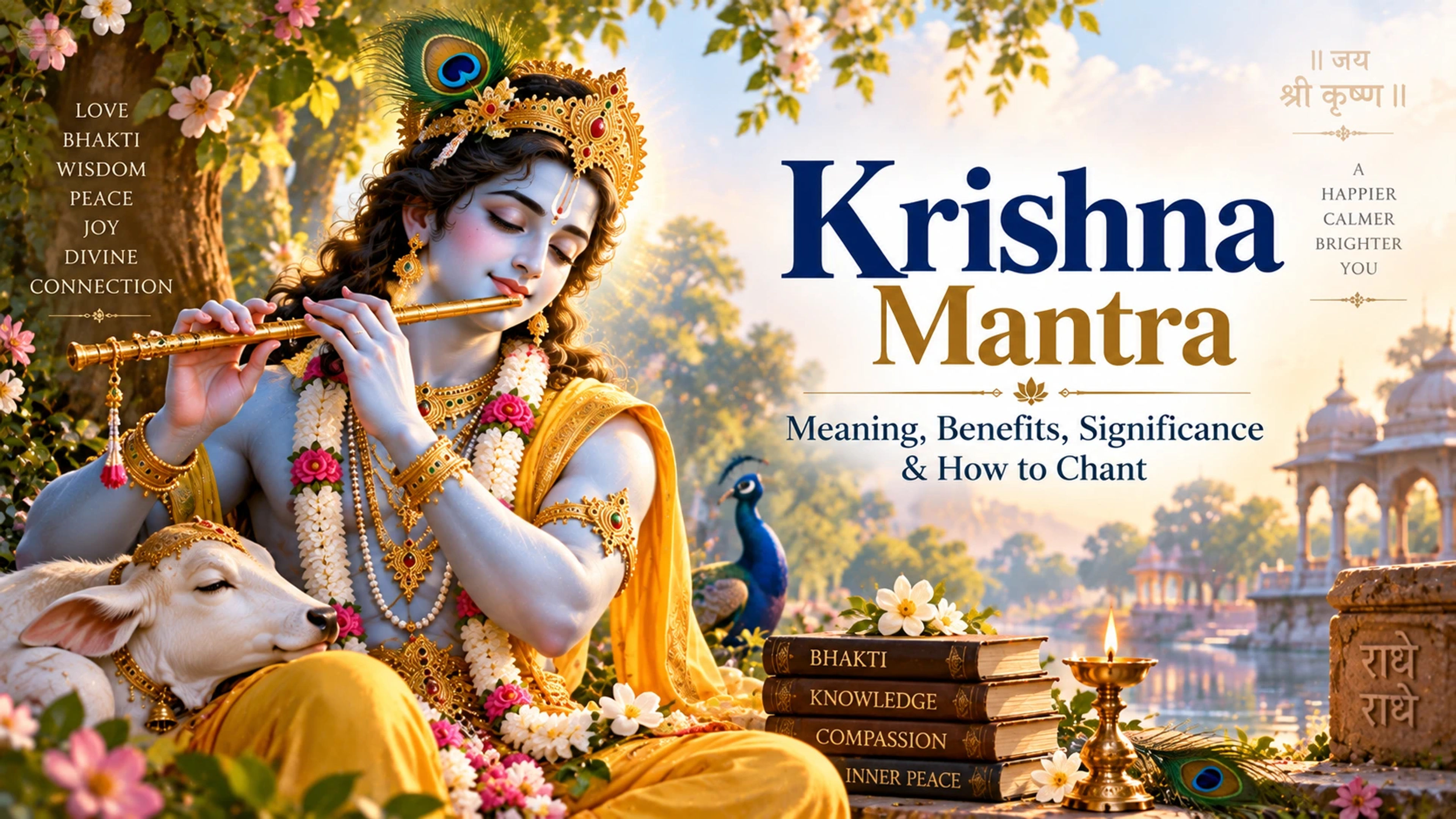
“Krishna Mantra” is not just one chant — it is a family of Sanskrit mantras dedicated to Lord Krishna, each with its own words, meaning and traditional use. Some are short seed mantras, some are prayers for wisdom, and some are simply the loving repetition of Krishna’s names.
This guide covers the Krishna mantras that matter most — what they mean, where they come from, and how a complete beginner can start chanting them the right way, without any confusion or exaggerated claims.
Table of contents
What Is a Krishna Mantra?
A mantra is a sacred sound, word or short verse that is repeated with attention and devotion. A Krishna mantra is any such mantra addressed to Krishna — the eighth avatar of Vishnu, and the central figure of the Bhagavad Gita and Bhagavata Purana. Krishna mantras usually do one of a few things: praise Krishna directly, call on one of his many names (Govinda, Gopala, Madhava, Vasudeva), or ask for his guidance and grace.
Devotees across different Vaishnava traditions — Gaudiya Vaishnavism, Pushtimarg, Nimbarka Sampradaya and others — use Krishna mantras slightly differently, but the underlying idea is the same: repeating Krishna’s name or a mantra dedicated to him as a way of staying connected to him through the day.
Mantra vs Mahamantra vs Prayer vs Naam Jaap
These four words are often used loosely, but they mean slightly different things:
- Mantra — a fixed Sanskrit formula, such as a seed (beej) mantra or a Gayatri-style mantra, usually chanted a set number of times.
- Mahamantra (“great mantra”) — a term specifically used for the Hare Krishna Maha Mantra, a 16-word chant of Krishna and Rama’s names that is open to everyone, with no fixed repetition count.
- Prayer / stotra — a longer devotional composition, often in praise of a deity’s qualities and stories, meant to be recited rather than counted on a mala (for example, a Krishna stotram or Ashtottara Shatanamavali of 108 names).
- Naam Jaap — the simple, repeated chanting of a deity’s name itself (like just saying “Krishna, Krishna” or “Radha Krishna”), without needing a formal mantra structure at all.
This article focuses on Krishna mantras in the first three senses. If you want to understand Naam Jaap as a broader practice, see our guide What Is Naam Jaap? Meaning, Benefits, How to Do It & Daily Practice.
Why Do Devotees Chant Krishna Mantras?
Traditionally, Krishna mantras are chanted for devotional and spiritual reasons rather than for material results. Vaishnava teachings connect this practice with:
- Bhakti (devotion) — building a loving, personal relationship with Krishna.
- Remembrance — keeping Krishna in mind through the day, especially during the Bhagavad Gita’s emphasis on remembering God at the time of action.
- Inner focus and discipline — japa (mantra repetition) is used as a way to steady a wandering mind.
- A regular spiritual habit — a short, repeatable practice that can be done daily, at home, without special equipment.
A note on benefit claims
These are traditional, devotional beliefs held within Hindu and Vaishnava practice — not scientifically verified claims. Chanting is not a guaranteed cure, a promise of wealth or success, or a substitute for medical, financial or professional advice. Many practitioners do find that a short daily practice helps them feel calmer and more centred, but that experience is personal, not a guaranteed outcome.
Important Krishna Mantras at a Glance
There are many Krishna mantras in circulation online, but only a handful are both traditionally significant and genuinely useful for a beginner. Here is a quick overview before we look at each one in detail.
| Mantra | Type | Best for |
|---|---|---|
| Hare Krishna Maha Mantra | Mahamantra | Everyone; no initiation needed |
| Om Kleem Krishnaya Namah | Beej (seed) mantra | Focused bhakti practice; often taken via initiation |
| Om Namo Bhagavate Vasudevaya | Gopal / Dvadashakshari mantra | Daily surrender-focused chanting |
| Krishna Gayatri Mantra | Gayatri-style mantra | Seeking clarity, guidance, wisdom |
| Govinda / Hare Govinda | Name chant | Simple, joyful daily chanting |
| Om Radha Krishnaya Namah | Devotional mantra | Devotees of Radha-Krishna together |
1. Hare Krishna Maha Mantra
ॐ हरे कृष्ण हरे कृष्ण कृष्ण कृष्ण हरे हरे । हरे राम हरे राम राम राम हरे हरे ॥
Hare Krishna Hare Krishna, Krishna Krishna Hare Hare / Hare Rama Hare Rama, Rama Rama Hare Hare
This is the most widely known Krishna-related chant in the world, closely associated with Gaudiya Vaishnavism and the Hare Krishna movement (ISKCON). It is called a Mahamantra — a “great mantra” — rather than a beej mantra, because it is simply a loving call of Krishna and Rama’s names, with no fixed repetition count and no initiation required to begin.
Because this mantra deserves full treatment on its own, we have covered its complete lyrics, word-by-word meaning and chanting method in a dedicated article: Hare Krishna Mahamantra: Lyrics, Meaning, Significance & How to Chant. The rest of this guide focuses on the other major Krishna mantras.
2. Krishna Beej Mantra
ॐ क्लीं कृष्णाय नमः
Om Kleem Krishnaya Namah
This short mantra is built around Kleem, one of the bija (seed) syllables used across several Sanskrit mantra traditions. Kleem is associated with attraction, love and devotion, and it is closely linked with Krishna, who is often described as the “all-attractive” form of God. Some sources connect this bija to Krishna-focused Upanishadic and tantric literature; because such attributions vary between schools, treat the exact textual source as a traditional claim rather than a settled fact.
| Om | The primordial, universal sound. |
| Kleem | Seed syllable of divine attraction and love. |
| Krishnaya | “To Krishna” / “unto Krishna.” |
| Namah | “I bow” / “I offer salutations.” |
Simple meaning: “I bow to Krishna, the all-attractive Lord of love.” In several traditions, beej mantras like this one are meant to be received from a teacher (guru) at initiation for serious, structured sadhana. In everyday practice today, it is also widely chanted informally by devotees as a short, loving salutation to Krishna.
3. Gopal Mantra — Om Namo Bhagavate Vasudevaya
ॐ नमो भगवते वासुदेवाय
Om Namo Bhagavate Vasudevaya
This is one of the most important Vaishnava mantras and is often called the Dvadashakshari Mantra (the “twelve-syllable mantra”). It is associated with the Vishnu Purana and Bhagavata Purana, and addresses Krishna in his form as Vasudeva — literally, “the one who dwells in all things, and in whom all things dwell.” It is also referred to as the Gopal Mantra in some Krishna-devotional traditions.
Simple meaning: “I bow to the divine, all-pervading Lord Vasudeva (Krishna).” In Vaishnava tradition, this mantra is described as a mukti (liberation) mantra of deep surrender, and it is one of the most commonly chanted Krishna mantras in daily worship, alongside prayer beads or during evening aarti.
4. Krishna Gayatri Mantra
ॐ देवकीनन्दनाय विद्महे वासुदेवाय धीमहि तन्नो कृष्णः प्रचोदयात्
Om Devakinandanaya Vidmahe Vasudevaya Dhimahi Tanno Krishnah Prachodayat
This mantra follows the well-known Gayatri format — the same three-part structure (“we meditate upon…we contemplate…may that being inspire us”) used for Gayatri mantras dedicated to other deities like Shiva, Durga and Ganesha. Here, it is addressed to Krishna as Devakinandana, “the beloved son of Devaki.”
Simple meaning: “We meditate on the son of Devaki. We contemplate Vasudeva. May that Krishna inspire and illumine our intellect.” Because it asks for guidance and clarity of mind rather than any material outcome, this mantra is popular with people who want a Krishna mantra focused on wisdom and inner direction, similar in spirit to the more universally known Gayatri Mantra from the Rigveda. You may also come across minor variations of this mantra online (for example, versions ending in “Tanno Vishnu Prachodayat”); the form given above is the version most consistently found across devotional and reference sources.
5. Govinda Mantra & the Names of Krishna
Govinda is one of Krishna’s most loved names, traditionally understood as “protector of the cows” or, more broadly, “protector of the senses.” Rather than one single fixed “Govinda Mantra,” you will usually come across Govinda used in two ways:
- As part of longer mantras — for example, the phrase Govindaya (“to Govinda”) appears inside several traditional Krishna mantras.
- As a standalone devotional chant, most famously in the popular kirtan “Govinda Jaya Jaya, Gopala Jaya Jaya”, sung widely in temples and by Krishna devotees. This is best understood as a devotional song (bhajan/kirtan) rather than a classical Sanskrit mantra with a scriptural seed syllable.
For a simple daily practice, many beginners just repeat the name itself — “Govinda, Govinda” or “Hare Govinda” — as a form of Naam Jaap, which needs no special Sanskrit knowledge at all.
6. Radha Krishna Mantra
ॐ राधाकृष्णाभ्यां नमः
Om Radha-Krishnabhyam Namah — “Om, salutations to Radha and Krishna together”
A simpler, very widely circulated version is ॐ राधा कृष्णाय नमः (Om Radha Krishnaya Namah). Both forms honour Radha and Krishna as a single, inseparable divine pair — central to Gaudiya Vaishnavism, the Nimbarka Sampradaya and the Pushtimarg tradition. Radha represents the highest devotion (bhakti) directed toward Krishna, so this mantra is often chanted by devotees who want to honour that loving relationship rather than Krishna alone.
A very simple, popular alternative is the repeated name chant “Radhe Radhe” or “Radhe Krishna” — again, a form of Naam Jaap rather than a formal Sanskrit mantra. If you want to go deeper into Radha-focused practice specifically, see What Is Radha Naam Jaap? Meaning, Significance & How to Practice.
Which Krishna Mantra Should You Chant?
There is no single “correct” mantra for everyone — this depends on your tradition, your teacher (if you have one), and what feels natural to you. As a general, non-prescriptive guide:
- New to chanting? Start with a simple name chant (“Krishna,” “Radha Krishna,” “Govinda”) or the Hare Krishna Maha Mantra.
- Want a short daily surrender practice? Om Namo Bhagavate Vasudevaya is a good, well-established choice.
- Looking for clarity or guidance? The Krishna Gayatri Mantra is traditionally chanted with this intention.
- Interested in a focused seed-mantra practice? Consider learning about Om Kleem Krishnaya Namah from a qualified teacher, since seed mantras are traditionally tied to personal guidance.
If you already follow a specific Vaishnava lineage or have a guru, their instruction should always take priority over any general guide, including this one.
How to Chant a Krishna Mantra
Krishna mantras are simple to start, even for a complete beginner. A few practical points, based on common Vaishnava practice:
- Aloud, softly, or silently — all three are accepted. Beginners often start by chanting aloud or softly (this helps with focus), then move to silent, mental repetition as it becomes familiar.
- Sit comfortably — a clean, quiet space is traditionally preferred, but a Krishna mantra can be chanted anywhere: at home, while walking, or during a commute.
- Morning or evening — many devotees chant early morning (brahma muhurta) or in the evening during aarti, but there is no rule that stops you from chanting at another time that fits your day.
- Consistency over intensity — a short, daily practice is generally considered more valuable than a long session done rarely.
- Pronunciation — aim for clarity rather than perfection. Chanting with sincere attention matters more than getting every Sanskrit sound exactly right, especially for a beginner.
Counting Repetitions & the Number 108
Japa (repeated mantra chanting) is traditionally counted, and the number 108 is the most common count across Hindu mantra practice — which is why a standard japa mala has 108 beads plus one “guru bead.” Different explanations exist for why 108 is significant (astronomical, numerological and symbolic reasons are all offered in different sources), and no single explanation is treated as the only correct one.
Common ways devotees count repetitions include:
- A 108-bead japa mala — the most traditional method, moving one bead per repetition.
- Fingers — counting on the joints of the fingers when a mala is not available.
- Physical clickers/counters — small handheld counters used by some devotees.
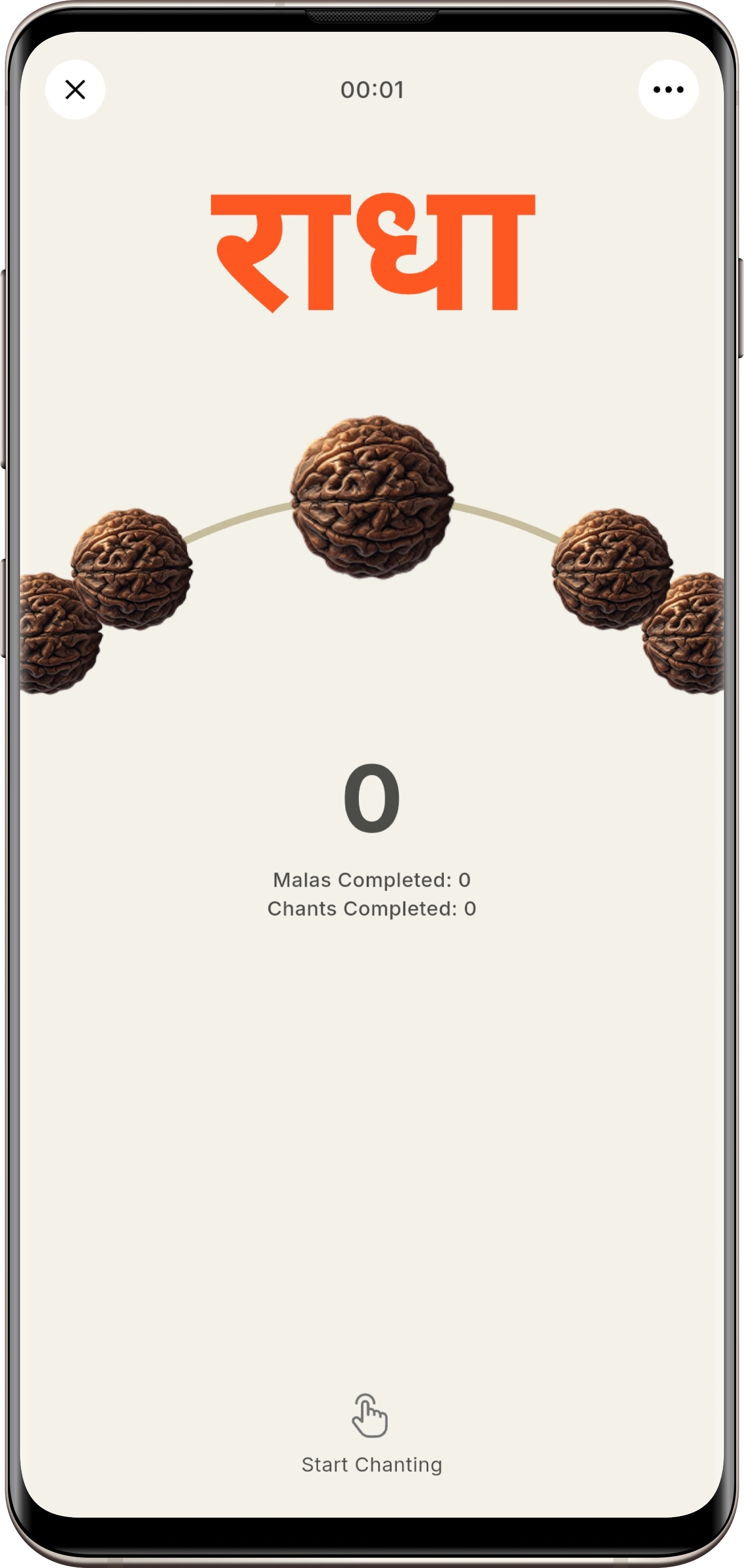
- Digital Jaap counters — mobile apps that count taps or use gentle vibration feedback for each repetition.
Importantly, 108 is not compulsory. Many beginners start with a smaller, comfortable number of repetitions — or a set number of minutes — and build up naturally over time. What matters most is a realistic daily goal you can actually keep, rather than a large number chanted inconsistently.
How Divya Marg Can Help
Once you have chosen a Krishna mantra or name to chant, the next step is simply staying consistent. Divya Marg is a Naam Jaap and mantra-counting app that can help with the practical side of this:
Set your Krishna Naam
Choose 'Krishna,' 'Govinda,' 'Radha Krishna,' or your chosen mantra as your active Naam.
Daily Jaap goal
Set a repetition or round goal that fits your day, and let the app track it.
Haptic bead counting
Feel each repetition through gentle vibration, so your focus stays on the mantra.
Works fully offline
Chant anywhere — at home, on a walk, or while travelling.
Daily reminders
A gentle nudge at a time you choose, to help build the habit.
Simple progress tracking
See your daily chants, completed malas and streak at a glance.
In short: learn a Krishna mantra, start chanting it in a way that feels natural, and use Divya Marg only to help you count repetitions and stay consistent — the practice itself always comes first.

Begin your Naam Jaap today
Offline-first and built entirely around one purpose — helping you show up for your practice, every single day.
- Free, always
- Works offline
- No ads

Frequently Asked Questions
Which Krishna Mantra is best for beginners?
There is no single 'best' mantra for everyone. Many beginners start with a simple name-based practice, such as chanting 'Krishna' or 'Radha Krishna,' or with the widely-known Hare Krishna Maha Mantra, since these do not require initiation. Seed (beej) mantras like Om Kleem Krishnaya Namah are traditionally taken from a teacher.
What does the Krishna Mantra mean?
It depends on which mantra you mean. 'Krishna Mantra' is a general term for several different mantras dedicated to Krishna. Each one has its own Sanskrit meaning — for example, Om Namo Bhagavate Vasudevaya means 'I bow to Lord Vasudeva (Krishna),' while the Krishna Gayatri Mantra is a prayer asking Krishna to guide the intellect.
How should Krishna Mantras be pronounced?
Try to say each Sanskrit syllable clearly rather than rushing the words together. If you are unsure of the pronunciation, listening to a few chants by known Vaishnava singers or teachers alongside the transliteration given in this article can help you get comfortable.
How many times should a Krishna Mantra be chanted?
A common traditional practice is one round of 108 repetitions on a mala, but this is not a fixed rule for every mantra or every person. Many people chant fewer rounds when starting out and increase gradually as it becomes a comfortable daily habit.
Is chanting 108 times necessary?
No. The number 108 is traditionally significant and is why a japa mala has 108 beads, but chanting fewer repetitions — or simply chanting for a few minutes a day — is also a valid and meaningful practice, especially for beginners.
Can Krishna Mantras be chanted without a mala?
Yes. A mala is a helpful tool for counting, but it is not compulsory. You can chant on your fingers, use a simple counter or app, or just chant for a set amount of time without counting at all.
Can Krishna Mantra be chanted daily?
Yes. Most Krishna mantras and the practice of remembering Krishna's names are meant to be part of a regular, daily devotional routine rather than a one-time ritual.
What is the difference between Krishna Mantra and the Hare Krishna Maha Mantra?
'Krishna Mantra' is a broad term covering several mantras — seed mantras, the Gopal mantra, Gayatri-style mantras and more. The Hare Krishna Maha Mantra is one specific, well-known chant of Krishna and Rama's names, open to everyone without initiation. You can read a full, dedicated guide to it here.
Do I need a guru or initiation to chant a Krishna Mantra?
It depends on the mantra. Simple name-based chanting (like 'Krishna' or 'Radha Krishna') and the Hare Krishna Maha Mantra are traditionally open to anyone. Seed (beej) mantras such as Om Kleem Krishnaya Namah are, in many traditions, meant to be received formally from a teacher during initiation (diksha) for serious, structured practice — though the mantra is also widely chanted informally today.