Gayatri Mantra: Lyrics, Meaning, Significance & How to Chant
The Gayatri Mantra is one of the oldest and most widely recited verses in Hindu tradition, chanted daily by millions of people. But its Sanskrit words can feel unfamiliar if you’re coming to it for the first time — what does it actually say, who is it addressed to, and how is it meant to be chanted?
This guide lays out the correct traditional text, a simple word-by-word meaning, where the mantra comes from, and practical guidance for chanting it — while being upfront about where different traditions genuinely differ, instead of presenting one view as the only rule.
Table of contents
Key takeaways
- The Gayatri Mantra comes from the Rigveda (3.62.10) and is addressed to Savitr, a Vedic deity linked with the sun's inspiring light.
- At its core, it's a prayer asking that divine light to awaken and guide the mind — not a request for a specific material outcome.
- Traditional practice around who chants it and when has varied historically; today it's chanted very widely, across backgrounds.
- There's no single mandatory repetition count — 108 is common with a mala, but shorter counts are also normal, especially for beginners.
What Is the Gayatri Mantra?
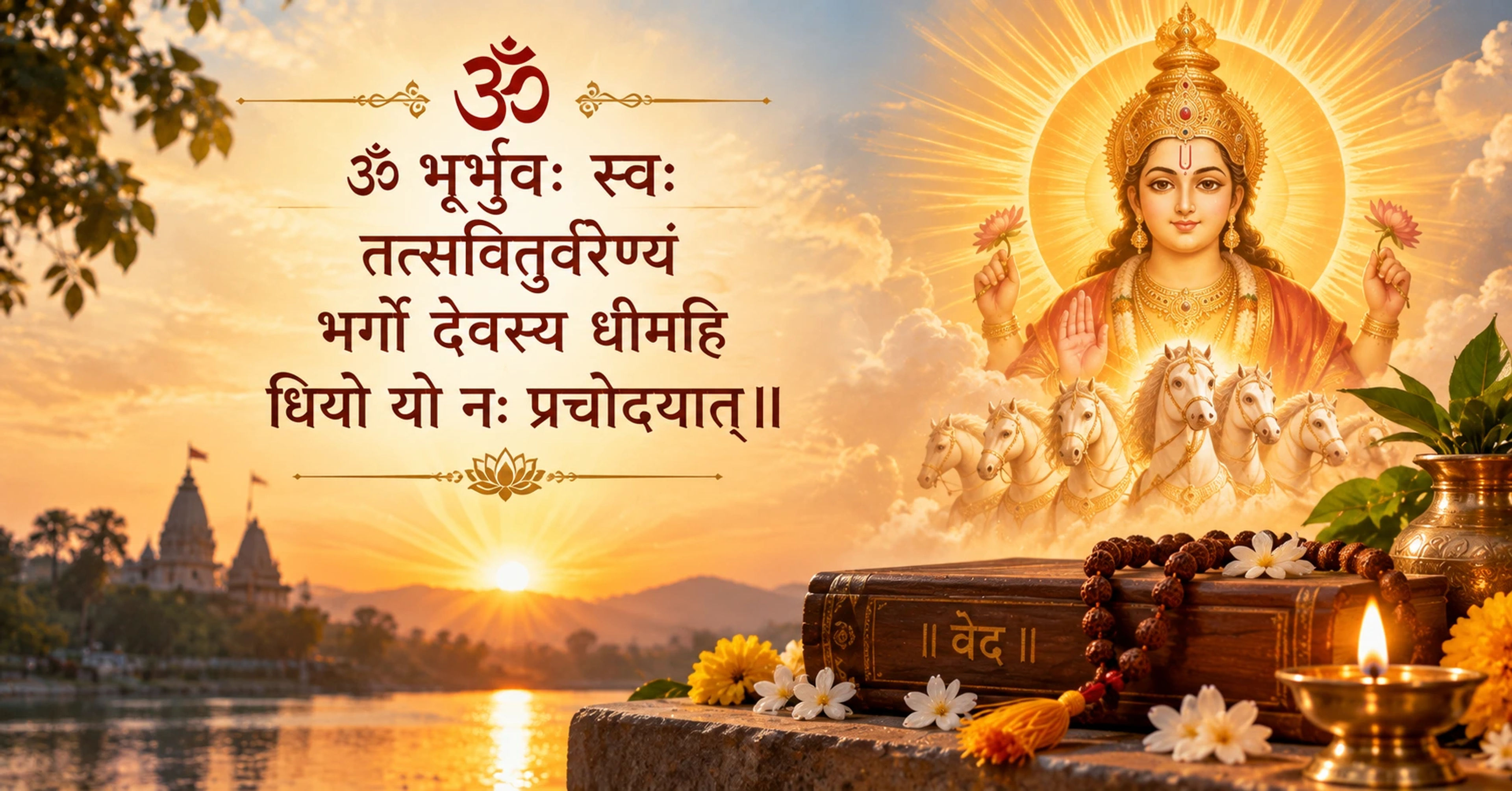
The Gayatri Mantra is a Vedic Sanskrit verse taken from the Rigveda, one of the oldest sacred texts in the world. It is also called the Savitri Mantra, because it is addressed to Savitr, a solar deity described in Vedic literature. The name “Gayatri” actually refers to the poetic metre the verse is written in — a 24-syllable structure, arranged in three lines of eight syllables each — rather than being the deity’s own name.
Because of this, other verses composed in the same gayatri metre can technically also be called “a gayatri,” but when people say “the Gayatri Mantra” without further explanation, they almost always mean this specific verse to Savitr.
The Full Mantra Text
The mantra is traditionally recited together with an introductory phrase called the mahavyahriti — Om, followed by bhur, bhuvah, svah — before the verse itself begins.
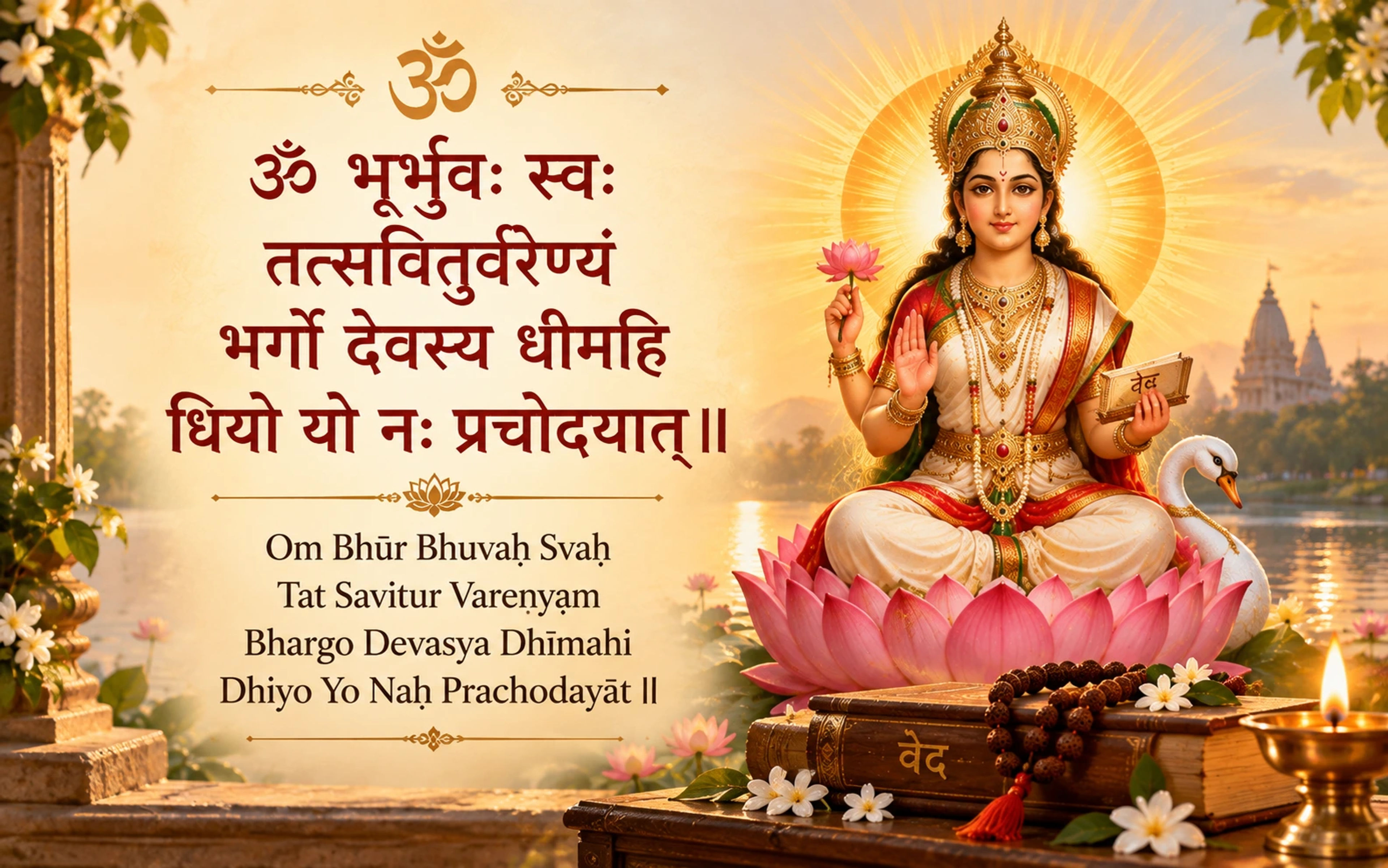
ॐ भूर्भुवः स्वः
तत्सवितुर्वरेण्यं
भर्गो देवस्य धीमहि
धियो यो नः प्रचोदयात्
Oṃ bhūr bhuvaḥ svaḥ
tat savitur vareṇyaṃ
bhargo devasya dhīmahi
dhiyo yo naḥ prachodayāt
A simpler, non-diacritic transliteration, easier to read for most English readers, looks like this:
Om bhur bhuvah svah, tat savitur varenyam, bhargo devasya dhimahi, dhiyo yo nah prachodayat.
This is the verse recorded as Rigveda 3.62.10, part of a section of the Rigveda traditionally attributed to the sage Vishvamitra. The mahavyahriti (bhur bhuvah svah) that precedes it is not part of the original Rigvedic verse itself; it is a later Vedic addition, described in texts such as the Taittiriya Aranyaka, that became a standard part of how the mantra is recited.
Word-by-Word Meaning
A word-by-word look can help make the Sanskrit feel less unfamiliar, though it's worth remembering that a word-for-word list doesn't fully capture the depth traditional commentators find in this verse.
| Word | Simple meaning |
|---|---|
| Om | A sacred sound, traditionally chanted before Vedic recitation |
| Bhur, Bhuvah, Svah | The three vyahritis — traditionally understood as the earthly, atmospheric, and celestial realms |
| Tat | “That” — pointing to the divine being described next |
| Savitur | Of Savitr, the deity linked with the sun's inspiring, life-giving light |
| Vareṇyam | Worthy of worship, excellent, or most desirable |
| Bhargo | Radiance, glory, or light |
| Devasya | Of the divine, of that shining being |
| Dhīmahi | Let us meditate on, or let us contemplate |
| Dhiyo | Our thoughts, intellect, or understanding |
| Yo | Who, referring back to that divine light |
| Naḥ | Our |
| Prachodayāt | May it inspire, awaken, or direct |
What the Mantra Means, in Simple Terms
Put together in plain English, the verse is usually understood along these lines: “Let us meditate on the wondrous, worshipable light of Savitr, the divine source; may that light inspire and awaken our understanding.”
Different scholars phrase this slightly differently — some emphasise Savitr as a solar deity in a fairly literal Vedic sense, while some later Vedantic commentators, such as those writing on the Shvetashvatara and Maitri Upanishads, read Savitr more philosophically, as a name pointing toward Brahman, the ultimate reality, using the sun as a symbol for that illuminating awareness rather than a claim about the mantra's meaning being only literal sun-worship.
Both readings sit within genuine, long-standing Hindu traditions of interpreting this verse. What they share is the mantra's central request: for light, in the sense of wisdom and clarity, to guide and awaken the mind.
Where the Mantra Comes From
The Gayatri Mantra is recorded in the Rigveda, Mandala 3, hymn 62, verse 10 — a section of the Rigveda traditionally associated with the sage Vishvamitra. It is counted among the oldest verses regularly chanted in Hindu practice today, and it is referenced and praised in several later classical texts, including the Manusmriti, the Harivamsha, and the Bhagavad Gita, which is part of why it holds such a central place across many Hindu traditions.
Its recitation together with Om and the mahavyahriti (bhur bhuvah svah) is described in the Taittiriya Aranyaka, which explains that Vedic recitation was traditionally introduced with Om, followed by the three vyahritis, and then the Gayatri verse itself.
Who Traditionally Chants It
Historically, formal initiation into the Gayatri Mantra was closely tied to the upanayanam ceremony, a rite of passage in which a guru imparted the mantra to a young boy, traditionally marking the start of Vedic study. In many orthodox settings, this ceremony and the mantra itself were specifically associated with Brahmin boys, and some traditional communities continue this practice.
Over time, and especially in the modern era, the Gayatri Mantra has come to be chanted very widely, by people of different backgrounds and by women, often without formal upanayanam-style initiation. Many well-known modern teachers actively encourage this broader practice, treating sincere chanting as more important than a person's formal eligibility under older customs.
Given how much practices differ here, it's fair to say there is no single, universally agreed rule about who may or must chant this mantra — only different traditions with different customs, some stricter and some more open than others.
How to Chant It
Practical chanting guidance also varies a little between traditions, but a few points are widely shared:
- Pronunciation matters to many traditions — Vedic Sanskrit recitation, including proper vowel length and tone, is treated carefully in orthodox practice, so listening to a correct recitation or learning from a knowledgeable teacher can help beginners get the sounds right.
- Sandhya (dawn, noon, dusk) is the traditional timing — with sunrise especially emphasised, though many modern practitioners chant at whatever time suits their day.
- Sitting calmly, facing a comfortable and quiet direction, is the common posture, though there's no single mandatory position.
- It can be chanted aloud in a clear voice, softly to yourself, or silently in the mind, depending on personal practice and setting.
- Steady, unhurried repetition with attention on the meaning is generally considered more valuable than speed.
If you're new to mantra chanting as a daily habit in general, our beginner’s step-by-step guide to Naam Jaap covers the basics of building a simple, consistent routine, which applies well alongside Gayatri Mantra practice too.
Counting Repetitions and the Number 108
The Gayatri Mantra is often chanted using a japa mala with 108 beads, moving one bead per repetition until a full round is complete. This is a widely followed custom, but it isn't the only accepted count. Many people recite the mantra 9, 21, or another smaller number of times as part of a daily routine, especially when starting out.
In other words, 108 is a common and traditional target tied to the standard mala, not a fixed requirement that applies to every person chanting the Gayatri Mantra. Whatever number you choose, a few common ways to keep count include:
- Japa mala — the traditional method, one bead per repetition.
- Physical clicker counter — a small mechanical counter, useful if you'd rather not hold a mala.
- Digital Jaap counter app — counts each tap automatically and can track your progress over time.
For a closer comparison of these three options, see Mala vs Physical Counter vs Digital Jaap Counter.
What Tradition Says About Its Significance
Within Hindu tradition, the Gayatri Mantra is regarded as a prayer for wisdom, clarity, and spiritual insight, and it is praised across several classical texts as one of the most important Vedic verses. Some devotional and modern sources also describe additional benefits, such as calmness of mind or general wellbeing, associated with regular recitation.
These are traditional and devotional teachings, held as matters of faith and practice within Hindu communities — they are not scientific claims, and chanting the mantra is not presented in scripture as a guaranteed fix for wealth, health, or specific life problems. It's best understood the way its own tradition frames it: a sincere prayer for insight and awakening, repeated with attention and respect.
If you'd like to understand mantra-based practice more broadly, our guide on what Naam Jaap means and how it's traditionally practised is a helpful companion read.
Keeping Count with a Digital Jaap Counter
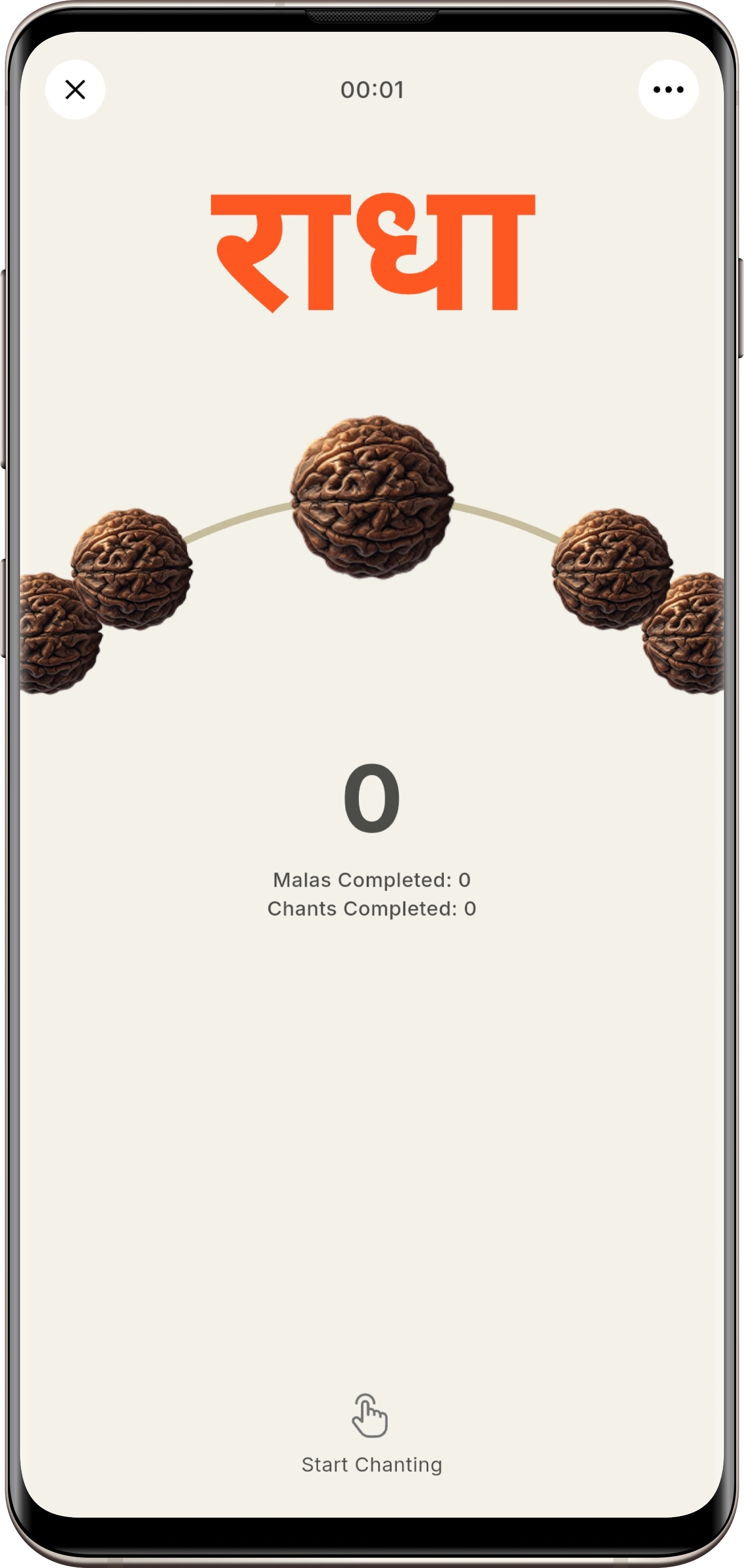
Once you've decided how you'd like to chant the Gayatri Mantra, keeping a simple count can help turn it into a steady daily habit. A digital Jaap counter like Divya Marg is built for exactly this — it counts each repetition as you tap or press a button, so you can stay focused on the mantra instead of keeping the number in your head.
It works well whether you're chanting a full mala's worth of repetitions or a shorter daily count, and it fits alongside a physical mala just as easily as on its own. The tool is simply there to support whatever chanting routine you choose to build.
Frequently Asked Questions
What is the Gayatri Mantra?
The Gayatri Mantra is a Vedic Sanskrit verse from the Rigveda (3.62.10), addressed to Savitr, a Vedic solar deity associated with the light that inspires and awakens. It is named after the gayatri metre it is composed in, and is one of the most widely recited mantras in Hindu tradition.
What does the Gayatri Mantra mean?
In simple terms, the mantra is a prayer asking the divine light of Savitr — often understood as the light of wisdom and understanding — to inspire and awaken the mind. A common rendering is: 'Let us meditate on the wondrous light of that source (Savitr), worthy of worship; may it inspire our understanding.' Different scholars and traditions phrase this slightly differently, so it's worth reading a few translations rather than treating one English sentence as final.
Who is Savitr?
Savitr is a solar deity described in the Rigveda, often connected with the sun's light just before and around sunrise. He is sometimes treated as the same as Surya, the sun god, and sometimes as a distinct aspect representing the sun's vivifying, awakening power rather than the physical sun itself.
Can anyone chant the Gayatri Mantra, or is initiation required?
Practices differ. Traditionally, the mantra was formally imparted by a guru to young Brahmin boys during the upanayanam ceremony, and some orthodox traditions still follow this. In modern practice, however, the Gayatri Mantra is very widely chanted by people of all backgrounds without formal initiation, and many teachers today encourage sincere chanting by anyone who wishes to. If formal initiation matters to you personally, it's worth asking a teacher from your own tradition rather than assuming one universal rule applies to everyone.
What is the best time to chant the Gayatri Mantra?
Traditionally, it is recited during sandhya — the transitional points of the day, namely dawn, midday, and dusk — with dawn being especially emphasised. That said, many people today chant it at whatever time fits their routine, and there's no scriptural rule that forbids chanting it at other times.
How many times should the Gayatri Mantra be chanted?
There's no single number required of everyone. A common traditional practice is chanting it in multiples related to a mala, often 108 times, but shorter counts such as 9 or 21 repetitions are also common in daily practice. Beginners can start with a small number and build up as the habit becomes steady.
Can the Gayatri Mantra be chanted without a mala?
Yes. A mala is a traditional and popular way to count repetitions, but it isn't compulsory. Counting on fingers, using a physical clicker counter, or using a digital Jaap counter app are all commonly used alternatives.
Can women chant the Gayatri Mantra?
Historically, formal initiation into the mantra through the upanayanam ceremony was largely restricted to Brahmin boys, but this has changed considerably over time. Today, the Gayatri Mantra is chanted by many women and by people across different backgrounds, and numerous modern teachers actively support this wider practice.

Begin your Naam Jaap today
Offline-first and built entirely around one purpose — helping you show up for your practice, every single day.
- Free, always
- Works offline
- No ads