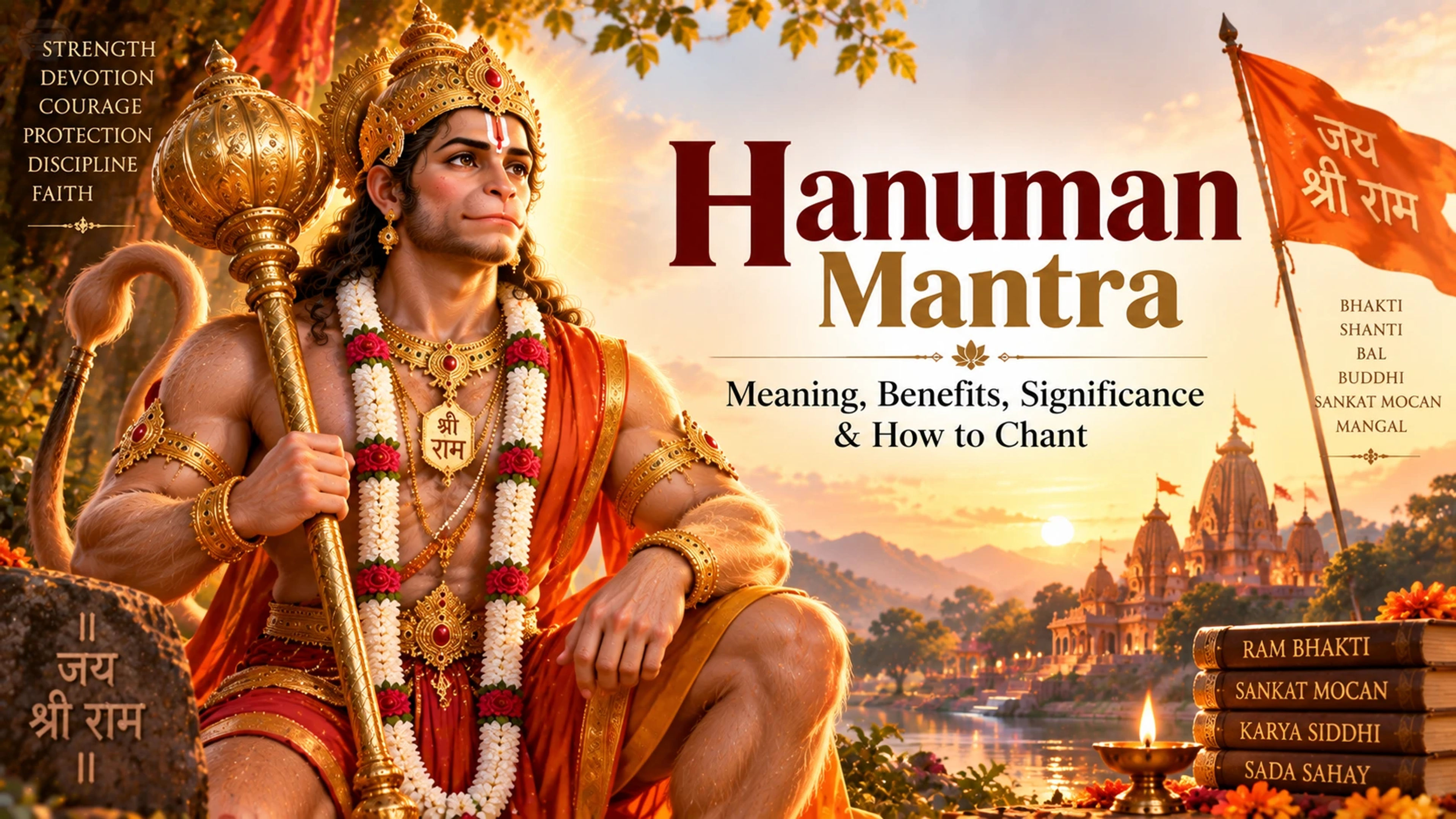
Why Did Hanuman Bring the Entire Mountain Instead of Just Sanjeevani?

The war in Lanka is at its darkest hour. Lakshmana lies motionless on the battlefield, and Hanuman has been sent across the sky to bring a life-giving herb from the Himalayas. He reaches the mountain, which is full of glowing plants, and he cannot tell which one he was sent for. So he does something no one expected: he lifts the whole mountain.
So why did Hanuman bring the entire mountain? In the Valmiki Ramayana, the answer is simple and practical. He could not identify the herbs, and there was no time to waste. In one episode the herbs even seem to hide from him. The rest of this article follows the story step by step, separates what the text says from what later tellings add, and looks at why this small decision has meant so much to devotees.
Table of contents
Key takeaways
- In Valmiki's Ramayana, Hanuman carries a mountain peak because he cannot identify the herbs, and time is short.
- Valmiki describes two mountain episodes, one after Indrajit's Brahmastra and one after Ravana's Shakti weapon strikes Lakshmana.
- The Ramcharitmanas tells the story differently, with Sushena of Lanka, Kalanemi and a meeting with Bharata, details not found in Valmiki.
- The idea of devotion as practical problem-solving is an interpretation drawn from the story, not a line from the ancient text.
The Battle in Lanka: Why Lakshmana Needed Help
Many people remember a single event, Lakshmana struck down and Hanuman rushing to save him. In fact, the Valmiki Ramayana describes two separate occasions in the Yuddha Kanda, the book of war, where Hanuman brings healing herbs. Knowing the difference makes the story far clearer.
The first comes in sarga 74 of the Yuddha Kanda. Indrajit, Ravana's son, releases the Brahmastra, a missile of Brahma, and Rama and Lakshmana fall unconscious along with a vast part of the vanara army. Sugriva, Nila, Angada and Jambavan do not know what to do.
The second is in sarga 101. Here Ravana himself strikes Lakshmana with a spear-like weapon called a Shakti, and Lakshmana falls, bleeding heavily. Rama, shaken, calls the vanara physician Sushena.
Two episodes, one memory
Popular memory often merges these into one story. In Valmiki's text they are separate events with different causes. In the Ramcharitmanas, the story is shaped differently again, as explained below.
Hanuman's Mission to Find Sanjeevani
In sarga 74, it is the aged Jambavan, son of Brahma, who gives the instruction. Vibhishana finds him wounded on the battlefield, and Jambavan's first question is whether Hanuman is alive. If Hanuman lives, he says, the army is not truly lost. He then tells Hanuman to cross the ocean to the Himalayas and look for the peaks of Rishabha and Kailasa. Between them stands a mountain of herbs, glowing in the night.
Jambavan names four herbs on its summit: Mritasanjivani, which restores the dead to life, Vishalyakarani, which removes weapons and heals the wounds they cause, Suvarnakarani, which restores the body's natural colour, and Sandhani, which joins broken parts. This is worth noticing. The famous Sanjeevani is one of several herbs, not the only one.
In sarga 101, Sushena sends Hanuman back to the same herbal mountain, which the text calls Mahodaya or Oushadhi, with Vishalyakarani as the herb the situation requires. The urgency is plain. Delay could cost Lakshmana his life.
Why Did Hanuman Bring the Entire Mountain Instead?
This is the heart of the question, and Valmiki gives a different reason in each episode.
The first time: the herbs disappear
In sarga 74, Hanuman reaches the mountain and starts searching, but the herbs become invisible to him. Summaries of the sarga describe them as hiding once someone begins to look for them, and retellings describe Hanuman as angry at this. He uproots the mountain, or its peak, and carries it back to Lanka. The scent of the herbs is enough: Rama, Lakshmana and the vanaras recover as they breathe it. Hanuman then returns the mountain to the Himalayas.
The second time: he cannot identify the herb
In sarga 101, the reason is more direct. Hanuman reaches the mountain, cannot tell which plant is the one Sushena described, and fears that wasting time will cost Lakshmana his life. He lifts the whole peak and tells Sushena he has brought all of it because he could not identify the herbs. It is a decision made under pressure, and it makes complete sense within the story: a wrong guess could be fatal, while a mountain can simply be handed to someone who knows medicine.
The text does not present this as a failure. Hanuman does not hide his limitation. He states it plainly, and the physician takes over where his own knowledge ends.
What Happened When Hanuman Returned?
In the second episode, Sushena identifies the herb on the peak, prepares it and treats Lakshmana. Lakshmana regains consciousness, and Rama embraces him. The healing is carried out by the physician, which is a detail often lost in popular retelling, where Hanuman seems to save Lakshmana single-handedly.
In the first episode, as noted, the fragrance of the herbs revives the whole army, and the mountain is taken back to the Himalayas. The text takes care to show that the world Hanuman disturbed is restored.
Do All Ramayana Versions Tell the Story the Same Way?
No. The version most families know today, with Sushena brought from Lanka, the demon Kalanemi and a meeting with Bharata, is shaped largely by medieval retellings. Tulsidas's Ramcharitmanas places the story in its Lanka Kand, where Meghanad's Shakti strikes Lakshmana, Sushena is the physician of Lanka, and Hanuman carries the mountain when he cannot identify the herb. The Kalanemi episode, in which the demon tries to delay Hanuman disguised as a sage, appears in many medieval narrations, including the Manas and the Telugu Ranganatha Ramayana, as this overview of Kalanemi in the Ramayana) explains.
| Detail | Valmiki, sarga 74 | Valmiki, sarga 101 | Ramcharitmanas (common retellings) |
|---|---|---|---|
| Who is struck | Rama and Lakshmana, by Indrajit's Brahmastra | Lakshmana, by Ravana's Shakti | Lakshmana, by Meghanad's Shakti |
| Who instructs Hanuman | Jambavan | Sushena, at Rama's request | Sushena, the physician of Lanka |
| Why the mountain | The herbs become invisible | Hanuman cannot identify the herb | Hanuman cannot identify the herb |
| Added details | Mountain is returned afterwards | Sushena treats Lakshmana | Kalanemi and the meeting with Bharata |
Names of the mountain also vary. Valmiki speaks of the herbal mountain between Rishabha and Kailasa, while later tradition often names it Dronagiri. These are differences of tradition, not contradictions to be argued over.
The Deeper Meaning of Hanuman's Decision
The following readings are interpretations. They are not stated in the ancient verses.
The first is responsibility. Hanuman treats the mission as his own, and when the original plan fails, he looks for another way to fulfil it instead of returning empty-handed. The second is humility. By admitting that he could not identify the herb, he hands the final step to the one who can, which many devotees read as the mark of a servant who cares more about the outcome than about being the hero.
The third is devotion in a practical form. Hanuman's love for Rama shows up not in speeches but in action under pressure. Traditional storytellers often connect this to Hanuman's constant remembrance of Ram's name. Readers who would like to begin a simple chanting practice can explore our Naam Jaap without a mala guide.
What We Can Learn From the Sanjeevani Episode
Most of us face moments when the instructions are unclear and the clock is running. The story suggests a calm approach: do what is within your power, be honest about what you do not know, and bring the right people into the work. A good answer is sometimes bigger and messier than the one you were asked for, and still the right one if it saves what matters.
Conclusion
Hanuman brought the entire mountain, or its peak, because he could not identify the herbs and Lakshmana's life depended on speed. Valmiki shows this twice, once when the herbs vanish and once when Hanuman honestly cannot tell them apart. Later retellings add Kalanemi, Bharata and a physician from Lanka, each giving the episode new colour. If you enjoy such stories, you can find more on the Divya Marg blog.
Why did Hanuman bring the entire mountain?
In the Valmiki Ramayana, Hanuman could not identify the required herbs in the second episode, and in the first they became invisible to him. Since time was short, he lifted the mountain peak and carried it to Lanka, where the physician could find the right herb.
Who told Hanuman to bring the Sanjeevani herb?
In Valmiki's first episode, Jambavan instructs Hanuman after Indrajit's Brahmastra. In the second, Sushena, the vanara physician, sends him after Ravana's Shakti strikes Lakshmana. In the Ramcharitmanas, Sushena is the physician of Lanka.
Is Sanjeevani the only herb Hanuman was sent to find?
No. Jambavan names four herbs in Valmiki's sarga 74: Mritasanjivani, Vishalyakarani, Suvarnakarani and Sandhani. In sarga 101, the herb Sushena stresses is Vishalyakarani, which heals weapon wounds.
Did Hanuman return the mountain?
In the first Valmiki episode, Hanuman takes the mountain back to the Himalayas after the herbs have revived the army. Many popular tellings also say he returned it. The texts differ on details, so it is best to read the specific version.
Who was Sushena in the Ramayana?
Sushena was a skilled vanara physician. In Valmiki's Ramayana he treats Lakshmana with the herb Hanuman brings. In the Ramcharitmanas he is described as the physician of Lanka, brought to Rama's camp to help.
Is the Kalanemi and Bharata story in Valmiki's Ramayana?
No. These episodes appear in later medieval retellings, including the Ramcharitmanas. Valmiki's text describes Hanuman's journey and the mountain but does not include them, so they should be treated as part of later devotional tradition.

Begin your Naam Jaap today
Offline-first and built entirely around one purpose — helping you show up for your practice, every single day.
- Free, always
- Works offline
- No ads