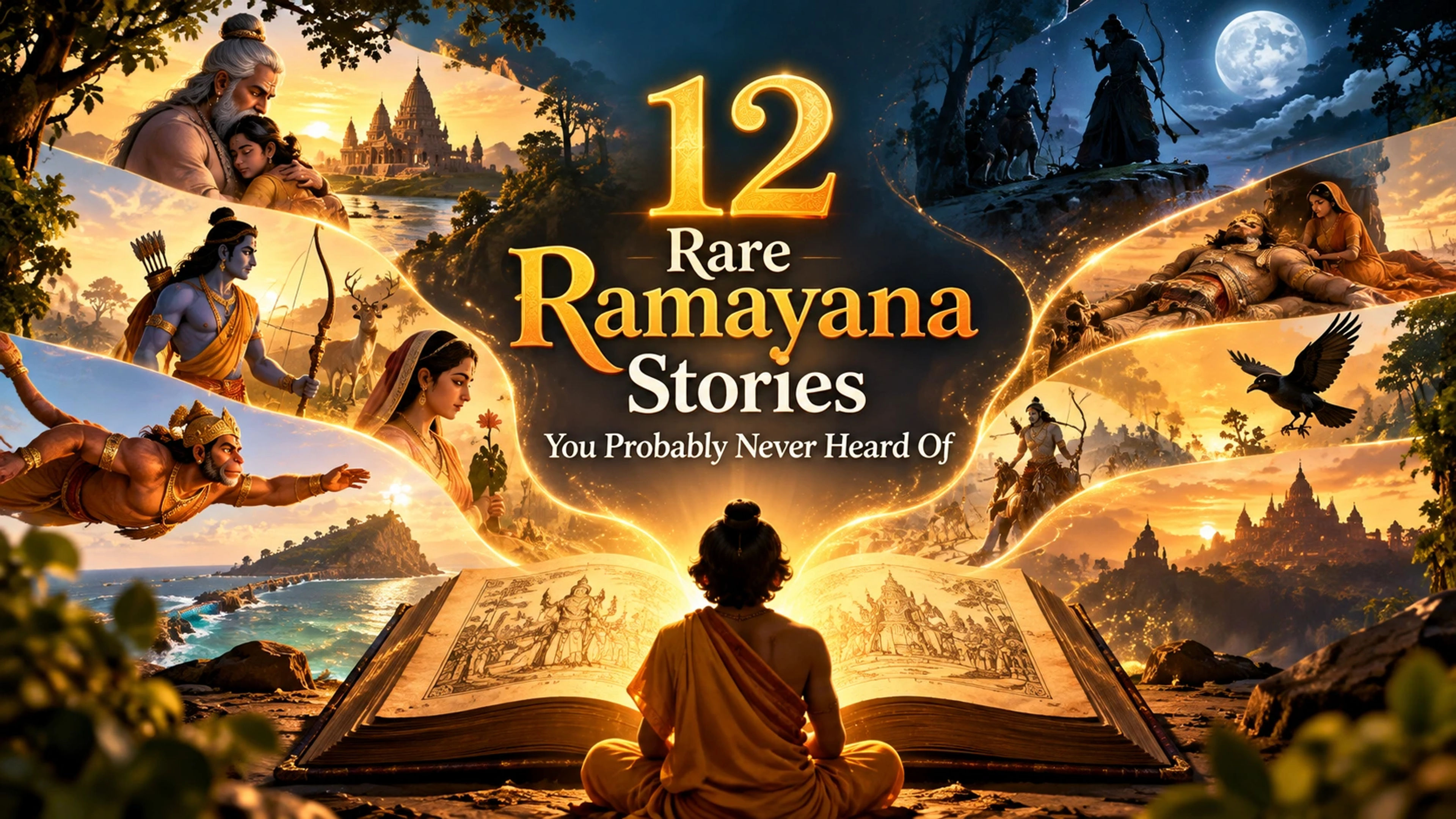
In one Ramayana, Sita takes the form of Kali and destroys a Ravana with a thousand heads. In another, Rama never kills Ravana at all. In a third, a Buddhist Jataka, Sita is Rama's sister. These are rare Ramayana stories, but none of them is a modern invention. Each belongs to a text or tradition that readers can trace, from Valmiki's Sanskrit epic to Tamil, Bengali, Pali, Prakrit and Southeast Asian retellings.
This list moves through twelve of them. Some sit quietly inside Maharshi Valmiki's own verses and are easy to miss. Others belong to later or regional tellings, and each section says plainly which is which, because the Ramayana has never been a single, identical story.
Table of contents
Key takeaways
- Several overlooked episodes, including Sampati, Svayamprabha, Trijata and Kabandha, are part of Valmiki's own Ramayana.
- Other well-loved stories, such as the squirrel, Mahiravana and the golden mermaid Suvannamaccha, come from later or regional retellings and not from Valmiki.
- Buddhist and Jain Ramayanas rewrite familiar events, including who kills Ravana and how Sita is related to Rama.
- The differences between versions show how the epic lived across languages, communities and centuries.
How to read this list
Every story below names its source. Where an episode is found in Valmiki's Ramayana, the kanda is mentioned. Where it belongs to a later or regional work, it is marked as such, so that no tradition is treated as identical to another.
Sita and the Thousand-Headed Ravana
The Adbhuta Ramayana, a Sanskrit text attributed to Valmiki but separate from his main epic, begins from a bold question: what if killing the ten-headed Ravana was not the end of the danger? In its seventeenth chapter, Sita reveals that Ravana has an elder brother with a thousand heads, who rules the island of Pushkara. Rama sets out to defeat him, but this enemy proves far stronger, and Rama faints on the battlefield. Sita then takes the terrifying form of Kali and destroys the thousand-headed Ravana and his army. A shaken Rama praises her with a hymn of 1,008 names, the Sita Sahasranama. The work is usually described as a Shakta retelling, one that places the Goddess at the centre of the story. A chapter-wise summary is available in Hindupedia's entry on the Adbhuta Ramayana. It is best read as a distinct tradition, not as an episode of Valmiki's Ramayana.
Sampati, the Vulture Who Lost His Wings
In the Kishkindha Kanda, Angada and Hanuman's search party reaches the southern shore, worn out and ready to give up. There they meet a gigantic vulture who cannot fly. This is Sampati, the elder brother of Jatayu. In their youth the two brothers raced towards the sun, and when Jatayu's wings began to burn, Sampati spread his own over him and lost them instead. He tells this story to the sage Nishakara in sarga 61. When the vanaras mention Jatayu's death, Sampati is stricken, and then he tells them that Sita is held in Lanka, across the sea. As the sage had foretold, his wings begin to grow back once he has shared the news, an event described in sarga 63. A broken old bird becomes the reason the search succeeds.
Svayamprabha and the Cave Beneath the Mountain
Before they meet Sampati, Hanuman's party, tired and thirsty, notices water-soaked birds flying out of a dark cave in the Vindhya region and follows them inside. They do not find a tunnel. They find a hidden world of golden trees, lakes and mansions, built by the demon architect Maya, as explained in sarga 51. Its guardian is Svayamprabha, an ascetic woman and friend of the apsara Hema. She feeds the exhausted vanaras, hears about their mission and, through her tapas, asks them to close their eyes. When they open them, they are standing on the seashore. The detail that matters is time. They had been underground so long that Sugriva's deadline had passed, which leads straight into Angada's despair, one of the most emotional turns in the Kishkindha Kanda.
Kabandha, the Headless Demon with a Hidden Past
In the Aranya Kanda, Rama and Lakshmana, still searching for Sita, are seized by a creature with no neck, arms a yojana long and a mouth in his belly. This is Kabandha. After the brothers cut off his arms, he explains that he was once a radiant being, a son of Danu, who was cursed by the sage Sthulashira. Later he arrogantly challenged Indra, whose thunderbolt drove his head and thighs into his body. He had been told that Rama would free him. When the brothers cremate him, he rises as a shining celestial and sends Rama to the vanara king Sugriva, as described in sarga 72. Later works differ on details, and some name the sage Ashtavakra as the one who cursed him, as this overview of Kabandha notes. Either way, a frightening monster turns out to be the one who points the story towards its allies.
The Squirrel on the Bridge, and Where the Story Comes From
Many families grow up hearing that a small squirrel carried pebbles for the bridge to Lanka, and that Shri Ram stroked its back with three fingers, leaving the stripes seen on Indian palm squirrels today. It is one of the gentlest episodes in the Rama story, yet it is not part of Valmiki's verses. It is found in later traditions, including the Telugu Ranganatha Ramayanamu, which is described here, and it is also said to be referred to by the Tamil Vaishnava poet Thondaradippodi Alvar, generally dated no later than the eighth century. Some popular articles place the squirrel in Valmiki's Yuddha Kanda, but it is generally treated as a later tradition. The story is a good reminder that an episode can be deeply loved as part of the Ramayana without being in the oldest text.
Trijata's Dream in the Ashoka Grove
Not every guard in Ravana's Ashoka grove was cruel to Sita. In sarga 27 of the Sundara Kanda, an aged rakshasi named Trijata wakes from a dream and warns the others not to harm Sita. She describes a vision of Rama's triumph and the fall of Ravana, and the other guards, who had been threatening Sita, grow frightened and stop their taunting. The episode gives Sita a moment of relief at the lowest point of her captivity. Later retellings, including Kamban's Tamil Ramayana, often make Trijata the daughter of Vibhishana, but in Valmiki's text she is described as an elderly rakshasi. Her dream is also treated in tradition as an early-morning dream that comes true, which is why it is quoted as a good omen.
Sarama, the Friend Inside Ravana's Palace
Another kind presence in Lanka is Sarama. When Ravana shows Sita an illusory severed head of Rama, hoping to break her spirit, it is Sarama who comforts her and reminds her that all is not as it seems. In Valmiki's account she is a loyal companion who brings Sita news and strength. The family connection comes later. In later Rama-centred literature Sarama is identified as the wife of Vibhishana and the mother of Trijata, and the Uttara Kanda, which scholars regard as a later addition to the epic, already describes her as Vibhishana's wife. You can read more in this overview of Sarama in the Ramayana). A friend inside the enemy's palace grows, over the centuries, into part of the one family that chose Rama's side.
Mahiravana and Hanuman's Journey to Patala
After Indrajit falls, a desperate Ravana turns to Mahiravana, also called Ahiravana, the sorcerer-king of the netherworld Patala. This episode belongs to the Bengali Krittivasi Ramayana, composed in the fifteenth century, and not to Valmiki. Hanuman guards the sleeping Rama and Lakshmana, but Mahiravana enters disguised as Vibhishana and carries the brothers away to sacrifice them before the goddess Mahamaya. Hanuman follows through a tunnel into Patala, and popular tellings add that Mahiravana's life could end only if five lamps burning in different directions were put out together, which is linked to Hanuman's five-faced Panchamukha form. He rescues the brothers and destroys the sorcerer. The tradition is summarised in this entry on Ahiravan. It is a story about devotion and cleverness, set in a part of the cosmos that Valmiki's epic never visits.
When Rama and Sita Saw Each Other Before the Bow
In the Valmiki Ramayana, Sita does not meet Rama before he lifts and breaks the great bow in Mithila. A scholarly exchange on the Indology mailing list notes that the Valmiki text describes no such meeting, and that Kamban's Tamil account is probably the first record of this motif. In Kamban's Ramavataram, the two see each other before the contest, and the glance that passes between them became one of the most admired passages of Tamil poetry. Kamban, whom Tamil tradition calls Kavi Chakravarti, acknowledges Valmiki as his inspiration, yet his work is independent, with its own emphasis on Rama's divinity. Sources date him anywhere from the tenth to the twelfth century. Many later poets and storytellers adopted the idea of that first look, and today it feels like part of the story itself.
Hanuman and the Golden Mermaid Suvannamaccha
In the Thai Ramakien and the Cambodian Reamker, the army cannot easily build the bridge to Lanka. Rocks keep vanishing. Hanuman investigates and discovers the culprit, a mermaid named Suvannamaccha, whose name means golden fish. She is Ravana's daughter, sent by her father to sabotage the work. When Hanuman explains the purpose of the bridge, she has a change of heart, returns the stolen rocks and helps. In these traditions the two fall in love, and she later bears his son Macchanu, who appears as a half-vanara, half-fish warrior. Suvannamaccha is not named among Ravana's children in Valmiki's Ramayana. Writer Chandrica Barua traces her role in this article on the Southeast Asian Ramayana, and she appears in murals at Wat Phra Kaew in Bangkok.
When Sita Is Rama's Sister: The Dasaratha Jataka
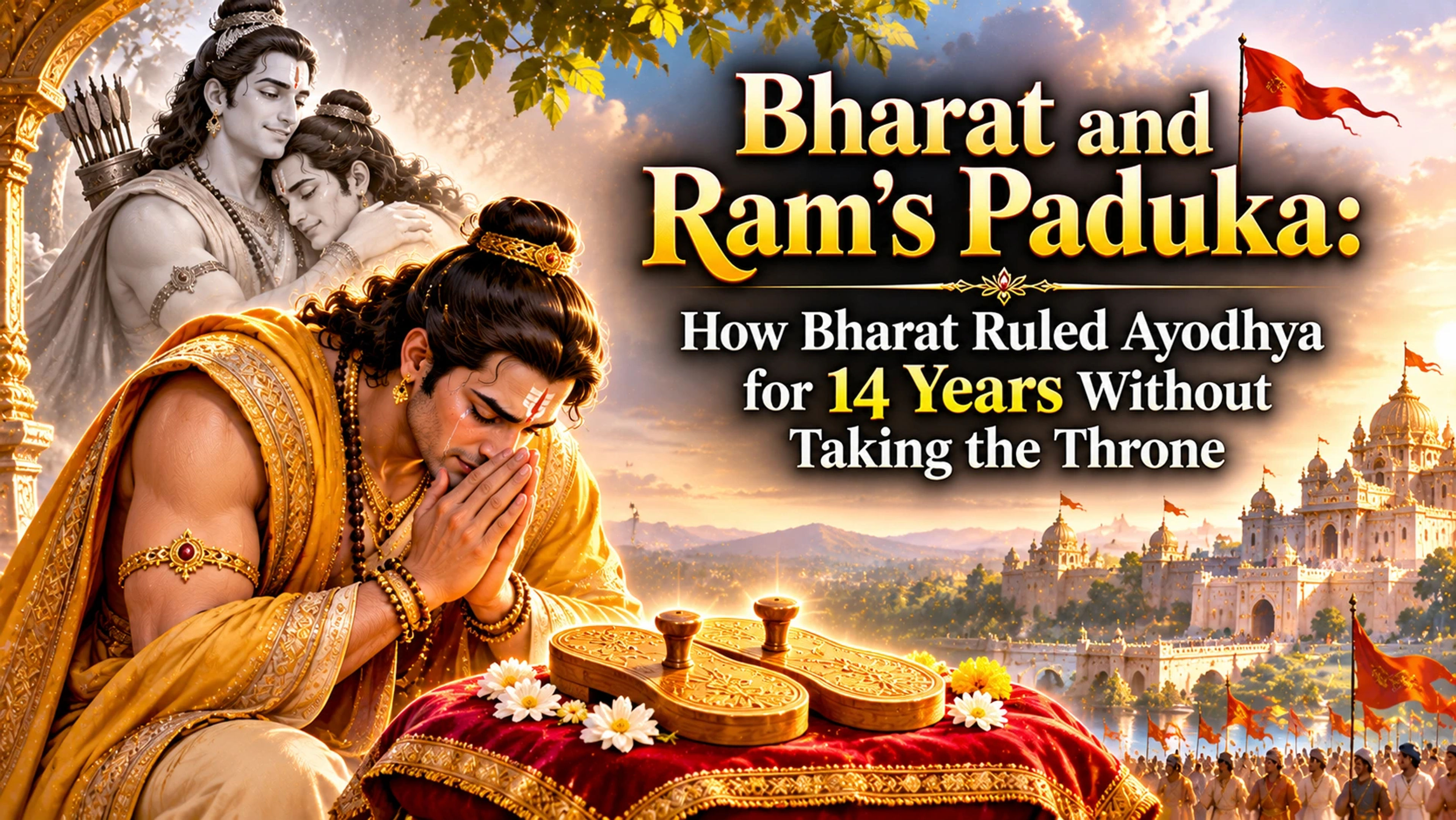
The Pali Dasaratha Jataka, number 461, retells the Rama story as a past life of the Buddha. King Dasaratha of Benares has three children: Rama-pandita, Prince Lakkhana and a daughter named Sita. The three go into exile in the Himalayas. When Bharata arrives with the news that their father has died, Lakkhana and Sita weep, but Rama-pandita stays calm, explaining that all things are impermanent. Bharata begs him to return, and Rama gives him his straw slippers to rule in his place. At the end of the exile, Rama returns and makes Sita his queen. You can read the story in Rouse's translation of the Jataka. Scholars generally regard it as a later Buddhist adaptation of the Ramayana's themes, a teaching story shaped by Buddhist ideas, not a competing version of the facts.
A Jain Ramayana Where Lakshmana Kills Ravana
The Paumachariya of the Jain monk Vimalasuri, written in Prakrit, is among the earliest surviving Jain tellings of the Rama story, and scholars debate its exact date. Here the rakshasas are not demons but civilised Vidyadharas, and Ravana is a learned king and devout Jain with a single weakness, Sita. His famous ten faces are explained rationally, as the reflection of his face in a necklace of jewels. Since Jain tradition holds that a non-violent hero like Rama cannot take life, it is Lakshmana who kills Ravana. Rama later becomes a Jain monk and attains liberation, while Ravana and Lakshmana are said to fall to hell because of the violence of the war. The Rama in Jainism overview and Vimalasuri's profile summarise these differences clearly.
Why These Stories Matter
The Ramayana never travelled as one fixed text. It moved through Sanskrit courts, Tamil and Bengali poetry, temple performance, folk storytelling, the dance dramas of Cambodia and Thailand, and the literature of Buddhist and Jain communities. Scholars often speak of hundreds of versions, and one paper on the Rama Setu narrative puts the number at around 300.
The differences are not accidents. Kamban keeps the godhood of Rama in view throughout, while Valmiki's Rama is a human hero of extraordinary dharma. The Adbhuta Ramayana places the Goddess at the centre. Jain authors stress non-violence, and Southeast Asian poets add characters that suit their own seas and courts. Reading these versions side by side does not mean treating them as interchangeable, and it does not mean one version cancels another. It means seeing each as a work of its own time, language and community, with the Valmiki Ramayana as the foundation that so many of them honour.
| Story | Source or tradition | Language or region |
|---|---|---|
| Sita and the thousand-headed Ravana | Adbhuta Ramayana, attributed to Valmiki | Sanskrit |
| Sampati's wings | Valmiki Ramayana, Kishkindha Kanda | Sanskrit |
| Svayamprabha's cave | Valmiki Ramayana, Kishkindha Kanda | Sanskrit |
| Kabandha's former identity | Valmiki Ramayana, Aranya Kanda | Sanskrit |
| The squirrel and the bridge | Later traditions such as the Ranganatha Ramayanamu | Telugu and Tamil traditions |
| Trijata's dream | Valmiki Ramayana, Sundara Kanda | Sanskrit |
| Sarama | Valmiki Ramayana and later literature | Sanskrit |
| Mahiravana in Patala | Krittivasi Ramayana | Bengali |
| Rama and Sita's first glance | Kamban's Ramavataram | Tamil |
| Suvannamaccha | Ramakien and Reamker | Thai and Khmer |
| Sita as Rama's sister | Dasaratha Jataka, no. 461 | Pali |
| Lakshmana kills Ravana | Paumachariya of Vimalasuri | Prakrit |
Final Thoughts
Taken together, these stories show a Ramayana far larger than any single retelling. Valmiki's own verses hold overlooked allies such as Sampati, Svayamprabha and Trijata. Kamban, Krittivasa, Southeast Asian poets and Buddhist and Jain authors each added or changed episodes to speak to their own audiences. Reading them side by side does not weaken devotion to Shri Ram. For many readers it deepens their sense of how widely his story travelled. If you would like to keep exploring, browse more spiritual stories and devotional reading on the Divya Marg blog. And if you want to carry the holy name into daily life, our guide to Naam Jaap without a mala is a simple place to begin.
Are there lesser-known stories in the Ramayana?
Yes. Valmiki's Ramayana itself contains overlooked episodes such as Sampati's burnt wings, Svayamprabha's cave and Trijata's dream. Beyond Valmiki, regional and later versions add stories like Mahiravana in Patala, Kamban's first glance between Rama and Sita, and the golden mermaid Suvannamaccha of Southeast Asia.
What is the Adbhuta Ramayana?
The Adbhuta Ramayana is a Sanskrit text attributed to Valmiki but distinct from his main epic. It is often called a Shakta retelling because it presents Sita as the supreme power. Its best-known episode has Sita defeating the thousand-headed Ravana of Pushkara in the form of Kali.
Does Sita fight a thousand-headed Ravana?
In the Adbhuta Ramayana, yes. After Rama faints in battle against Ravana's elder brother, Sita takes the form of Kali and destroys him. This episode is not found in Valmiki's main Ramayana, so it should be understood as belonging to a separate tradition.
Who was Sampati in the Ramayana?
Sampati was the elder brother of the vulture Jatayu and the son of Aruna. He lost his wings shielding Jatayu from the sun. In the Kishkindha Kanda he meets the vanara search party, tells them Sita is held in Lanka, and his wings begin to grow back.
Is the squirrel story found in the Valmiki Ramayana?
It is generally treated as a later tradition and not as part of Valmiki's verses. The story, in which Rama strokes a squirrel's back and leaves three stripes, appears in later works such as the Telugu Ranganatha Ramayanamu and in popular tradition, especially in South India.
Why are there different versions of the Ramayana?
The epic travelled across languages, regions, religions and centuries, and each community retold it in its own way. Poets such as Kamban and Krittivasa, Buddhist and Jain authors, and Southeast Asian storytellers added or changed episodes. Scholars often speak of hundreds of versions.
Which Ramayana should a beginner read first?
Most beginners start with a faithful English translation or abridgement of Valmiki's Ramayana, since many later versions build on it. Readers who prefer devotional poetry often begin with Tulsidas's Ramcharitmanas. Once you know the main story, regional versions like Kamban's become more rewarding.
Begin your Naam Jaap today
Offline-first and built entirely around one purpose — helping you show up for your practice, every single day.
- Free, always
- Works offline
- No ads