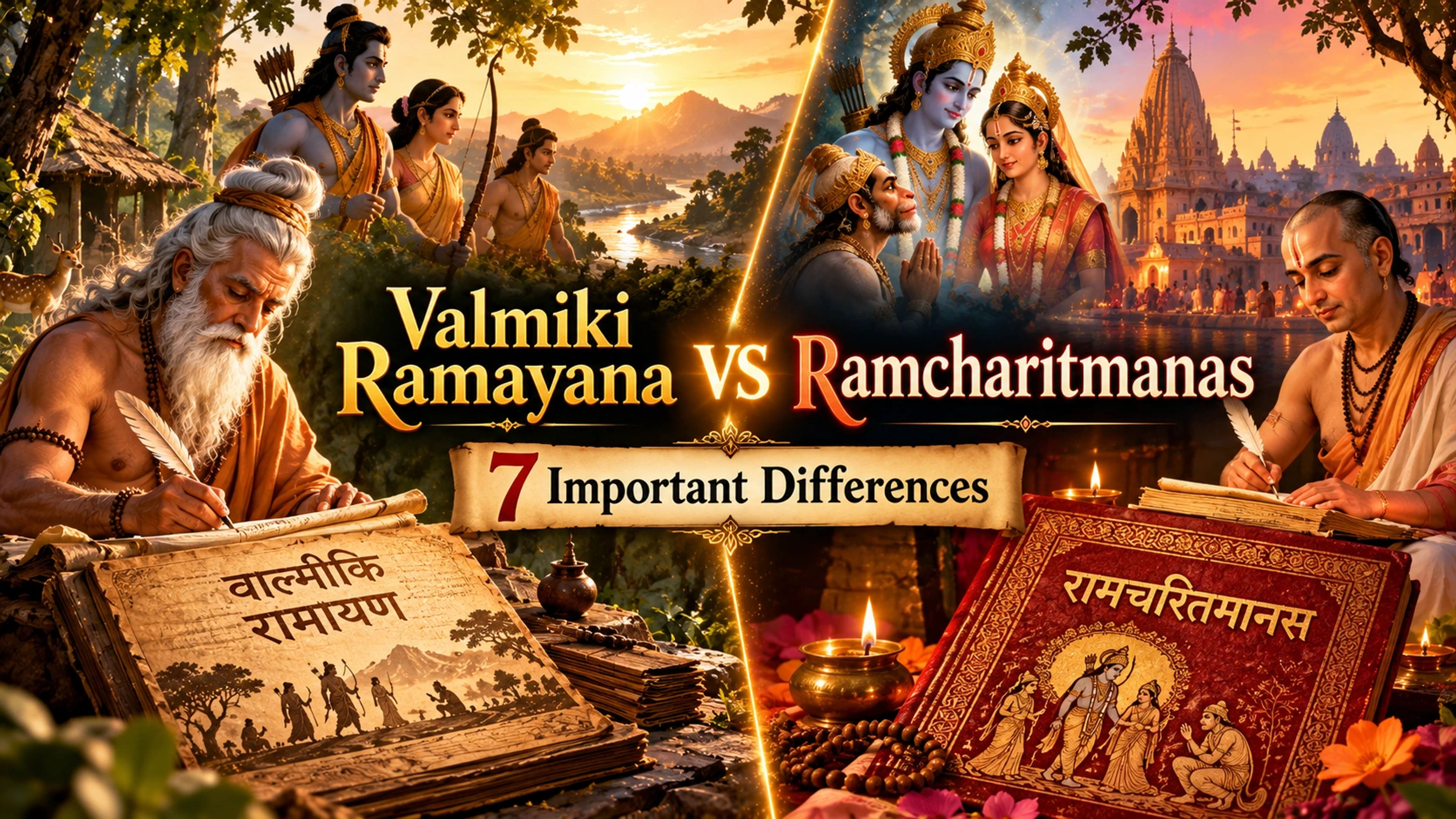
Valmiki Ramayana vs Ramcharitmanas: 7 Important Differences
Most of us first meet Rama through a grandmother's stories, a Ramleela ground, a temple recitation or a television serial. Behind these sit two great texts: the Sanskrit Valmiki Ramayana and the Awadhi Ramcharitmanas of Goswami Tulsidas. The question of Valmiki Ramayana vs Ramcharitmanas comes up often, because the two share a story but do not tell it in the same way.
The short answer is that they are related but not the same. The Ramcharitmanas is not a translation of the Valmiki Ramayana. It is an independent devotional retelling, composed in the 16th century, that draws on an older and wider Rama tradition. This article looks at seven meaningful differences: language, historical context, literary form, the portrayal of Rama, selected episodes, devotional and philosophical emphasis, and cultural influence. The aim is to understand what each text offers, not to rank them.
Table of contents
Key takeaways
- The Valmiki Ramayana is a Sanskrit epic traditionally attributed to Maharishi Valmiki. The Ramcharitmanas is an Awadhi work by Goswami Tulsidas, composed in the 16th century.
- The Ramcharitmanas is a devotional retelling that draws on earlier Rama traditions. It is not a translation of the Valmiki Ramayana.
- Both texts have seven kandas, but their contents, emphasis and treatment of episodes differ, for example the shadow Sita motif and the ending of the story.
- Rama is both human and divine in both works. The balance and the way it is expressed differ, with bhakti at the centre of the Ramcharitmanas.
- Both works have shaped Hindu religious and cultural life in different ways, and neither needs to be read before the other.
What Is the Valmiki Ramayana?
The Valmiki Ramayana is a Sanskrit epic traditionally attributed to Maharishi Valmiki, whom tradition honours as the adi kavi, the first poet. A well known account in the Bala Kanda describes how Valmiki, moved by the grief of a bird, found that his sorrow took the form of a verse. Tradition sees this as the birth of the shloka, the verse form in which most of the epic is composed.
It is traditionally organised into seven kandas: Bala, Ayodhya, Aranya, Kishkindha, Sundara, Yuddha (also called Lanka) and Uttara. Its textual history is complex. Scholars generally see the epic as having grown over several centuries, roughly between the middle of the first millennium BCE and the early centuries CE, and many consider the Bala and Uttara Kandas to include later layers. Not every scholar agrees on the details. There are also several regional recensions, commonly grouped as northern, north-western and southern, and a critical edition was prepared at the Oriental Institute, Baroda.
What Is the Ramcharitmanas?
The Ramcharitmanas was composed by Goswami Tulsidas, a poet-saint whose life is placed by traditional accounts in the 16th and early 17th centuries. It is written primarily in Awadhi, a language of the Hindi literary tradition, with Sanskrit verses at the start of each kanda. Tulsidas himself states that he began the work in Ayodhya on Ram Navami in Samvat 1631, which corresponds to 1574 CE, and tradition holds that he completed it in Varanasi.
The title means roughly 'the lake of Rama's deeds'. Tulsidas uses the image of a sacred lake, with the seven kandas as its steps. The work is a devotional retelling that draws on the Valmiki Ramayana and on other Sanskrit sources and traditions. Scholars often point to works such as the Adhyatma Ramayana as part of this wider background.
Valmiki Ramayana vs Ramcharitmanas: 7 Important Differences
| Aspect | Valmiki Ramayana | Ramcharitmanas |
|---|---|---|
| Author | Traditionally attributed to Maharishi Valmiki | Goswami Tulsidas |
| Language | Sanskrit | Primarily Awadhi, with Sanskrit verses at the start of each kanda |
| Period | Long, layered composition, debated by scholars | 16th century (begun in 1574 CE by Tulsidas's own account) |
| Main verse forms | Mostly the shloka, with some other metres | Chaupai and doha, along with other forms such as sortha and chhand |
| Narrative frame | Valmiki composes the story; Lava and Kusha recite it | Shiva tells Parvati; Tulsidas also draws on other tellers such as Yajnavalkya and Kakabhushundi |
| Emphasis | Epic narrative, dharma, family, kingship and an ethical world | Bhakti, devotion to Rama as the Supreme |
| Ending | Uttara Kanda includes Sita's banishment and Rama's departure | Ends with Ramrajya and reflections on devotion and knowledge |
1. Language and Intended Readership
The language of Valmiki Ramayana is Sanskrit, the classical language of the epic and Puranic world. The language of Ramcharitmanas is primarily Awadhi, the speech of the Ayodhya region and its surroundings. This choice shapes how the texts sound, how they are sung and who finds them easy to approach.
Awadhi verse in the Ramcharitmanas lends itself to group recitation and singing in north India. Even so, it would be wrong to say that Sanskrit was only for priests or that every ordinary person could follow vernacular poetry. Sanskrit texts have long been recited, heard and taught in different settings, and access to literacy, learning and performance varied by region and community. The better way to put it is that Tulsidas wrote in a language close to the spoken and devotional life of his region, while Valmiki's Sanskrit belongs to the classical literary tradition.
2. Historical Period and Literary Context
Traditional accounts credit Valmiki with composing the Ramayana, and a narrative within the text presents him as a contemporary of Rama. Modern scholarship treats the received text as the product of a long process of composition and transmission, which is why no single date can honestly be given for the whole work. Traditional attribution and scholarly estimates are different kinds of evidence, and both are best stated as such.
The Ramcharitmanas has a far more precise setting. Tulsidas worked in the 16th century, at a time when Rama was already the subject of many Sanskrit and vernacular works, and when bhakti movements were shaping religious life across north India. He did not invent Rama's story. He retold it in his own devotional voice, and the invocation at the start of the Bala Kanda acknowledges that he draws on multiple sources including the Puranas, the Vedas and the Ramayana.
3. Literary Structure and Storytelling Style
Both works have seven kandas, but this does not make them structurally identical. The Valmiki Ramayana is an epic in sargas (chapters), composed largely in the shloka metre, with some chapters closing in other metres. It is traditionally described as having about 24,000 verses, and its narration moves through court, forest, battlefield and hermitage with detailed description.
The Ramcharitmanas is built from a different poetic toolkit. Its core unit is the chaupai, a four-line verse form, interspersed with dohas (couplets) and other forms such as sortha and chhand. The narrative frame is also layered. Tulsidas presents the story as first told by Shiva to Parvati, and later passes it through other tellers, including Yajnavalkya speaking to Bharadwaj at Prayag and the crow Kakabhushundi speaking to Garuda. In the Valmiki Ramayana, by contrast, the story is composed by Valmiki and later recited by Lava and Kusha.
4. How Lord Rama Is Portrayed
A common shortcut says that Rama is a human hero in the Valmiki Ramayana and a God in the Ramcharitmanas. The texts are more complex than that. The Valmiki Ramayana presents Rama as the ideal king, son, husband and warrior, whose conduct is tested by duty and loss. Yet the epic also speaks of him as Vishnu's incarnation. Some scholars regard the passages that stress his divinity, especially in the Bala and Uttara Kandas, as later layers, while the Yuddha Kanda also contains a scene in which the gods address him as Narayana. In the same epic Rama himself speaks of regarding himself as a man, the son of Dasharatha.
The Ramcharitmanas places Rama's divinity at the forefront, presenting him as the Supreme Being who takes human form out of grace. Tulsidas gives several reasons for the incarnation in the Bala Kanda, drawing on stories such as the curse of Narada. But Rama in the Manas also grieves, searches for Sita in the forest and acts within human relationships. Tulsidas treats these as leela, divine play, so that the human and divine aspects are held together. Both texts therefore combine the two. What differs is where the emphasis falls and how it is explained.
5. Narrative Differences and Selected Episodes
The clearest way to see the difference is to look at particular episodes. Three examples show how each text presents its own emphasis.
- The shadow Sita. In the Ramcharitmanas, Rama, in the Aranya Kanda, tells Sita that he is about to play out a divine leela, and asks her to enter fire while a shadow image of her remains. It is this shadow figure who is taken by Ravana. After the war in the Lanka Kanda, the real Sita returns from the fire and the shadow merges into it. The Valmiki Ramayana does not tell the story this way. There, Ravana abducts Sita herself, and she undergoes her trial by fire after the battle at Lanka.
- Shabari. In the Ramcharitmanas, Rama, in the Aranya Kanda, teaches Shabari the nine forms of devotion, known as navadha bhakti. In the Valmiki Ramayana, Shabari appears as an ascetic woman who welcomes Rama and Lakshmana and is described with respect, but the extended teaching on nine forms of devotion is a feature of Tulsidas's retelling.
- The ending. The Uttara Kanda of the Valmiki Ramayana narrates events after the return to Ayodhya, including Sita's banishment, the birth of Lava and Kusha, and Rama's departure from the world. The Ramcharitmanas does not narrate the banishment. Its Uttara Kanda moves from Ramrajya into dialogues on devotion, knowledge and the nature of Rama, including the exchange between Kakabhushundi and Garuda.
These examples do not mean one text is more accurate than the other. They show that each was shaped by its own purpose and tradition, and readers should check specific passages in a reliable edition when they want to be sure of what a text says.
6. Devotional and Philosophical Emphasis
Bhakti, or loving devotion, is the organising principle of the Ramcharitmanas. Tulsidas presents Rama as the object of devotion, praises the power of Rama's name, and shows figures such as Hanuman, Bharata, Shabari and Vibhishana as models of devotion. Readers who find meaning in repeating the divine name may also like our guide to naam jaap without a mala.
The Valmiki Ramayana is not without devotion or reflection, and it would be wrong to call it purely secular or purely philosophical. Its main strength lies in an epic panorama of dharma, kingship, family bonds, loyalty, exile, war and the ethical choices that characters face. The Ramcharitmanas has its own narrative, ethical and philosophical layers too. The difference is one of emphasis, not of presence or absence.
7. Cultural Influence and Religious Practice
The Valmiki Ramayana has served for centuries as a foundational source for Rama's story, and many later Ramayana traditions in Indian languages, such as the Tamil work of Kamban and the Bengali Krittivasi Ramayana, reworked the story in their own ways and with their own emphases. Its Sundara Kanda is widely recited, and its verses continue to be studied, chanted and translated.
The Ramcharitmanas has a particularly strong presence in north Indian devotional life. It is sung and recited in households and temples, read in continuous recitations, and used as a basis for many Ramleela performances, including the well known Ramleela of Ramnagar in Varanasi. UNESCO inscribed the Ramleela tradition on its list of the intangible cultural heritage of humanity in 2008. Since Hindu communities across regions read and value these works in different ways, it is safer not to claim that either text is more widely read or preferred overall.
Are the Valmiki Ramayana and Ramcharitmanas the Same Story?
They share a foundation: Rama's birth in Ayodhya, the exile, the abduction of Sita, the alliance with Hanuman and Sugriva, the war with Ravana and the return. But a shared outline is not the same as an identical story. The two works differ in language, literary form, narrative frame, theological emphasis and in how they treat certain episodes. Neither should be treated as a correction of the other. They are works from different times and traditions that approach Rama's story with different purposes.
Is Ramcharitmanas a Translation of the Valmiki Ramayana?
No. A translation carries a text from one language into another while staying close to its content. An adaptation reshapes a story for a new audience. A devotional retelling, which is what the Ramcharitmanas is, uses an existing story to express a particular religious vision in a new poetic voice. Tulsidas composed original verses in Awadhi, restructured the narrative frame, added and shifted episodes, and placed devotion at the centre. It draws on the Valmiki Ramayana and on other sources, but it stands as a work in its own right.
Which Text Should a Beginner Read First?
There is no required order, and neither text needs to be read before the other. Your interest is a better guide.
- For the Sanskrit epic in English: Robert Goldman and colleagues' multi-volume translation of the Valmiki Ramayana from Princeton University Press is a scholarly choice. Arshia Sattar's abridged translation published by Penguin is a gentler way in.
- For Tulsidas's devotional poetry: Philip Lutgendorf's translation of the Ramcharitmanas, published as part of the Murty Classical Library of India, is a reputable English edition. The Gita Press edition with Hindi commentary is widely used by readers who want a traditional devotional edition.
- For a short start in either: Begin with a single kanda, such as the Sundara Kanda, and read slowly with notes.
Conclusion
The Valmiki Ramayana and the Ramcharitmanas tell the story of Rama in different languages, periods and voices. One is a Sanskrit epic with a long and layered history. The other is a 16th century devotional work that makes bhakti the heart of the story. Reading them side by side shows how a single story can be received, shaped and renewed across centuries without either work losing its own character.
If this comparison has made you curious, you can continue with more Ramayana stories and other spiritual articles on Divya Marg.
What is the main difference between Valmiki Ramayana and Ramcharitmanas?
The Valmiki Ramayana is a Sanskrit epic traditionally attributed to Valmiki, with an emphasis on narrative, dharma and the human world. The Ramcharitmanas is an Awadhi devotional retelling by Tulsidas, composed in the 16th century, with bhakti at its centre. Both present Rama as human and divine, but they differ in language, form and emphasis.
Is Ramcharitmanas a translation of the Valmiki Ramayana?
No. It is an original devotional work in Awadhi that draws on the Valmiki Ramayana and other sources. Tulsidas changed the narrative frame, added and reshaped episodes, and wrote his own verses.
Who wrote the Ramcharitmanas?
Goswami Tulsidas, a poet-saint of the 16th century. By his own statement in the text, he began composing it on Ram Navami in Samvat 1631, which corresponds to 1574 CE.
In which language was the Valmiki Ramayana written?
It was composed in Sanskrit, mostly in the shloka verse form.
In which language was the Ramcharitmanas written?
It is written primarily in Awadhi, a language of the Hindi literary tradition, with Sanskrit verses at the beginning of each kanda.
Which text was composed first?
The Valmiki Ramayana. Its exact dating is debated and its received text developed over a long period, while the Ramcharitmanas was composed by Tulsidas in the 16th century.
Do both texts contain seven kandas?
Yes. Both are traditionally divided into seven kandas, but the contents and treatment of episodes within them are not identical. For example, the Valmiki Ramayana's Uttara Kanda covers events such as Sita's banishment, which the Ramcharitmanas does not narrate.

Begin your Naam Jaap today
Offline-first and built entirely around one purpose — helping you show up for your practice, every single day.
- Free, always
- Works offline
- No ads