Jatayu's Story: The Bird Who Risked His Life to Save Sita
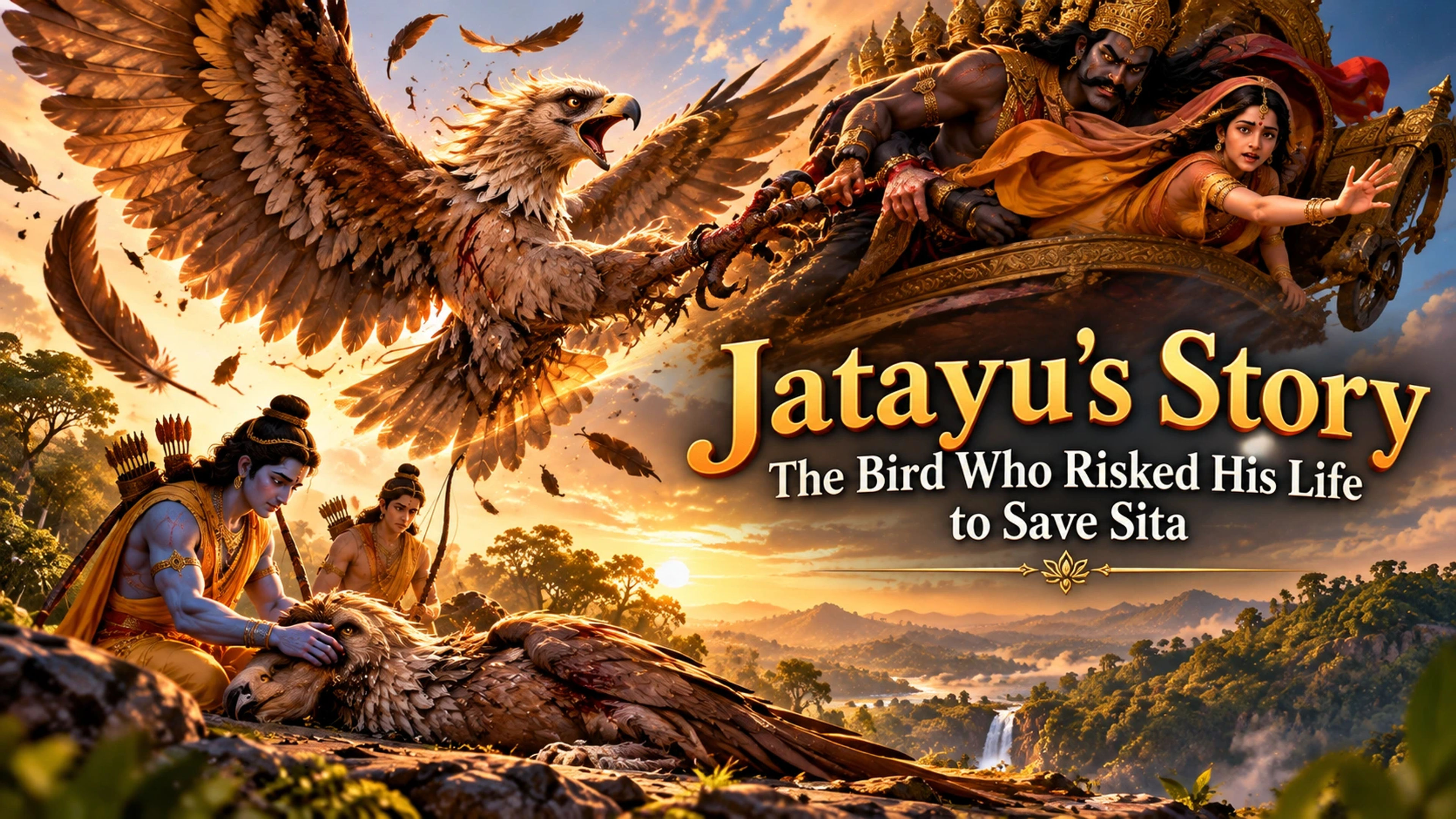
Ravana is racing across the sky with Sita in his chariot when an old bird, woken by her cries, sees him. Jatayu is aged, Ravana is young and armed, and no one has asked Jatayu to interfere. He has a simple choice: watch, or stop the king of Lanka. The Jatayu story in the Ramayana is the story of the choice he makes.
This article follows his story in the Valmiki Ramayana, mainly the Aranya Kanda, and marks clearly where later devotional tradition adds to it. You will meet Jatayu's family, his friendship with King Dasharatha, his battle with Ravana and his last meeting with Rama. You will also see why the brief information he gave Rama mattered so much to the search for Sita.
Table of contents
Key takeaways
- In Valmiki's Ramayana, Jatayu is the son of Aruna, the Sun's charioteer, and Shyeni, and an old friend of Rama's father, Dasharatha.
- Jatayu confronts Ravana unprompted, first by appealing to his dharma as a king and then in direct combat, wrecking his chariot before Ravana cuts off his wings.
- Before dying, Jatayu tells Rama that Ravana abducted Sita and names him, which gives Rama his first firm lead.
- Rama cremates Jatayu with the rites due to a relative, an honour the text treats with great weight.
- Stories of Sita's blessing and of Jatayu waiting to meet Rama belong largely to later devotional traditions.
Who Was Jatayu in the Ramayana?
Jatayu is a great bird, often called a vulture or eagle, and described as king of the birds. In sarga 14 of the Aranya Kanda, he introduces himself to Rama as the son of Aruna, the charioteer of the Sun, and of Shyeni. His elder brother is Sampati. Some other traditions name their mother differently, as Kamban's Tamil Ramayana does.
The two brothers appear together in an earlier story. As young birds, they flew towards the sun, and when Jatayu's wings began to burn, Sampati spread his own wings over him and lost them. The brothers are said never to have met again, which is why Sampati's reaction on hearing of Jatayu's death, much later, is so moving.
Jatayu and King Dasharatha
When Rama, Sita and Lakshmana are travelling towards Panchavati, they come across this huge bird and at first take him for a rakshasa. He reassures them, and Rama, on learning that Jatayu was his father's friend, greets him with respect. Valmiki describes Rama's regard for Jatayu as flowing from that old friendship.
How the friendship began is told differently. Later retellings such as Kamban's Ramayana say that Jatayu once protected Dasharatha in his battle against the demon Sambara. This origin is not part of the Valmiki passages discussed here, so it is best read as part of the wider tradition. In Valmiki, Jatayu offers to stay near Sita while Rama and Lakshmana are away, and Rama entrusts her protection to him.
How Jatayu Discovered Ravana Abducting Sita
The abduction happens while Rama and Lakshmana are away from the hermitage. Ravana, in disguise, seizes Sita and carries her away in his flying chariot. Sita cries out, and Jatayu, who is nearby, hears her. In the Google Arts and Culture account of an early eighteenth century painting of the scene, the sequence is described faithfully: Jatayu first appeals to Ravana as a king bound by dharma.
He tells Ravana to stop, warns him that the act will bring his own ruin, and says he will not let Sita be taken while he lives. Jatayu is old, Ravana is young, armed and in a chariot, and the text does not hide the imbalance. His decision to act anyway is the moral centre of the story.
Jatayu's Battle With Ravana
When Ravana ignores the warning, the fight begins. Sarga 51 describes a ferocious combat in the sky. Ravana showers arrows. Jatayu turns them aside with his wings, breaks Ravana's bow with his feet, tears his armour, destroys the chariot and kills the animals yoked to it, and with his beak removes the head of the charioteer.
Ravana, now on the ground and still holding Sita, is forced to continue the fight on foot. Jatayu strikes him repeatedly, and for a time the contest seems to favour the old bird. Valmiki compares the clash to two great clouds colliding in the sky. The Cleveland Museum of Art holds an early painting of this battle based on the same chapters.
Ravana finally cuts off Jatayu's wings, feet and sides, and Jatayu falls. He has not defeated Ravana, but he has destroyed his chariot and delayed him.
What Happened to Jatayu After the Battle?
Ravana lifts Sita again and flies on to Lanka. Jatayu lies on the ground, badly wounded, in the forest near Rama's hermitage.
Rama and Lakshmana return to the empty hermitage, and in great distress begin searching the forest. They find the bloodied bird. Valmiki's account says that Rama, in anguish, at first suspects that this large creature may have harmed Sita, and raises his bow. Jatayu, spitting blood, speaks and tells him the truth, and Rama's suspicion turns to grief.
Jatayu's Final Moments With Lord Rama
In sarga 68, Rama asks Jatayu to tell him about Sita, about Ravana's strength and where he lives. Jatayu says that Ravana abducted her by creating a great storm of illusion and went south. He adds that Ravana took her in the muhurta called Vinda, an auspicious time in which lost wealth is regained, and that Ravana did not realise this.
He tells Rama that Ravana, having taken Sita, will soon perish, like a fish that swallows a baited hook. Then he names Ravana as the son of Vishrava and the brother of Kubera, and dies before he can say more.
Rama's response is deeply personal. He treats Jatayu as a relative. He has Lakshmana gather firewood, and he performs the cremation himself. The text then describes the offering of balls of food and the chanting of mantras, and the two brothers offer water at the Godavari according to custom.
Valmiki and later traditions
Valmiki's text records Jatayu's information, his death and Rama's funeral rites. Later devotional works add emphasis on Jatayu's liberation. A museum note on a painting from the Vaidehisha Vilasa, for example, says that Rama's rites enabled Jatayu to reach heaven, a place no vulture was believed to have attained. Some devotional tellings also say that Sita blessed him to live until he could meet Rama, a detail that does not appear in the passages cited here.
Why Is Jatayu's Sacrifice So Important?
In practical terms, Jatayu gives Rama his first reliable clue: Sita has been taken by Ravana, and Ravana went south. Without this, Rama would be searching a forest with no knowledge of who had taken her.
His death also shapes what comes next. After Jatayu, Rama meets Kabandha, who sends him to Sugriva, and the vanara search for Sita begins. Much later, when Jatayu's brother Sampati learns that Jatayu is dead, he in turn tells the vanaras where Sita is held. One brother's sacrifice, and the other's grief, shape the search.
The Deeper Meaning of Jatayu's Story
The following are interpretations, not statements in the text.
Many readers see Jatayu as a symbol of dharma lived without calculation. He is old, outmatched and under no obligation to a woman he barely knows, yet he acts. The story does not say he expected to win. Courage here means doing what is right when success is uncertain.
Loyalty runs through it too. Jatayu's care for Sita comes from his friendship with Dasharatha, and devotional traditions read his death as repayment of that bond. Rama's cremation of Jatayu, as though for his own father, is understood as the answer to that love.
What Jatayu's Story Teaches Us
Most of us will never face a Ravana. We do meet moments when someone nearby is being wronged and others look away. Jatayu's example is not about physical strength. It is about noticing, and about deciding that a stranger's need is also your responsibility.
His story also shows that partial success still matters. He did not rescue Sita, yet his information changed the course of the search. A small, imperfect act of courage can turn out to be what others build on.
Conclusion
Jatayu remains one of the most memorable figures in the Ramayana because he acts when he has every reason to hold back. He challenges Ravana, loses, and still leaves Rama with the knowledge he needs. Rama's own farewell, performing the rites with his hands, is the Ramayana's answer to what such courage deserves.
If you enjoyed this story, you can find more Ramayana stories and devotional reading on the Divya Marg blog, or visit the Divya Marg homepage to explore further.
Who was Jatayu in the Ramayana?
Jatayu was a great bird, the king of birds, and the son of Aruna, the Sun's charioteer, and Shyeni. He was the younger brother of Sampati and an old friend of King Dasharatha. He fought Ravana to save Sita and died of his wounds.
What was the relationship between Jatayu and Dasharatha?
In Valmiki's Ramayana, Jatayu is described as Dasharatha's friend, which is why Rama greets him respectfully as a friend of his father. Kamban's later retelling says the friendship began when Jatayu protected Dasharatha in his battle with the demon Sambara.
How did Jatayu fight Ravana?
He first urged Ravana to give up the abduction. When Ravana refused, Jatayu shielded himself from arrows with his wings, broke Ravana's bow, destroyed his chariot and killed its charioteer. Ravana finally cut off Jatayu's wings, feet and sides.
What did Jatayu tell Rama before he died?
He told Rama that Ravana had abducted Sita and gone south, and that Ravana took her at the muhurta called Vinda. He named Ravana as the son of Vishrava and brother of Kubera, and said Ravana would be destroyed.
Did Rama perform Jatayu's last rites?
Yes. In the Valmiki Ramayana, Rama has the pyre prepared, cremates Jatayu himself and performs the offerings and water libations as for a relative. Later devotional traditions emphasise that this gave Jatayu liberation.
Is Jatayu related to Garuda?
Jatayu and Sampati are the sons of Aruna, who is Garuda's elder brother in Puranic tradition, so some sources call Jatayu Garuda's nephew. In Valmiki's Aranya Kanda, Jatayu himself traces his lineage through Aruna and Kashyapa.
Begin your Naam Jaap today
Offline-first and built entirely around one purpose — helping you show up for your practice, every single day.
- Free, always
- Works offline
- No ads