
Saraswati Mantra: Meaning, Benefits, Significance & How to Chant
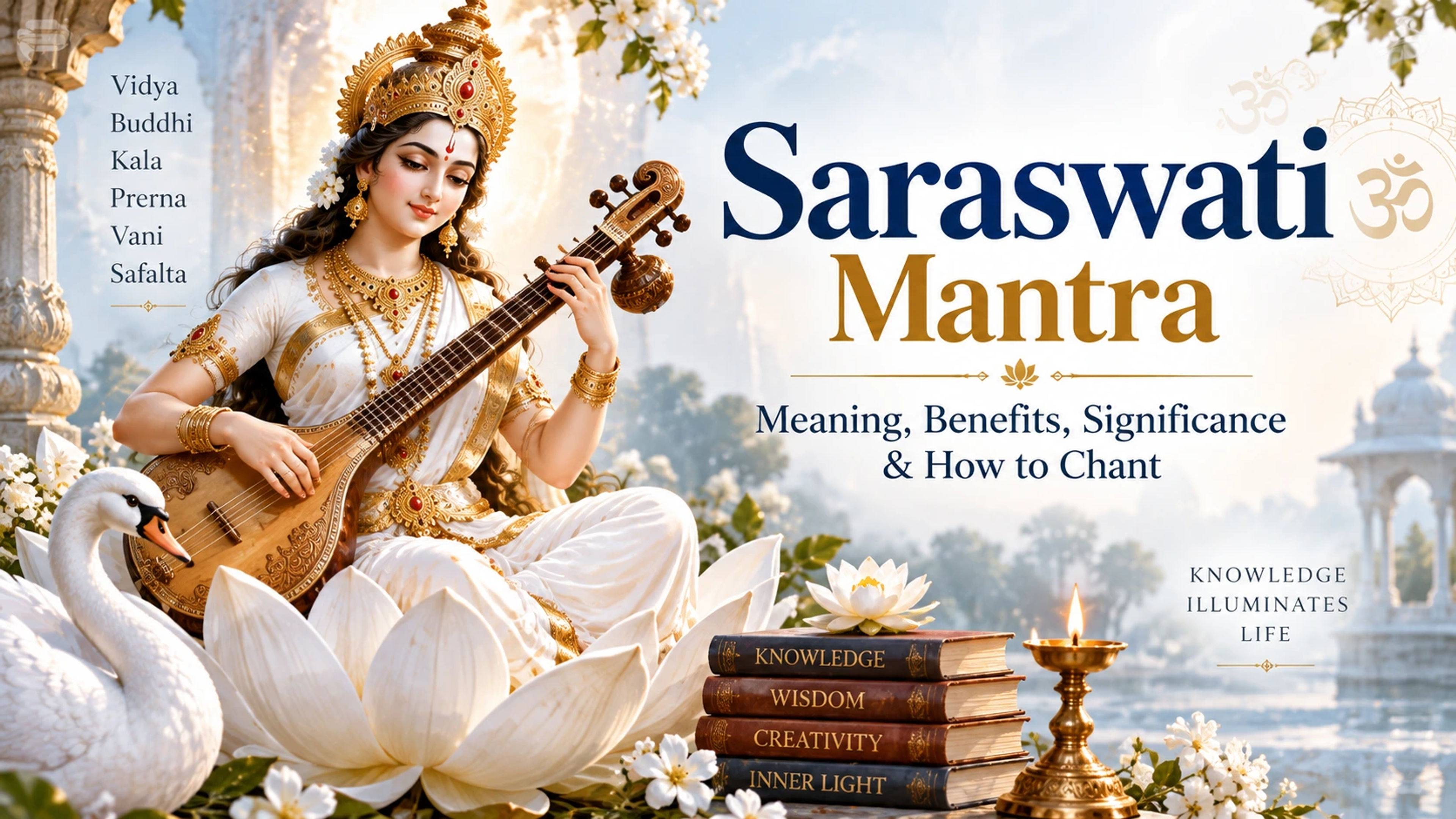
The Saraswati Mantra is chanted to invoke Goddess Saraswati, the deity of knowledge, learning, speech, music and the arts. It is one of the mantras students and lifelong learners turn to most often.
In this guide, you will find the correct Sanskrit text, transliteration and simple meaning of the most important Saraswati mantras, how they are traditionally chanted, how repetitions are counted, and how this connects to Vasant Panchami and Saraswati Puja.
Table of contents
Who Is Goddess Saraswati?
Saraswati is the goddess of knowledge, wisdom, learning, speech, music and the arts in Hindu tradition. She is usually shown dressed in white, seated on a white lotus, holding a veena (a stringed instrument), a book, and a rosary. Her association with the colour white is often read as a symbol of purity and clarity of thought. She is worshipped by students, teachers, musicians, writers and artists alike.
What Is a Saraswati Mantra?
A Saraswati Mantra is a short Sanskrit phrase repeated with devotion to invoke Goddess Saraswati. Aim (ऐं) is her beej, or seed sound, traditionally linked to speech, learning and creative expression. Namah means “I bow” or “salutations.”
The most commonly chanted Saraswati Mantra is Om Aim Saraswatyai Namah, but a few other Saraswati prayers are also widely used, each suited to slightly different purposes.
Mantra, Beej Mantra or Vandana — What’s the Difference?
Quick distinction
- Beej (seed) mantra — a single syllable like Aim. It has no literal dictionary meaning; its significance is traditionally understood to lie in sound, not translation.
- Mantra — a short phrase meant to be repeated many times (japa), such as Om Aim Saraswatyai Namah.
- Vandana / Stotra — a longer devotional verse or hymn, such as the well-known “Ya Kundendu Tushara Haradhavala.” It is usually recited once or a few times, not repeated on a mala the way a short mantra is.
Important Saraswati Mantras With Meaning
There are many Saraswati prayers in circulation online, but not all are equally established or practical for daily chanting. The three below were chosen for their traditional importance, search demand and beginner usefulness.
Most widely chanted
Om Aim Saraswatyai Namah
ॐ ऐं सरस्वत्यै नमः
Om Aim Saraswatyai Namah
Meaning: “Om, salutations to Goddess Saraswati.” Aim is Saraswati’s seed sound, Saraswatyai means “to Saraswati,” and Namah means “I bow.”
Traditional significance: This is the most common Saraswati mantra used for daily japa, considered accessible for beginners and students since it requires no initiation.
Saraswati Beej Mantra
Om Aim Namah
ॐ ऐं नमः
Om Aim Namah
Meaning: Aim (ऐं) is a bija — a seed syllable without a literal dictionary meaning. It is traditionally regarded as the sound-form of Saraswati’s energy connected to speech, learning and the arts.
Traditional significance: Used on its own for short daily chanting, or combined with Saraswati Namah for a slightly longer practice. Some traditions extend it further, such as Om Aim Mahasaraswatyai Namah.
Vedic-style invocation
Saraswati Gayatri Mantra
ॐ सरस्वत्यै च विद्महे ब्रह्मपुत्र्यै च धीमहि । तन्नो देवी प्रचोदयात् ॥
Om Sarasvatyai Cha Vidmahe Brahmaputryai Cha Dheemahi Tanno Devi Prachodayat
Meaning: “Om, let us meditate on Goddess Saraswati, the daughter of Brahma. May that Goddess inspire and guide our understanding.”
Traditional significance: Follows the Gayatri format used for many deities — an invocation asking for guidance and clarity rather than a request for a specific outcome.
Vandana, not a short mantra
Saraswati Vandana
या कुन्देन्दुतुषारहारधवला या शुभ्रवस्त्रावृता ।
Ya Kundendu Tushara Haradhavala Ya Shubhra Vastravrita (opening line)
Meaning: “She who is as white as the kunda flower, the moon and snow; who is dressed in pure white; whose hands hold the veena.” The full verse continues describing Saraswati seated on a white lotus and worshipped by Brahma, Vishnu and Shiva, asking her to remove mental dullness.
Traditional significance: One of the most recited Saraswati verses in Indian schools and during Saraswati Puja. Its exact authorship is not firmly established in scholarship — it is treated as a Puranic-era composition passed down through tradition rather than attributed to a single confirmed source.
Traditional Benefits of Chanting
Hindu tradition associates chanting Saraswati mantras with devotion to the goddess, remembrance of knowledge and wisdom, focus during learning, clarity in speech and expression, and support for musical or artistic practice. Many people also describe it simply as a calming, grounding daily discipline.
These are traditional and devotional beliefs, not scientifically established claims. Chanting a mantra does not guarantee exam success, higher marks, intelligence, a job, academic admission, or any specific memory or learning outcome. It is best approached as a devotional and personal practice, not a shortcut to a particular result.
Saraswati Mantra for Students
Because Saraswati is closely associated with learning, many students chant her mantra before starting to study, before exams, or as a short daily ritual to settle the mind. This is a personal and devotional habit, similar to how some people pause for a moment of quiet before an important task.
There is no scriptural or scientific claim that chanting alone improves grades or guarantees exam results. What it can offer is a small, consistent moment of focus before study begins — the actual learning still depends on the effort put into it.
How to Chant the Saraswati Mantra
- Beginners are welcome. No initiation is required to chant Om Aim Saraswatyai Namah or the beej mantra Om Aim Namah.
- Aloud or silently. Both are accepted. Many people chant softly or mentally (manasika japa) once they know the mantra well.
- A mala helps, but isn’t required. A 108-bead mala is a traditional aid for counting, not a condition for the mantra to work.
- Morning is commonly preferred. Many people chant Saraswati mantras early in the day or before study, though this is a common practice rather than a strict rule.
- Follow your own tradition first. If your family, school or a teacher has taught you a specific method, that takes priority over any general guide.
Counting Your Repetitions
Because Divya Marg is a Naam Jaap and mantra-counting app, here is a quick look at the common ways people count Saraswati mantra repetitions:
- 108-bead mala — the traditional method, one bead per repetition.
- Physical counters — handheld click-counters, useful when a mala isn’t practical, including during study breaks.
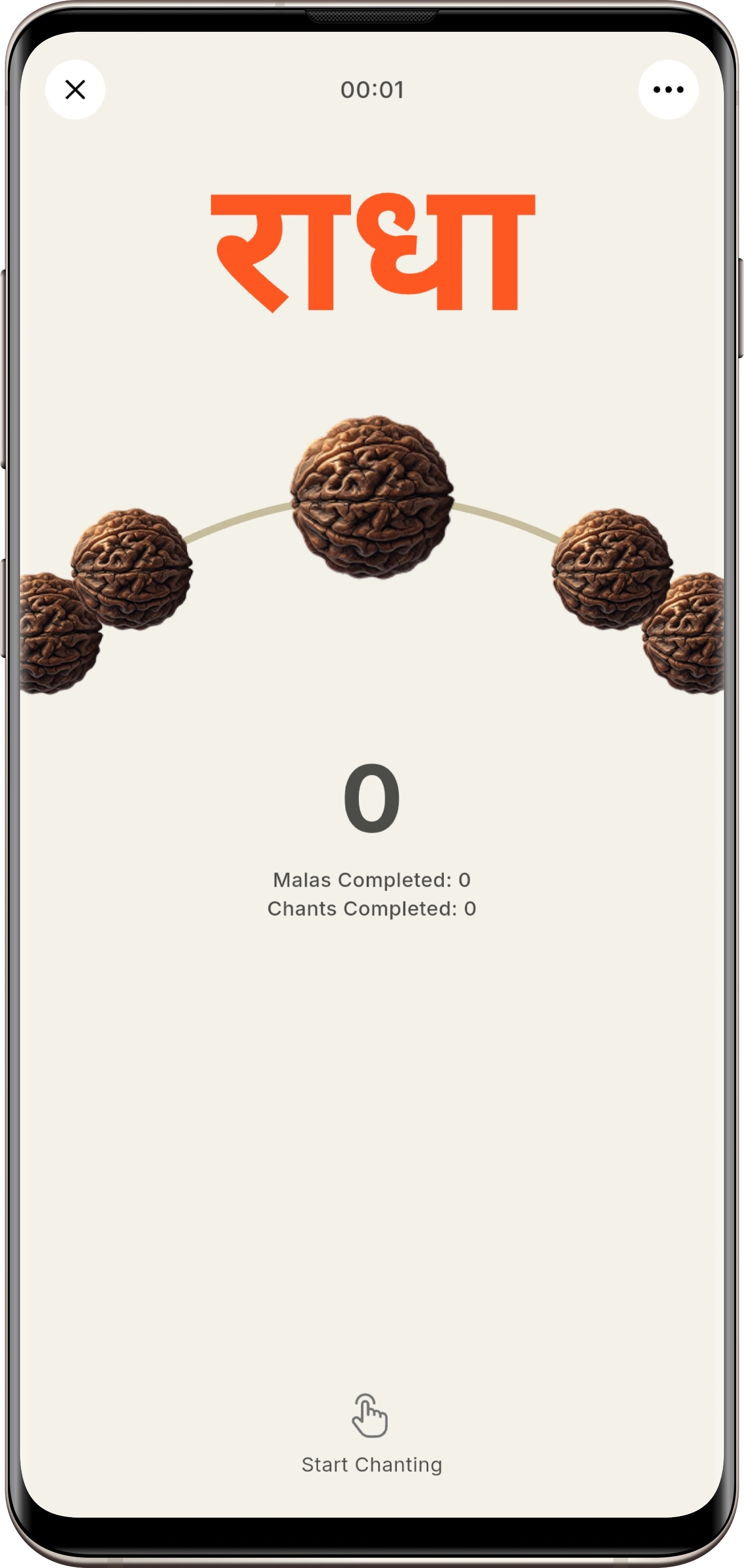
- Digital Jaap counters — apps that count taps or beads and track your daily total automatically.
108 is a well-known traditional count, but it is not a rule that applies to everyone. What matters most for a daily practice is picking a realistic, sustainable goal — for example, a short set before study each day — and staying consistent with it.
To understand daily chanting practice in more depth, see our guides on What Is Naam Jaap? Meaning, Benefits, How to Do It & Daily Practice and How to Do Naam Jaap: A Beginner’s Step-by-Step Guide.
Saraswati Mantra, Vasant Panchami & Saraswati Puja
Vasant Panchami (also called Basant Panchami) is widely celebrated across India as Saraswati Puja day, marking the arrival of spring and honouring the goddess of knowledge and the arts. Schools, colleges and homes often perform a small puja, place books and musical instruments near her image, and recite Saraswati mantras or the Saraswati Vandana as part of the day.
In parts of eastern India, this is one of the most important festivals of the year for students, while other regions mark it more simply. Customs vary by region and family, so it is worth following whatever tradition is practiced in your own home. Outside of the festival, the same mantras are just as valid for everyday chanting.
How Divya Marg Can Help
Once you have chosen a Saraswati mantra to chant, Divya Marg can help you keep the practice going:
Choose your Saraswati Naam
Set 'Saraswati' as your active Naam and begin anytime.
Daily Jaap goal
Set a realistic repetition target and let the app track it for you.
Haptic bead counting
Feel each repetition so your attention can stay on the mantra.
Works fully offline
Chant anywhere, signal or not.
Daily reminders
A gentle nudge at whatever time you choose to practice.
Simple progress tracking
See your chants, malas and streak without any setup.

Begin your Naam Jaap today
Offline-first and built entirely around one purpose — helping you show up for your practice, every single day.
- Free, always
- Works offline
- No ads

Frequently Asked Questions
Which Saraswati Mantra is best for beginners?
Om Aim Saraswatyai Namah is usually the easiest starting point. It is short, well known, and does not need any initiation or special training to begin chanting.
What does the Saraswati Mantra mean?
Om Aim Saraswatyai Namah means 'Om, salutations to Goddess Saraswati.' Aim is Saraswati's seed sound, Saraswatyai means 'to Saraswati,' and Namah means 'I bow.' The meaning of each word is explained above.
What is the Saraswati Beej Mantra?
The beej (seed) mantra of Saraswati is Aim (ऐं). It is a single syllable without a literal dictionary meaning, traditionally understood as the concentrated sound-form of her energy connected to speech, learning and the arts.
How should the Saraswati Mantra be pronounced?
Say it slowly at first: Om (as in home), Aim (rhymes with 'time'), Saras-vat-yai, Namah (na-mah). A simple transliteration is given above for each mantra to help with pronunciation.
How many times should I chant it?
There is no fixed rule. Many people use a 108-bead mala as a traditional count, but chanting fewer times with attention is generally considered better than rushing through 108 without focus. Beginners can start with any comfortable number, like 11 or 21.
Is 108 repetitions necessary?
No. 108 is a well-known traditional number linked to mala beads, but it isn't compulsory. What matters more for a lasting practice is consistency rather than hitting an exact count.
Can I chant the Saraswati Mantra without a mala?
Yes. A mala is a helpful counting tool, not a requirement for the mantra to be valid. You can count on your fingers, use a physical counter, or a digital Jaap counter like Divya Marg.
Can students chant the Saraswati Mantra?
Yes. Many students include it in their daily routine, often before starting study. It is best understood as a devotional practice for focus and calm rather than a guaranteed way to improve marks or exam results.
What is the connection between Saraswati Mantra and Vasant Panchami?
Vasant Panchami is widely celebrated as Saraswati Puja day, when the goddess is worshipped for knowledge, music and the arts. Many students and schools recite Saraswati mantras or the Saraswati Vandana on this day, though customs vary by region.