Why Did Sita Want the Golden Deer? The Untold Story of Maricha in the Ramayana

In the quiet forest of Panchavati, a deer appeared that did not look like any other creature of the woods. Its coat shone like gold, and it moved so gracefully that it seemed to belong to another world. The golden deer in Ramayana is one of the most famous episodes of the epic, because this single sighting changed the course of the story.
The deer was not what it appeared to be. It was Maricha, a rakshasa, who had been sent by Ravana to lure Lord Rama away from his hermitage. Behind the beautiful form lay a carefully planned deception, and Sita, Rama and Lakshmana were all drawn into it without knowing the truth.
This article answers the questions readers most often ask. Why did Sita want the golden deer? Who was Maricha? Why did Rama chase the animal, and why did Lakshmana doubt it? We follow the account of the Valmiki Ramayana, the oldest and most authoritative telling, and note where later traditions differ.
Table of contents
Key takeaways
- The golden deer was the rakshasa Maricha, who took this form at the command of Ravana as part of a plan to abduct Sita.
- Maricha had met Rama before and knew his power. According to Valmiki, he warned Ravana against the plan, but agreed once Ravana insisted.
- Sita was captivated by the deer's extraordinary beauty and asked Rama to obtain it. She had no way of knowing it was a disguise, and the text does not blame her for what followed.
- Maricha's dying cry in Rama's voice made Sita fear for Rama's life. Lakshmana left her to search for him, which gave Ravana the chance to abduct her.
- Spiritually, the episode is often read as a lesson on appearance versus reality, but the responsibility for the abduction rests with Ravana, not Sita.
The Golden Deer in the Ramayana: How the Story Begins
The episode belongs to the Aranya Kanda, the book of the Ramayana set in the forest. Lord Rama, Sita and Lakshmana were living in a hermitage at Panchavati, on the banks of the Godavari, during the fourteen years of Rama's exile. For some time their life there was simple and peaceful.
That peace had already been disturbed. Surpanakha, Ravana's sister, had been rebuffed and humiliated, and the rakshasas Khara and Dushana had been defeated by Rama when they attacked in revenge. Rama and his companions did not yet know that these events had set Ravana's mind on a darker course.
One day Sita saw a deer near the hermitage. Valmiki describes it as unlike any ordinary animal, with a shining golden coat marked with silver spots and a body that seemed to glow among the trees. It wandered close, then bounded away, then returned again, as if it wished to be noticed.
Sita was filled with wonder. She called Rama and Lakshmana to come and see the remarkable creature.
Who Was Maricha in the Ramayana?
Maricha was a rakshasa, the son of Tataka and the brother of Subahu. He first appears in the Bala Kanda, when the sage Vishwamitra took the young Rama and Lakshmana to guard his sacrifice. Maricha and Subahu had been defiling the rite with blood and flesh.
In that encounter Rama killed Subahu. Maricha was struck by a missile that hurled him far into the sea, and Rama did not kill him. Maricha never forgot the force of that blow.
In the Aranya Kanda, Maricha himself recalls a later, frightening meeting with Rama in the forest, again in the form of a deer. He escaped with his life, while his companions did not. Valmiki presents him as a rakshasa who had learned to fear Rama deeply.
This history matters because it explains the tension in the golden deer episode. Maricha was a master of illusion and shape-changing, which made him useful to Ravana. He was also one of the few who understood how dangerous Rama truly was.
Ravana's Plan: Why Did Maricha Become the Golden Deer?
After the defeat of Khara and Dushana, a rakshasa named Akampana carried the news to Ravana. He advised that Rama could not be beaten in open battle, and suggested that Ravana abduct Sita instead. Surpanakha's descriptions of Sita's beauty strengthened Ravana's resolve.
Ravana then went to Maricha and asked for his help. This is the heart of Ravana's plan to abduct Sita. If Rama and Lakshmana could be drawn away from the hermitage, Sita would be alone.
Maricha did not agree at once. According to Valmiki, he urged Ravana to give up the idea, reminding him of Rama's strength and warning that the plan would bring ruin upon Ravana and Lanka. He spoke from experience, having already felt Rama's power.
Ravana did not listen. When he pressed the matter, he made it clear that refusal would cost Maricha his life. Maricha concluded that if he must die, it was better to die at the hands of Rama than at the hands of Ravana, and he agreed to take the form of a golden deer.
This detail is worth noticing. Maricha was not a willing partner but a man who knew the danger and was compelled to proceed. The responsibility for the plan, though, rests with Ravana, who chose to ignore wise counsel.
Why Did Sita Want the Golden Deer?
Sita wanted the golden deer because she was struck by its extraordinary beauty. In the Valmiki Ramayana, the deer was designed to attract attention, and it succeeded. Nothing in the forest had prepared her to expect danger from a graceful animal wandering near her home.
She asked Rama to obtain it for her. The text records that she hoped it could be caught alive, to be kept at the hermitage and perhaps taken back to Ayodhya after the exile. She also said that if it could not be captured, its skin would be a beautiful thing to possess.
It helps to remember that Rama himself found the deer remarkable. A creature of such beauty would have drawn the attention of anyone, and Sita's wonder was natural. She could not have known that Ravana had set a trap.
The episode should never be reduced to blaming Mata Sita for what happened. The trap was built by Ravana and Maricha, and its entire purpose was to exploit an innocent moment of admiration.
Why Did Lakshmana Suspect the Deer?
Lakshmana was the first to doubt. He told Rama that he suspected the deer was Maricha in disguise, because a creature of this kind did not seem to exist in the natural world. In his view, the rakshasa had been known to take such forms to harm travellers and hunters in the forest.
His reasoning was careful and logical. The deer's beauty was too perfect, and its appearance near their hermitage too convenient. Lakshmana was acting as a protector, and his caution reflects the alertness expected of someone responsible for the safety of Rama and Sita.
Sita, however, was delighted and wanted the deer. This creates the central tension of the episode: Lakshmana's caution on one side, and Sita's sincere wish on the other. Neither was acting wrongly, since each was responding honestly to what they saw.
Why Did Rama Chase the Golden Deer?
Rama heard Lakshmana's suspicion and did not dismiss it. He too found the deer extraordinary, and said that if it was truly Maricha, it should be killed, since such rakshasas harmed many sages in the forest. Rama's decision therefore combined his wish to fulfil Sita's request with his duty to remove a possible threat.
Before leaving, Rama asked Lakshmana to stay with Sita and guard her carefully, in the company of the wise vulture Jatayu. Taking his bow, he set off after the deer.
The chase did not go as a simple hunt would. The deer appeared and vanished, drew close and then bounded away, leading Rama deeper into the forest. Maricha was doing exactly what Ravana had asked: pulling Rama far from Sita.
At last Rama became convinced that the creature was indeed Maricha, and he shot an arrow at it. Maricha fell and took back his true rakshasa form. Even in defeat, he had one more part of the plan to carry out.
Maricha's Final Deception: The Cry That Changed Everything
As he lay dying, Maricha imitated Rama's voice and called out the names of Sita and Lakshmana, as though Rama himself were in danger. It was a deliberate act of deception, meant to be heard back at the hermitage. Rama realised at once what the cry would do, and was troubled that Sita and Lakshmana might be alarmed.
Sita heard the voice and was frightened. She urged Lakshmana to go to Rama's aid. Lakshmana tried to reassure her, saying that no one in the three worlds could defeat Rama, and that the cry was certainly a rakshasa's illusion.
Sita's fear for Rama deepened, and in her distress she spoke harshly to Lakshmana. Her words came from anguish, not from malice, and they hurt him deeply. Valmiki shows Lakshmana leaving with a heavy heart, unwilling to abandon her but unable to bear her distress, and troubled by ill omens as he went.
Valmiki, Ramcharitmanas and the Lakshmana Rekha
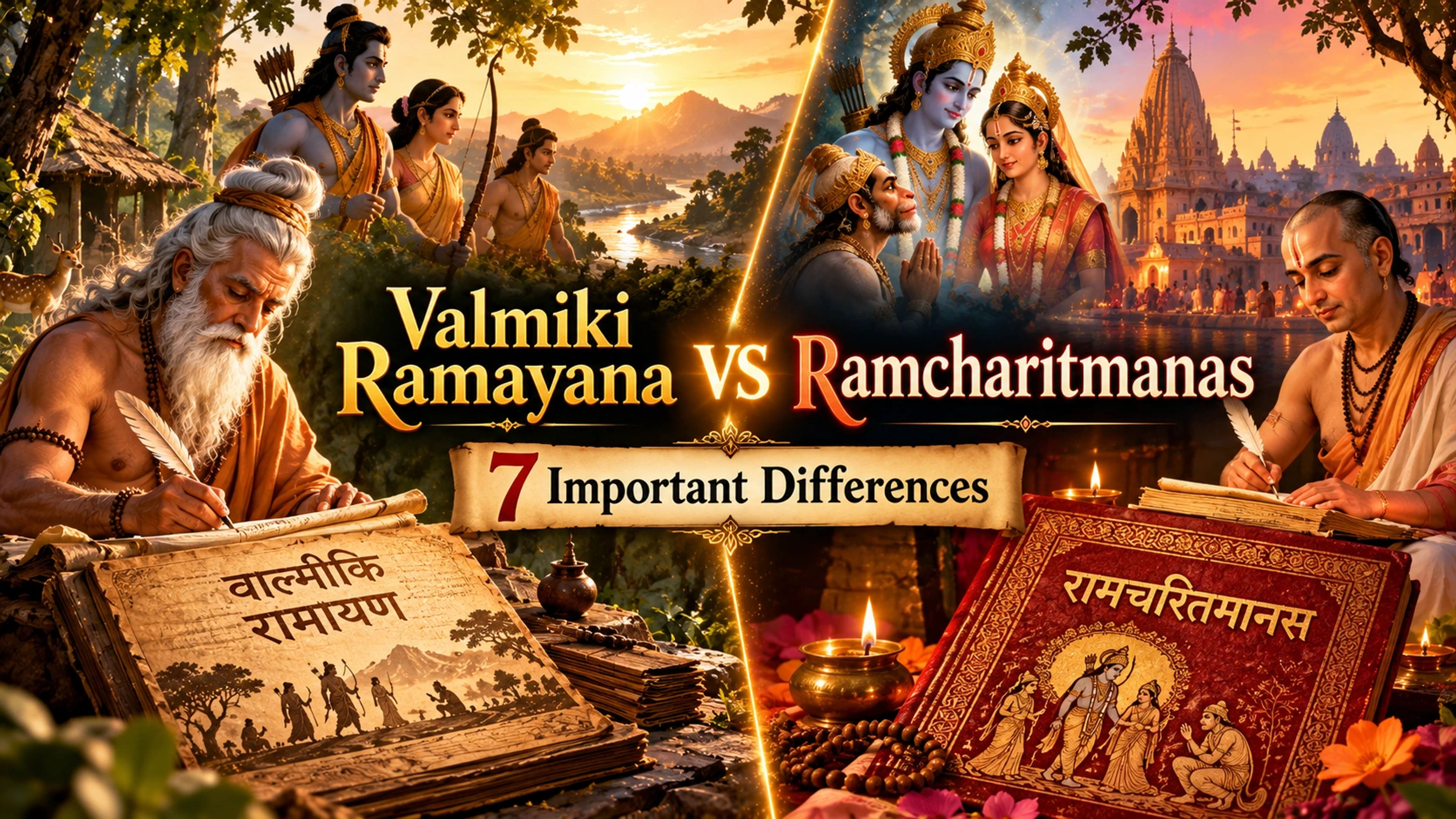
The popular image of Lakshmana drawing a protective line, the Lakshmana Rekha, is not found in the Valmiki Ramayana, and traditions differ on whether and how it appears. The Ramcharitmanas of Tulsidas tells the episode with a stronger devotional frame, presenting Rama as fully aware of the divine plan. Readers should treat the details of each telling as belonging to that tradition rather than to all of them.
How the Golden Deer Led to Sita's Abduction
With both Rama and Lakshmana gone, Sita was alone at the hermitage. This was the moment Ravana had been waiting for. He approached in the guise of a mendicant, a wandering holy man, which made him appear harmless.
Sita welcomed him with the courtesy due to a guest. Ravana then revealed his true identity and his intentions, and when she refused him, he seized her by force and carried her away in his chariot. Jatayu tried to stop him and fought bravely, but was gravely wounded.
The chain of events is clear. Ravana ordered Maricha to become the deer, the deer drew Rama away, Maricha's cry drew Lakshmana away, and the abduction followed. Every link was Ravana's design, built on deception.
| Character | Role in the episode |
|---|---|
| Ravana | Planned the abduction and commanded Maricha to take the deer's form. |
| Maricha | Became the golden deer, lured Rama away, and imitated Rama's cry. |
| Sita | Admired the deer and asked for it, without knowing it was a disguise. |
| Lakshmana | Suspected the deer, then left Sita after the false cry. |
| Rama | Pursued the deer to remove a possible threat and fulfil Sita's wish. |
The Deeper Meaning of the Golden Deer
The most common reading is that the golden deer represents appearance versus reality. Something beautiful and attractive can hide a harmful purpose. This is a spiritual and moral interpretation drawn by later teachers, not an explicit statement in the text.
A second reading concerns caution. Lakshmana's suspicion was correct, which shows the value of discernment. Yet the episode also shows that caution has limits: Lakshmana's fear for Sita's safety and her fear for Rama's life pulled him in two directions, and Ravana used that very conflict.
A third reading is that deception can harm many people at once. The deer deceived Sita, Rama and Lakshmana in different ways. It reminds us that dishonesty rarely affects only one person.
Some teachers also say the episode warns against being drawn by outward attraction. This is a helpful reflection, but it should not be stretched to claim that desire alone caused Sita's suffering. The text places the responsibility on Ravana's choices, and any lesson must respect that.
Five Lessons from the Golden Deer Episode
- Look beyond appearances. The deer was dazzling, but it concealed a plan. When something seems unusually perfect or convenient, it is wise to pause and look more carefully, as Lakshmana did.
- Listen to honest warnings. Maricha warned Ravana about Rama's power, and Ravana ignored him. In our own lives, advice from a person who has seen the consequences is worth taking seriously, even when it is unwelcome.
- Do not judge those who are deceived. Sita admired a beautiful animal and had no reason to suspect a trap. The fault lies with those who deceive, so we should respond to deception with compassion for its victims.
- Fear can cloud judgment. Sita's alarm at the false cry and Lakshmana's torn loyalty show how fear can push even good people into hard choices. Taking a moment to verify the facts before acting can protect us from such traps.
- Responsibility belongs to the one who plans harm. Ravana designed every step of the plan and refused good counsel. The episode teaches us to hold ourselves accountable for our own choices and not to shift the blame onto others.
Conclusion: A Turning Point in the Ramayana
The golden deer episode is a small scene with large consequences. Maricha, who feared Rama and had warned Ravana, became the instrument of a plan he did not wish to join. Ravana, ignoring wise advice, turned an innocent moment into a trap.
For devotees, the episode is a reminder to practise discernment, to stand by those we love, and to remember that deception is the fault of the deceiver. It marks the point where the Ramayana turns from forest life to the long search for Sita, the friendship with Lord Hanuman and the vanaras, and the great war that follows.
Who was the golden deer in the Ramayana?
The golden deer was the rakshasa Maricha, who took the form of a beautiful deer at Ravana's command. His purpose was to lure Rama away from the hermitage at Panchavati so that Ravana could abduct Sita.
Why did Sita want the golden deer?
Sita was captivated by the deer's extraordinary beauty and asked Rama to obtain it. In the Valmiki Ramayana she hoped it could be caught alive, and said its skin would be valuable if it could not. She did not know it was a disguise, and the text does not blame her for what followed.
Who was Maricha, and why did he help Ravana?
Maricha was a rakshasa, the son of Tataka, who had earlier been struck and flung into the sea by Rama's arrow during Vishwamitra's sacrifice. According to Valmiki, he warned Ravana against the plan, but agreed when Ravana insisted and threatened him, reasoning that death at Rama's hands was better than death at Ravana's.
Why did Rama chase the golden deer?
Rama chased the deer to fulfil Sita's wish and because, if it was Maricha, it posed a danger to the sages of the forest. Before leaving, he asked Lakshmana to stay and guard Sita carefully.
How did Maricha's cry deceive Sita and Lakshmana?
When Rama's arrow struck him, Maricha took his true form and imitated Rama's voice, calling out the names of Sita and Lakshmana as if Rama were in danger. Sita feared for Rama's life and urged Lakshmana to go. Although Lakshmana believed it was an illusion, he finally left her, which gave Ravana his chance.
How did the golden deer lead to Sita's abduction?
The deer drew Rama far from the hermitage, and Maricha's false cry then drew Lakshmana away. With Sita alone, Ravana approached disguised as a mendicant, revealed himself, and carried her off in his chariot. Every step was part of Ravana's plan.
Is the golden deer story the same in the Valmiki Ramayana and Ramcharitmanas?
The main events are similar: Maricha becomes the deer, Rama pursues it, the false cry is heard, and Ravana abducts Sita. However, details and emphasis differ. The Ramcharitmanas gives the episode a stronger devotional frame, and the Lakshmana Rekha does not appear in Valmiki, so it should not be treated as part of every telling.

Begin your Naam Jaap today
Offline-first and built entirely around one purpose — helping you show up for your practice, every single day.
- Free, always
- Works offline
- No ads