The Power of Naam Jaap: What the Vedas and Scriptures Say

Of all the forms of worship in Sanatan Dharma, none is simpler than naam jaap. No altar, no priest, no special time. Just a name, repeated with love.
And yet the scriptures speak of it as one of the most powerful practices of all. Shri Krishna himself says in the Gita that among all sacrifices, he is the japa yajna. In this article we trace what the Vedas, Upanishads, Yoga Sutras, Gita and Puranas tell us about the power of the Divine name.
Table of contents
Key takeaways
- The Rig Veda teaches that one Truth is called by many names, and invites us to utter Vishnu's name.
- The Upanishads describe Om as Brahman itself, and the Kali-Santarana Upanishad gives the Mahamantra.
- Patanjali defines japa as repetition with reflection on its meaning, and Krishna calls japa his own form among yajnas.
- The Puranas and saints declare naam to be the easiest and most powerful path in Kali Yuga.
- The Divya Marg app helps you keep count, track your sankalp and build a daily naam jaap habit.
What Is Naam Jaap?
Naam means name, and jaap (japa) means repetition. Naam jaap is the practice of repeating a name of God, or a mantra built around that name, again and again with devotion. It can be done aloud, in a whisper or silently in the mind, often counted on a mala of 108 beads.
It needs no temple, no priest, no special materials and no fixed time. That simplicity is exactly why it has become the most widely practised form of sadhana in Bharat.
Where the roots lie
The Vedas themselves do not use the phrase naam jaap. But the idea at its heart, that sacred sound and the names of the Divine carry power, runs from the Rig Veda through the Upanishads, the Gita and the Puranas. Below we follow that thread, one scripture at a time.
1. The Rig Veda: One Truth, Many Names
The oldest scripture of Sanatan Dharma already speaks of the Divine through names. One of its most famous verses says:
एकं सद्विप्रा बहुधा वदन्ति
Ekaṁ sad viprā bahudhā vadanti
Truth is one; the wise call it by many names (Rig Veda 1.164.46). Every name of God, whether Ram, Krishna, Shiva or Narayan, points to the same one reality. This is why devotees believe any sincere name can lead to the same goal.
A hymn to Vishnu in the Rig Veda goes further and invites us to speak his name. Vaishnava teachers often quote this line as a Vedic call to naam sankirtan:
आस्य जानन्तो नाम चिद्विवक्तन महस्ते विष्णो सुमतिं भजामहे
Āsya jānanto nāma cid vivaktana mahas te viṣṇo sumatiṁ bhajāmahe
Its sense: knowing him, utter his name; O Vishnu, we seek your great and gracious favour (Rig Veda 1.156.3).
The Gayatri: The Original Japa Mantra
The Rig Veda also gives us the Gayatri mantra (Rig Veda 3.62.10), which for thousands of years has been chanted daily as japa during sandhya vandana. In a sense, the Vedic tradition itself was the first school of japa: a sacred mantra, repeated with focus, every single day.
2. The Upanishads: The Power of Om
The Upanishads, the philosophical heart of the Vedas, teach that the sacred syllable Om is not just a sound but Brahman itself. The Mandukya Upanishad opens with:
ओमित्येतदक्षरमिदं सर्वम्
Om ity etad akṣaram idaṁ sarvam
Om, this syllable, is all this (Mandukya Upanishad 1). The Katha Upanishad adds that this syllable is Brahman, the supreme. If a single sacred syllable can contain everything, then repeating it with awareness is a way of turning the mind towards the infinite. This is the foundation of all mantra jaap.
The Kali-Santarana Upanishad
A minor Upanishad connected to the Krishna Yajurveda, the Kali-Santarana Upanishad, is devoted entirely to naam. In it, Narada asks Brahma how to cross the difficulties of Kali Yuga. Brahma answers with sixteen names of the Lord, the Mahamantra:
हरे राम हरे राम राम राम हरे हरे। हरे कृष्ण हरे कृष्ण कृष्ण कृष्ण हरे हरे॥
Hare Rāma Hare Rāma Rāma Rāma Hare Hare, Hare Kṛṣṇa Hare Kṛṣṇa Kṛṣṇa Kṛṣṇa Hare Hare
Brahma declares that these sixteen names destroy the impurities of Kali Yuga, and that no better means is seen in all the Vedas.
3. The Yoga Sutras: Japa with Meaning
Maharishi Patanjali, in the Yoga Sutras, gives one of the clearest definitions of japa ever written. Speaking of Ishvara (God), he says:
तस्य वाचकः प्रणवः ॥ तज्जपस्तदर्थभावनम् ॥
Tasya vācakaḥ praṇavaḥ. Taj-japas tad-artha-bhāvanam.
His name is Om. Its japa, with reflection on its meaning, is the practice (Yoga Sutras 1.27 and 1.28). Patanjali adds that this practice removes obstacles and turns the mind inward. The key word is bhavanam: japa is not mechanical repetition, but repetition with feeling and understanding.
4. The Bhagavad Gita: I Am the Japa Yajna
In the Gita, Shri Krishna describes the forms in which he is most fully present. Among them, he says:
यज्ञानां जपयज्ञोऽस्मि
Yajñānāṁ japa-yajño 'smi
Among sacrifices, I am the sacrifice of japa (Bhagavad Gita 10.25). Of all the great Vedic yajnas, with their fire altars, offerings and priests, Krishna chooses the simplest one, which anyone can perform anywhere, as his own form.
The Gita also teaches the power of the name at life's final moment: one who leaves the body uttering Om and remembering the Lord reaches the supreme goal (Bhagavad Gita 8.13).
5. The Smritis: Three Ways to Chant
The Manusmriti, one of the oldest texts of dharma, praises japa above elaborate rituals and describes three ways of doing it:
विधियज्ञाज्जपयज्ञो विशिष्टो दशभिर्गुणैः। उपांशुः स्याच्छतगुणः साहस्रो मानसः स्मृतः॥
Vidhi-yajñāj japa-yajño viśiṣṭo daśabhir guṇaiḥ, upāṁśuḥ syāc chata-guṇaḥ sāhasro mānasaḥ smṛtaḥ
| Type | How it is done | Merit described |
|---|---|---|
| Vachika | Chanted aloud | Ten times greater than ritual sacrifice |
| Upanshu | Whispered, lips moving, barely audible | A hundred times greater |
| Manasika | Silently, in the mind | A thousand times greater |
The message is beautiful: the more inward the chanting becomes, the deeper its power. Beginners usually start aloud, and the practice naturally grows quieter over time.
Chanting silently? Keep count without losing focus
Counting beads in your head pulls attention away from the name. The Divya Marg app counts every chant for you with a gentle vibration on each bead, so your mind can stay on the Lord, whether you chant aloud, in a whisper or silently.
6. The Puranas: The Path for Kali Yuga
By the time of the Puranas, naam jaap was celebrated as the path for our age. The Bhagavata Purana says that although Kali Yuga is an ocean of faults, it has one great quality:
कलेर्दोषनिधे राजन्नस्ति ह्येको महान्गुणः। कीर्तनादेव कृष्णस्य मुक्तसङ्गः परं व्रजेत्॥
Kaler doṣa-nidhe rājann asti hy eko mahān guṇaḥ, kīrtanād eva kṛṣṇasya mukta-saṅgaḥ paraṁ vrajet
Simply by chanting the Lord's name, one becomes free and reaches the supreme (Bhagavata Purana 12.3.51). The Brihan-Naradiya Purana puts it even more strongly, repeating itself three times for emphasis:
हरेर्नाम हरेर्नाम हरेर्नामैव केवलम्। कलौ नास्त्येव नास्त्येव नास्त्येव गतिरन्यथा॥
Harer nāma harer nāma harer nāmaiva kevalam, kalau nāsty eva nāsty eva nāsty eva gatir anyathā
The name of Hari, the name of Hari, only the name of Hari. In Kali Yuga there is no other way, no other way, no other way.
7. The Saints: Living Proof
What the scriptures taught, the saints lived. Goswami Tulsidas summed up centuries of teaching in one line of the Ramcharitmanas:
कलियुग केवल नाम अधारा। सुमिरि सुमिरि नर उतरहिं पारा॥
Kaliyuga kevala nāma adhārā, sumiri sumiri nara utarahiṁ pārā
In Kali Yuga, the name alone is the support; by remembering it again and again, people cross over. Kabir, Meera, Surdas, Chaitanya Mahaprabhu, Namdev, Tukaram and countless others built their entire spiritual lives on the name.
Why Naam Is Believed to Be So Powerful
- The name and the named are one. The tradition teaches nama-nami abheda: God's name is not different from God. To chant the name is to be in his presence.
- It is open to everyone. Unlike many Vedic rituals, naam jaap needs no special qualification, wealth or setting.
- It works on the mind. Repetition gives a restless mind one place to rest, which is the beginning of all meditation.
- It purifies gradually. The scriptures compare it to fire: whether you touch it knowingly or not, it burns away impurity.
- It goes with you everywhere. You can chant while walking, working or lying awake at night. No other sadhana is so portable.
From the Rig Veda to Tulsidas, the message is the same: the Divine can be reached through his name.
Your mala, always in your pocket
Naam jaap is meant to go with you everywhere, but a mala does not always fit into office hours, travel or a late-night commute. With Divya Marg on your phone, you can do a full mala anywhere, and your count is saved even if you are interrupted. Download Divya Marg
How to Begin Your Own Naam Jaap
- Choose a name you love. Ram, Krishna, Shiva, Radha or your Ishta Devata. Love matters more than the choice itself.
- Start small. One mala of 108 a day is a strong beginning.
- Keep a fixed time. Morning is ideal, but consistency matters more than the hour.
- Chant with meaning. Following Patanjali, remember who you are calling as you chant.
- Let it deepen naturally. Begin aloud, then move to a whisper, then to silent chanting, as the Manusmriti describes.
A simple place to start is the 13-syllable Ram mantra:
श्री राम जय राम जय जय राम
Shrī Rām Jay Rām Jay Jay Rām
Read our guide on the meaning of Shri Ram Jai Ram Jai Jai Ram and how to chant it on a mala.
Make Naam Jaap a Daily Habit with Divya Marg
The scriptures are clear about the power of naam. The hard part is not understanding it. It is doing it every day. Most of us start with enthusiasm, lose count halfway through a mala, miss a few days, and slowly stop.
We built Divya Marg to solve exactly that. It is a jaap companion that turns your phone into a mala and helps you keep your practice going, day after day.
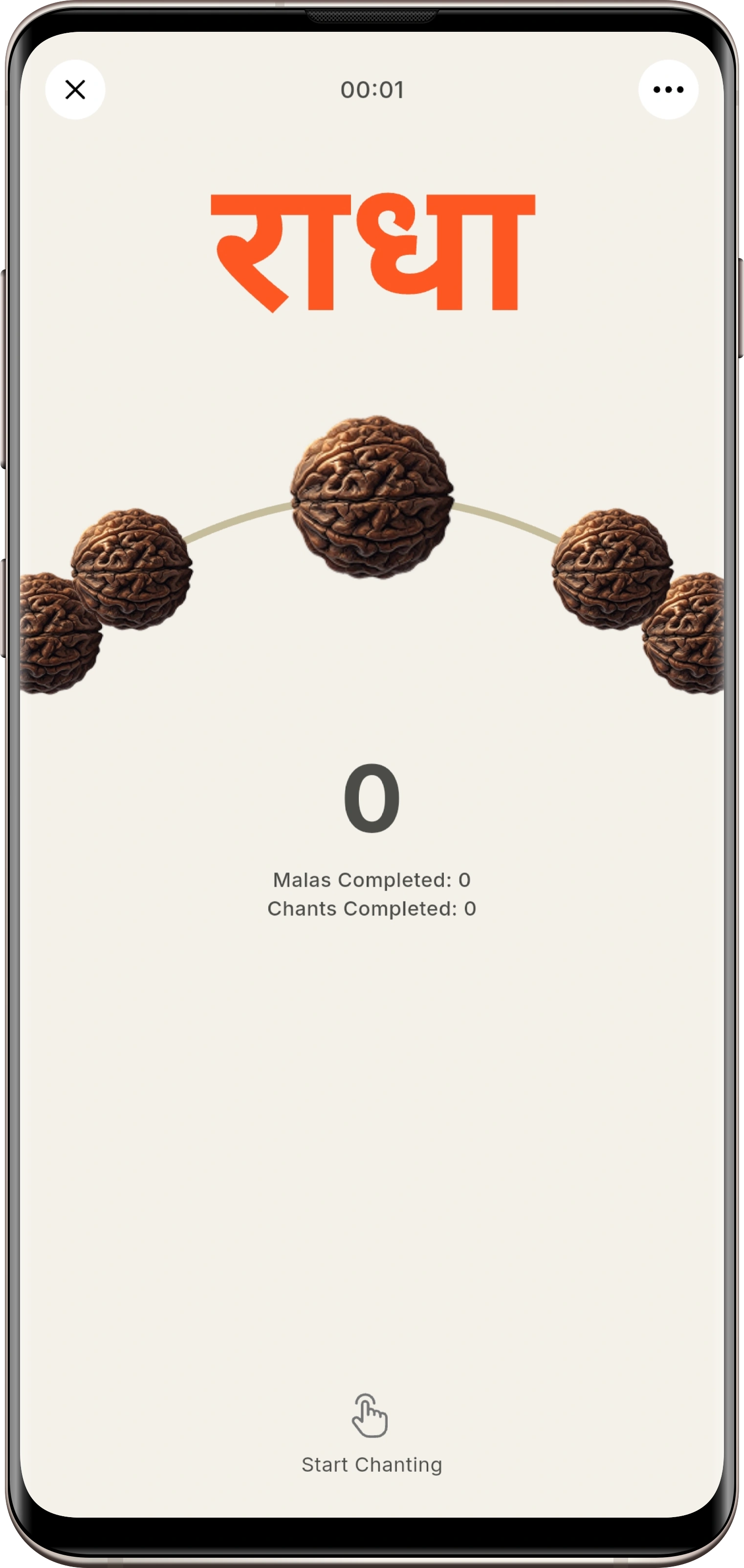
- A beautiful digital mala. Real bead visuals move with every chant, so it feels like chanting on a true mala.
- Gentle haptic feedback. Feel a soft vibration on each bead, and keep your eyes closed and your mind on the name.
- Never lose your count. Every session is saved automatically, even if you get interrupted midway.
- Daily goals and progress. Set a target and see how close you are to completing it each day.
- Privacy mode. Chant discreetly wherever you are.
- Sankalp tracking. Take a sankalp, like one lakh names, and watch your progress grow.
- Chant together. Start a group jaap with your family or friends, and celebrate together with a shareable completion card when you finish.
| Common struggle | How Divya Marg helps |
|---|---|
| Losing count in the middle of a mala | Counts every chant for you |
| Forgetting where you stopped | Saves every session automatically |
| Can't carry a mala to work or while travelling | Your mala is always on your phone |
| Losing motivation after a few days | Daily goals and sankalp progress keep you going |
| Chanting alone feels hard | Group jaap with family and friends |
Start Your First Mala in One Minute
- Install Divya Marg from the Google Play Store.
- Set your daily goal. One mala of 108 is a perfect start.
- Start chanting. Close your eyes, chant the name you love, and let the app keep count.
Krishna says he is present in the japa yajna. All it takes to begin is one mala, today. Download Divya Marg and start your naam jaap now.
Is naam jaap mentioned in the Vedas?
The phrase naam jaap is not used in the Vedas, but its roots are there. The Rig Veda speaks of the many names of one Truth and invites us to utter Vishnu's name, the Gayatri mantra has been chanted as japa since Vedic times, and the Upanishads describe Om as Brahman itself.
What does the Bhagavad Gita say about japa?
In Bhagavad Gita 10.25, Shri Krishna says that among all sacrifices, he is the japa yajna, the sacrifice of chanting. In 8.13 he says that one who leaves the body chanting Om and remembering him reaches the supreme goal.
Which is better: chanting aloud or silently?
The Manusmriti describes three kinds of japa and calls whispered chanting a hundred times greater than ritual sacrifice, and silent mental chanting a thousand times greater. Beginners often start aloud and move inward as their practice deepens.
Why is naam jaap called the path for Kali Yuga?
Texts like the Bhagavata Purana and Brihan-Naradiya Purana say that in Kali Yuga, chanting the name of the Lord is the simplest and most effective path, since elaborate rituals and austerities are hard to perform in this age. Tulsidas echoes this in the Ramcharitmanas.
Which name should I chant?
The Rig Veda teaches that one Truth is called by many names, so any sincere name of God can be chanted. Choose the name you feel most drawn to, such as Ram, Krishna, Shiva or Radha, and chant it regularly with devotion.
Is there an app to count naam jaap?
Yes. Divya Marg is a naam jaap app with a digital mala, haptic feedback on each bead, automatic session saving, daily goals, sankalp tracking and group jaap with family and friends. It is available on the Google Play Store.
Do I need initiation to do naam jaap?
Most traditions teach that chanting God's name is open to everyone and does not require formal initiation. Some specific mantras are traditionally given by a guru, but simple naam jaap can be started by anyone.

Begin your Naam Jaap today
Offline-first and built entirely around one purpose — helping you show up for your practice, every single day.
- Free, always
- Works offline
- No ads