Lord Dhanvantari: Story, Significance, Ayurveda, Health & Dhanvantari Mantra

Ask most people what Dhanteras is about and they will say gold, utensils and new purchases. That is part of the picture, but it is not where the festival began. Long before it became a day for shopping, Dhanteras was the day Hindu tradition remembers the birth of Lord Dhanvantari, the divine physician who rose from the ocean holding a pot of Amrita. He is the god of Ayurveda, and his day is a gentle reminder that health is the first form of wealth. In this article we walk through who Dhanvantari is, the story of Samudra Manthan, his place in Ayurveda, why he is honoured on Dhanteras and Dhanvantari Jayanti, and the Dhanvantari mantra that devotees chant for health and wellbeing.
Table of contents
Key takeaways
- Lord Dhanvantari is revered in Hindu tradition as the physician of the gods, an incarnation of Lord Vishnu, and the divine source of Ayurveda.
- According to the Puranas, he emerged from Samudra Manthan carrying the pot of Amrita.
- Dhanvantari Jayanti falls on Trayodashi of Kartik Krishna Paksha, the same day as Dhanteras. In 2026 that is Friday, 6 November.
- Popular Dhanvantari mantras include the short 'Om Dhanvantaraye Namah', the Dhanvantari Gayatri, and a longer mantra addressed to Dhanvantari as a form of Vishnu.
- Beginners can chant with or without a mala, silently or aloud. Consistency matters more than any fixed number.
Who Is Lord Dhanvantari?
But who exactly is Dhanvantari? In Hindu tradition he is known as the physician of the gods and the divine teacher of medicine. Devotees often call him Dhanvantari Bhagwan, and the Puranic tradition regards him as an avatar, or manifestation, of Lord Vishnu. The Bhagavata Purana counts him among Vishnu's appearances, and he is remembered both as the one who rose from the ocean and as the source from which the healing arts of Ayurveda flow.
His image is easy to recognise once you know what to look for. Dhanvantari is traditionally shown with a calm, gentle face and a dark, bluish complexion, dressed in yellow like Vishnu. He usually has four arms. In them he holds a conch (shankha), a chakra, a leech (jalauka) and a kalasha, a pot of Amrita. Some depictions show him with medicinal herbs or a text of Ayurveda instead of one of these. It is a quiet, reassuring figure: a god who comes not with weapons of war but with a vessel of nectar.
The Story of Dhanvantari and Samudra Manthan
To understand Dhanvantari, we have to go back to one of the great stories of Hindu tradition: Samudra Manthan, the churning of the cosmic ocean. The devas had lost much of their strength and prosperity, and Lord Vishnu advised them to work together with their rivals, the asuras, to churn the ocean of milk and bring out the Amrita, the nectar of immortality.
Mount Mandara became the churning rod, and the serpent Vasuki became the rope. Both sides pulled, the ocean heaved, and as the churning went on, many extraordinary things came out of the water: the divine cow, the wish-fulfilling tree, the goddess Lakshmi, and, along with them, a terrible poison that Lord Shiva drank to protect the worlds.
This is where the story becomes especially interesting. Near the end of the long churning, a radiant figure rose from the waters, carrying a kalasha filled with Amrita. That figure was Dhanvantari. The very thing the devas and asuras had struggled for arrived in the hands of a healer. Tradition therefore remembers him as the bearer of life-giving nectar, and over time that image grew into something larger: Dhanvantari as the divine physician, the giver of health and long life.
Dhanvantari and Ayurveda
His connection with Ayurveda goes much deeper than a single story. Ayurveda, the traditional Indian system of health, is understood in its own texts as a knowledge that came down from the divine to human teachers. In the Sushruta Samhita, one of the foundational Ayurvedic works and the classic source for surgery, the teaching is presented as coming from Dhanvantari, who is described in that tradition as the king of Kashi, often called Divodasa Dhanvantari. In the Puranic tradition, he is the same divine physician who emerged during Samudra Manthan.
Scholars note that Ayurveda's lineages are layered. Other major texts, such as the Charaka Samhita, trace their knowledge through different divine and sage teachers, and the figure of Dhanvantari appears in a mix of religious and textual traditions. What remains consistent across them is that Dhanvantari holds a special place as the god of Ayurveda and the patron of those who practise it.
That is why Dhanvantari Jayanti matters so much to Ayurveda practitioners. Vaidyas, physicians and students of Ayurveda often observe the day with special prayers, and the Government of India has marked the day of Dhanteras as National Ayurveda Day. For them, honouring Dhanvantari is a way of remembering that their work is meant to be a form of service, rooted in a long cultural tradition of care.
Why Is Dhanvantari Associated With Dhanteras?
According to tradition, Dhanvantari appeared on Trayodashi of Krishna Paksha in the month of Kartik, which is exactly the tithi on which Dhanteras (also called Dhantrayodashi) falls. That is why Dhanteras is also celebrated as Dhanvantari Jayanti, the day of his appearance. It opens the five-day Diwali festival, two days before Lakshmi Puja.
The word dhan is usually read as wealth, and Dhanteras is indeed a day to welcome Lakshmi and Kubera and to buy something auspicious. But many families also see the day as an invitation to think about what wealth is for. A person with gold but poor health cannot enjoy it, and this is exactly the thought the festival carries: before the lamps of Diwali are lit, we first pray for a healthy body and mind. In some homes and temples, Dhanvantari is worshipped alongside Lakshmi and Kubera on this evening, and buying medicines or health-related items is considered auspicious in some traditions.
In 2026, Dhanteras and Dhanvantari Jayanti fall on Friday, 6 November, with Diwali (Lakshmi Puja) on Sunday, 8 November. Exact puja timings depend on your city, so it is best to check a local panchang for the muhurat. If you are planning the rest of the festival, you can also follow our Dhanteras 2026 guide on Divya Marg for the full date and puja details.
The Dhanvantari Mantra
For devotees, this is also where the Dhanvantari mantra becomes meaningful. There is no single, universally fixed Dhanvantari mantra. Different traditions and temples use slightly different forms, from a simple one-line salutation to a longer invocation. Here are three that are widely recited, starting with the simplest.
1. Dhanvantari Beej Mantra (Short Mantra)
ॐ धन्वन्तरये नमः॥
Om Dhanvantaraye Namah
Meaning: Om, salutations to Lord Dhanvantari. This is the easiest place to start. It is short, easy to remember, and suited to daily Naam Jaap, especially for beginners.
2. Dhanvantari Gayatri Mantra
ॐ वासुदेवाय विद्महे सुधाहस्ताय धीमहि। तन्नो धन्वन्तरिः प्रचोदयात्॥
Om Vasudevaya Vidmahe Sudha-hastaya Dhimahi, Tanno Dhanvantarih Prachodayat
Meaning: We know Vasudeva and meditate on the one who holds the nectar in his hand. May Dhanvantari inspire and guide our thoughts. Written in the Gayatri metre, this is a meditative prayer, often chanted by those who like a slower, more reflective practice.
3. Dhanvantari Mantra (Invocation to Dhanvantari as Vishnu)
ॐ नमो भगवते वासुदेवाय धन्वन्तरये अमृतकलशहस्ताय सर्वामयविनाशनाय त्रैलोक्यनाथाय श्रीमहाविष्णवे नमः॥
Om Namo Bhagavate Vasudevaya Dhanvantaraye Amrita-kalasha-hastaya Sarvamaya-vinashanaya Trailokya-nathaya Shri Maha-Vishnave Namah
Meaning: Om, salutations to the Lord Vasudeva, to Dhanvantari, who holds the pot of Amrita in his hand, who removes all ailments, the lord of the three worlds, Shri Maha Vishnu. This is the mantra most often seen on posters and in puja guides, and it ties Dhanvantari directly to his identity as a form of Vishnu. You may come across versions of this mantra that add or change a few words, depending on the temple or family tradition. If you have a mantra given by a guru or family elder, that is the one to keep.
Dhanvantari Mantra for Health and Wellbeing
Most people searching for a Dhanvantari mantra for health are looking for something quite simple: a way to pray for themselves or for someone they love. That makes sense. Dhanvantari is traditionally the god of Ayurveda, of healing, and of Amrita, and devotional traditions turn to him for health, protection from illness, and a long, well-lived life. Chanting his name is a way of placing that wish in the hands of the deity who is most closely associated with it.
Many devotees also find that the practice itself brings steadiness. Sitting quietly for a few minutes each morning, repeating a sacred name with attention, tends to calm the mind, and a calmer mind is a good companion to any effort towards wellbeing. That is a gentle benefit of regular Jaap, and it fits naturally with the spirit of Dhanvantari worship. Mantra chanting is a spiritual practice and does not replace medical care. If you or a family member is unwell, you can pray to Dhanvantari and also see a doctor, which is what most devotees naturally do.
How to Chant the Dhanvantari Mantra
If you are new to the practice, you do not need to make it complicated. A few simple things are enough.
- When: Early morning after a bath is a popular time, because the mind is fresh and the house is quiet. But the mantra can be chanted at any peaceful time of day.
- On special days: Dhanteras and Dhanvantari Jayanti are traditional days to chant it, often during the puja or in the evening with a lit diya.
- Daily practice: It works well as part of a regular Naam Jaap routine. Many people chant a short mantra such as 'Om Dhanvantaraye Namah' every day.
- Mala: A mala is helpful but not necessary. If you have a tulsi or rudraksha mala, you can use it. If not, you can simply count on your fingers or use a counter.
- Silent or aloud: Both are accepted. Some people prefer to chant softly aloud, others silently in the mind. Choose whichever helps you concentrate.
- Posture: Sit comfortably with a straight back, keep your mind calm, and chant at a natural pace. There is no need for strict rules.
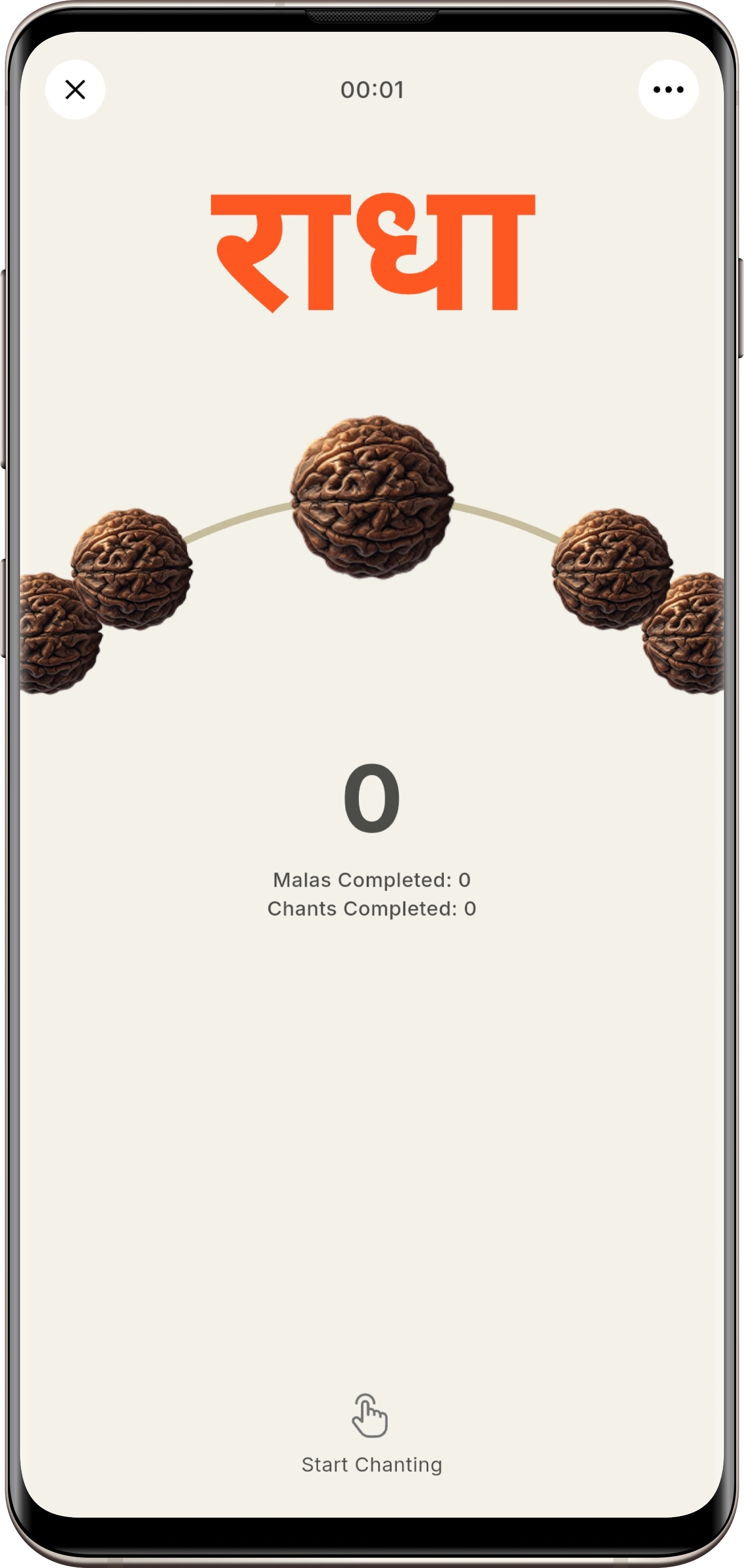
If you want a simple way to keep track, you can use Divya Marg for offline Jaap counting. It lets you set daily goals, track malas and counts, and see your progress over time, which can help when you want to build a steady Naam Jaap habit.
How Many Times Should You Chant the Dhanvantari Mantra?
There is no single number that every tradition requires. The most common practice is 108 repetitions, which is one full mala. The number 108 is considered sacred in many Hindu and yogic traditions, and a mala of 108 beads makes counting easy: you complete one round and you know exactly how much you have done.
That said, beginners do not have to start there. You can begin with 11, 21 or one round of 27 and slowly work upwards. Some devotees take a resolve to chant a larger number on Dhanvantari Jayanti, or a fixed count for a set number of days. All of these are personal choices. What tends to matter more is consistency: a small practice kept up every day usually does more for you than a large one that you abandon after a week.
Dhanvantari Puja: A Simple Overview
Dhanvantari worship does not need elaborate arrangements. Many families follow a simple pattern, though the details vary from region to region and from home to home.
- Clean the puja space and place an image or idol of Lord Dhanvantari. On Dhanteras, he is often placed alongside Lakshmi and Kubera.
- Light a diya and incense.
- Offer flowers and fruit. Some traditions offer sweets, and some mention yellow sweets for Dhanvantari.
- Chant a Dhanvantari mantra, and offer an aarti or prayer for the health of your family.
- Share the prasad with everyone at home.
Treat this as a gentle outline rather than a strict rulebook. A heartfelt prayer with a lamp and a flower is just as meaningful as a long ritual, and families who have their own customs should follow them.
What Dhanvantari Symbolises
Every part of Dhanvantari's image carries a meaning. The kalasha of Amrita stands for life, vitality and the healing power of nature, and the idea that true medicine is a form of divine grace. The conch is associated with the sacred sound that awakens and purifies, and the chakra with the protective order of Vishnu, a reminder that Dhanvantari is part of Vishnu's care for the world.
The leech, which may surprise first-time viewers, points to Ayurveda's old practices of treatment, where leeches were used in certain therapies. Together these symbols portray a god who does not simply grant health from a distance but represents the whole tradition of careful, compassionate medicine. Even his calm expression carries a message: healing begins with patience.
Dhanvantari, Ayurveda and Modern Readers
Today, Dhanvantari worship is best understood as a devotional tradition, and chanting his mantra can be a meaningful part of a spiritual routine. It can bring calm, gratitude and a sense of connection. If you are dealing with a health condition, it is sensible to also consult a qualified doctor or Ayurvedic practitioner, and to see prayer and treatment as walking side by side.
Frequently Asked Questions About Lord Dhanvantari
Who is Lord Dhanvantari?
Lord Dhanvantari is the physician of the gods in Hindu tradition and is regarded as an avatar of Lord Vishnu. He is revered as the divine source of Ayurveda and is traditionally shown holding a pot of Amrita, a conch, a chakra and a leech.
What is Lord Dhanvantari known for?
He is known for emerging from Samudra Manthan with the pot of Amrita, and for being the god of Ayurveda, healing and health.
What is the Dhanvantari mantra?
Several mantras are used. The simplest is 'Om Dhanvantaraye Namah'. Others include the Dhanvantari Gayatri ('Om Vasudevaya Vidmahe Sudha-hastaya Dhimahi, Tanno Dhanvantarih Prachodayat') and a longer invocation beginning 'Om Namo Bhagavate Vasudevaya Dhanvantaraye'.
What is the Dhanvantari mantra for health?
Devotees commonly chant 'Om Dhanvantaraye Namah' or the Dhanvantari Gayatri as a prayer for health and wellbeing. It is a devotional practice and can be followed alongside regular medical care.
When should I chant the Dhanvantari mantra?
Early morning is a popular time, but any calm time works. Dhanteras and Dhanvantari Jayanti are especially traditional days for chanting.
How many times should I chant the Dhanvantari mantra?
108 times (one mala) is the most common count, but beginners can start with 11, 21 or 27 and build up gradually. No single number is universally required.
Why is Dhanvantari worshipped on Dhanteras?
Tradition holds that Dhanvantari appeared on Trayodashi of Kartik Krishna Paksha, the same day as Dhanteras. The day is therefore also known as Dhanvantari Jayanti.
What is the connection between Dhanvantari and Ayurveda?
Dhanvantari is regarded as the divine physician and patron of Ayurveda. The Sushruta Samhita presents its teachings as coming from Dhanvantari, and Ayurveda practitioners honour him on Dhanvantari Jayanti.
Who can chant the Dhanvantari mantra?
Anyone with faith and a sincere intention can chant it. If you have a mantra from a guru or family tradition, you may prefer to keep to that.
Can I chant the Dhanvantari mantra without a mala?
Yes. A mala is helpful for counting but is not required. You can count on your fingers or use a Jaap counter, such as the offline counting in Divya Marg.
What is Dhanvantari Jayanti?
It is the birth anniversary of Lord Dhanvantari, observed on Trayodashi of Kartik Krishna Paksha along with Dhanteras. In 2026 it falls on Friday, 6 November.
Begin your Naam Jaap today
Offline-first and built entirely around one purpose — helping you show up for your practice, every single day.
- Free, always
- Works offline
- No ads