
Shani Mantra: Meaning, Benefits, Significance & How to Chant

Shani Dev is often talked about with fear online — pages warning of bad luck, punishment, and misfortune if you don’t chant a certain mantra. That is not how this guide approaches it.
Here you will find the Shani mantras that genuinely matter — their Sanskrit, meaning and traditional significance — along with a calm, factual look at Saturday worship and Sade Sati, written for a complete beginner.
Table of contents
Who Is Shani Dev?
Shani Dev is the Hindu deity associated with the planet Saturn, and is one of the Navagraha — the nine celestial beings central to Hindu astrology. He is traditionally described as the son of Surya (the Sun god) and Chhaya, and the elder brother of Yama, the god of death and justice. In Puranic tradition, Shani is associated with karma, justice, discipline and the consequences of one’s actions — not as a figure of punishment for its own sake, but as a reminder of accountability, patience and hard-earned growth.
What Is a Shani Mantra?
A mantra is a sacred sound, word or short verse repeated with attention and devotion. A Shani Mantra is any such mantra addressed to Shani Dev. These range from a short salutation mantra, to a seed (beej) mantra built from sacred syllables, to a Gayatri-style prayer asking for guidance. Longer devotional hymns about Shani — such as the Dashrath-krit Shani Stotra, traditionally associated with King Dashrath — are technically stotras (praise-hymns) rather than mantras, and are usually recited in full rather than counted on a mala.
Why Do Devotees Chant Shani Mantras?
Traditionally, Shani Mantras are chanted for devotional and reflective reasons connected to what Shani represents in Hindu thought:
- Discipline and patience — Shani is associated with steady, long-term effort rather than quick results.
- Humility and self-reflection — a traditional theme in Shani worship is looking honestly at one’s own actions.
- Devotion (bhakti) — chanting as an act of respect and remembrance, like worship of any deity.
- Spiritual steadiness — some traditional sources associate regular chanting with a sense of calm and resilience during difficult periods.
A note on benefit claims
These are traditional, devotional and astrological beliefs — not scientifically verified claims. Chanting Shani Mantra does not guarantee removal of Sade Sati, wealth, job or business success, protection from every difficulty, or any specific outcome. It is not a substitute for medical, legal or financial advice. Many devotees find a calm, regular practice personally steadying, but that experience is individual, not guaranteed.
Important Shani Mantras at a Glance
A few Shani mantras are both traditionally well-established and genuinely useful for a beginner. Here is a quick overview before we look at each one in detail.
| Mantra | Type | Best for |
|---|---|---|
| Om Sham Shanaishcharaya Namah | Mool (root) mantra | Beginners; short daily chanting |
| Om Praam Preem Praum Sah Shanaishcharaya Namah | Beej (seed) mantra | Focused, regular Saturday practice |
| Shani Gayatri Mantra | Gayatri-style mantra | Seeking clarity, reflection, guidance |
| Nilanjan Samabhasam | Dhyana (meditation) shloka | Visualising Shani before japa |
1. Shani Mool Mantra — Om Sham Shanaishcharaya Namah
ॐ शं शनैश्चराय नमः
Om Sham Shanaishcharaya Namah
| Om | The primordial, universal sound. |
| Sham | The seed syllable associated with Shani. |
| Shanaishcharaya | “To Shanaishchara” — “the slow-moving one,” a name for Shani describing Saturn’s slow orbit. |
| Namah | “I bow” / “I offer salutations.” |
Simple meaning: “I bow to Shanaishchara (Shani), the slow-moving one.” This short mantra follows the common “Om [seed syllable] [deity]-aya Namah” pattern used across many Sanskrit mantras. It is one of the simplest, most accessible ways for a beginner to start a Shani chanting practice.
2. Shani Beej Mantra
ॐ प्रां प्रीं प्रौं सः शनैश्चराय नमः
Om Praam Preem Praum Sah Shanaishcharaya Namah
This is the most widely recognised Shani Beej Mantra. It strings together three seed (bija) sounds — Praam, Preem, Praum — along with the sound Sah, before the salutation to Shanaishchara. Because it uses multiple seed syllables rather than a simple sentence, it is considered a slightly more structured mantra than the mool mantra above, and is commonly chanted by devotees with an established daily or Saturday practice.
Simple meaning: A devotional salutation to Shani, invoking his sacred sound-forms while asking for his steadying, disciplined influence. As with other beej mantras, some devotees prefer to learn the precise pronunciation from a teacher, though it is also widely chanted informally today.
3. Shani Gayatri Mantra
ॐ काकध्वजाय विद्महे खड्गहस्ताय धीमहि तन्नो मन्दः प्रचोदयात्
Om Kakadhvajaya Vidmahe Khadga Hastaya Dhimahi Tanno Mandah Prachodayat
This mantra follows the familiar three-part Gayatri structure used for Gayatri mantras dedicated to other deities such as Krishna, Rama and Shiva. Here, Shani is addressed as Kakadhvaja (“the one whose banner bears a crow”) and Manda (“the slow one,” referring to Saturn’s slow orbit).
Simple meaning: “We meditate on the crow-bannered one; we contemplate the one who holds a sword. May that Manda (Shani) inspire and illumine our intellect.” You may also come across a common variant, Om Shanaishcharaya Vidmahe Suryaputraya Dhimahi Tanno Mandah Prachodayat (“we meditate on Shanaishchara, the son of Surya”), which is equally widespread; both forms are accepted across different devotional sources.
4. Nilanjan Samabhasam (Dhyana Shloka)
नीलाञ्जनसमाभासं रविपुत्रं यमाग्रजम् । छायामार्तण्डसम्भूतं तं नमामि शनैश्चरम् ॥
Nilanjana Samabhasam Raviputram Yamagrajam, Chhaya Martanda Sambhutam Tam Namami Shanaishcharam
This is technically a dhyana shloka — a meditation verse describing Shani’s form — rather than a mantra in the strict sense, though it is chanted extremely widely and is often treated as one in everyday practice. It appears in Navagraha devotional literature associated with the nine planetary deities.
Simple meaning: “I bow to Shanaishchara, who shines like dark collyrium (kajal), the son of the Sun and elder brother of Yama, born of Chhaya and Martanda (the Sun).” Many devotees recite this verse first, to bring Shani’s form to mind, before beginning japa of the mool or beej mantra.
Shani Dev and Saturday (Shaniwar)
In the Navagraha system, each day of the week is traditionally linked to one of the nine celestial beings. Saturday (Shanivar) is Shani’s day — which is why Saturday is considered the most significant day for Shani Dev worship, including visiting a Shani temple, lighting a mustard or sesame (til) oil lamp, and chanting Shani mantras.
This does not mean Shani can only be worshipped on Saturday. Many devotees include a short Shani mantra as part of a daily practice, and simply give it extra attention on Saturdays.
Sade Sati, Dhaiya & Shani Dosha — Explained Calmly
These terms come from Vedic astrology (jyotish), and it is worth understanding them plainly, without drama:
- Sade Sati — a period of roughly seven and a half years when, according to Vedic astrology, Saturn transits the twelfth, first and second houses counted from a person’s Moon sign.
- Shani Dhaiya (Dhaiyya) — a shorter, roughly two-and-a-half-year period when Saturn transits the fourth or eighth house from the Moon sign, also considered significant in Vedic astrology.
- Shani Dosha — a general astrological term used when Saturn is considered weak, afflicted, or unfavourably placed in a person’s birth chart.
These are traditional astrological concepts, not scientifically established facts, and different astrologers and traditions interpret their effects differently. Many devotees choose to chant Shani mantras during these periods as a form of devotion, patience and steadiness. This is best understood as a traditional spiritual support — not a guarantee that the period, or any specific difficulty connected to it, will be removed.
Which Shani Mantra Should You Chant?
There is no single “correct” mantra for everyone. As a general, non-prescriptive guide:
- New to chanting? Start with the short mool mantra, Om Sham Shanaishcharaya Namah.
- Want a more structured daily or Saturday practice? The Shani Beej Mantra is a well-established choice.
- Looking for reflection and guidance? The Shani Gayatri Mantra is traditionally chanted with this intention.
- Want to begin with visualisation? Recite the Nilanjan Samabhasam shloka before your japa.
If you already consult an astrologer or follow a specific tradition, their guidance should always take priority over any general guide, including this one.
How to Chant a Shani Mantra
Shani mantras are simple to start, even for a complete beginner:
- Aloud, softly, or silently — all three are accepted. Beginners often start aloud or softly, which helps with focus.
- A calm, quiet space — a clean setting is traditionally preferred, though the mantra can be chanted anywhere that feels comfortable.
- Saturday, or any day — Saturday is traditionally emphasised, but a daily practice on any day is also widely accepted.
- Consistency over intensity — a short, regular practice is generally considered more valuable than a long session done rarely.
- Pronunciation — aim for clarity rather than perfection. Sincere, attentive chanting matters more than getting every Sanskrit sound exactly right.
Counting Repetitions & the Number 108
Japa (repeated mantra chanting) is traditionally counted, and 108 is the most common count across Hindu mantra practice — which is why a standard japa mala has 108 beads plus one “guru bead.” Some traditional sources describe larger cumulative counts for Shani mantras built up gradually over weeks or months rather than in a single sitting; treat any such larger number as a long-term traditional guideline, not something to attempt all at once.
Common ways devotees count repetitions include:
- A 108-bead japa mala — the most traditional method, often an iron or rudraksha mala for Shani chanting specifically, moving one bead per repetition.
- Fingers — counting on the finger joints when a mala is not available.
- Physical clickers/counters — small handheld counters used by some devotees.
- Digital Jaap counters — mobile apps that count taps or use gentle vibration feedback for each repetition.
Importantly, 108 is not compulsory. Many beginners start with a smaller, comfortable number of repetitions and build up gradually, rather than feeling pressured to complete a large count immediately.
How Divya Marg Can Help
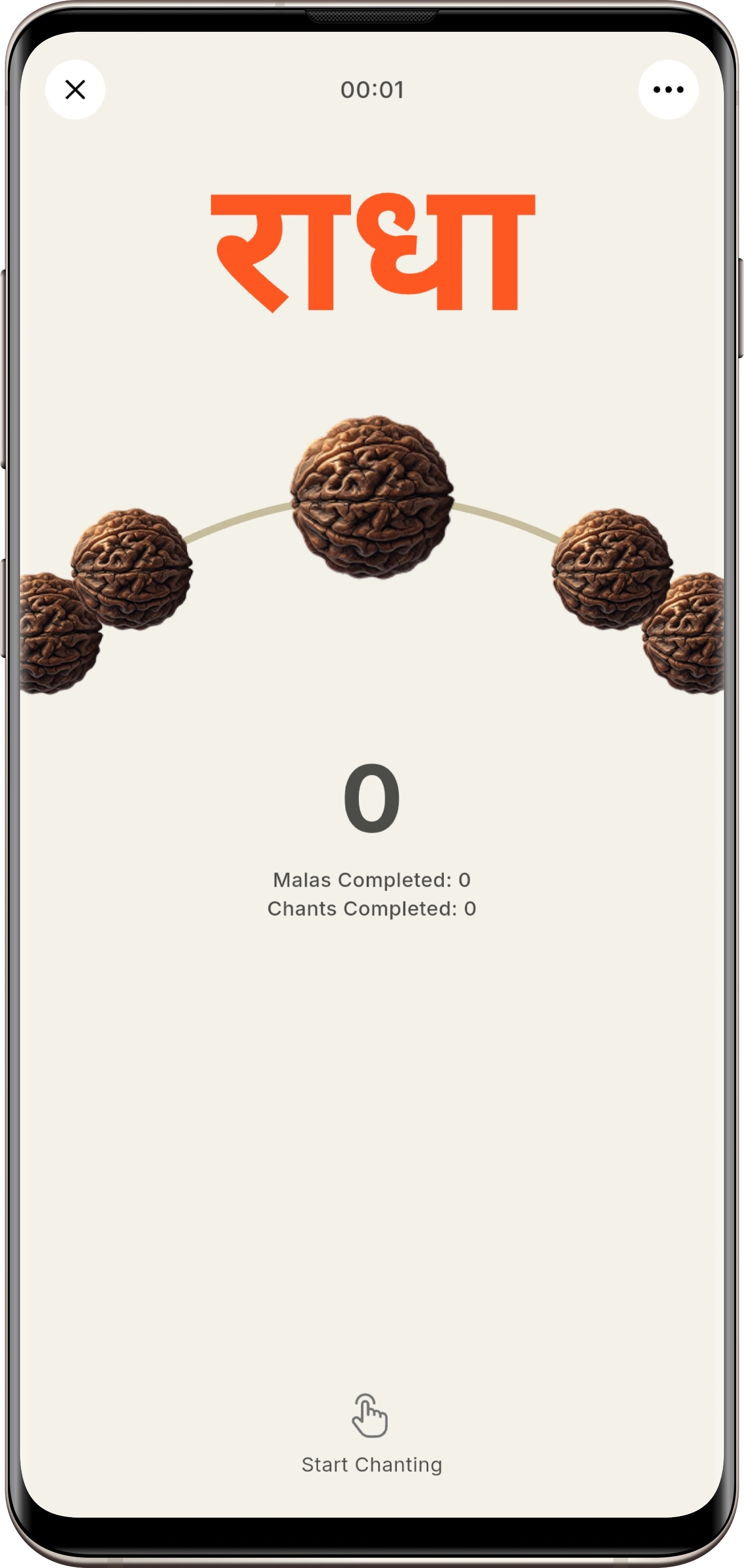
Once you have chosen a Shani mantra, the next step is simply staying consistent. Divya Marg is a Naam Jaap and mantra-counting app that can help with the practical side of this:
Set your Shani mantra
Add your chosen Shani mantra as your active Naam and begin anytime.
Daily Jaap goal
Set a repetition or round goal that fits your day, and let the app track it.
Haptic bead counting
Feel each repetition through gentle vibration, so your focus stays on the mantra.
Works fully offline
Chant anywhere — at home, at a temple, or while travelling.
Daily reminders
A gentle nudge at a time you choose, including Saturdays if you prefer.
Simple progress tracking
See your daily chants, completed malas and streak at a glance.
In short: learn a Shani mantra, chant it in a calm and unhurried way, and use Divya Marg only to help you count repetitions and stay consistent — the practice itself always comes first.

Begin your Naam Jaap today
Offline-first and built entirely around one purpose — helping you show up for your practice, every single day.
- Free, always
- Works offline
- No ads

Frequently Asked Questions
Which Shani Mantra is best for beginners?
The short mool mantra, Om Sham Shanaishcharaya Namah, is easy to learn and widely used as a starting point. Beginners can also simply chant 'Shani Dev' or 'Shanaishcharaya Namah' with attention before moving on to longer mantras.
What does Shani Mantra mean?
It depends on the mantra. Om Sham Shanaishcharaya Namah means 'I bow to Shanaishchara (Shani).' The Shani Beej Mantra combines several seed sounds as a salutation to Shani. The Shani Gayatri Mantra asks Shani to guide and illuminate the intellect.
What is the Shani Beej Mantra?
The Shani Beej Mantra is Om Praam Preem Praum Sah Shanaishcharaya Namah. It combines the seed (bija) sounds Praam, Preem and Praum with a salutation to Shanaishchara, and is one of the most commonly chanted Shani mantras in traditional practice.
How should Shani Mantra be pronounced?
Say each syllable clearly and unhurriedly rather than rushing through the words. If you are unsure, listening to the mantra chanted by a known source alongside the transliteration in this article can help.
How many times should Shani Mantra be chanted?
A common traditional practice is one round of 108 repetitions on a mala, often on Saturdays. This is a traditional guideline, not a fixed rule — many people begin with fewer repetitions and build up gradually.
Is 108 repetitions necessary?
No. The number 108 is traditionally significant and is why a japa mala has 108 beads, but chanting fewer repetitions consistently is also a meaningful and valid practice, especially for beginners.
Can Shani Mantra be chanted without a mala?
Yes. A mala helps with counting, but you can also chant on your fingers, use a simple counter or app, or chant for a set amount of time without counting at all.
Can Shani Mantra be chanted daily?
Yes. While Saturday is traditionally considered especially significant for Shani worship, many devotees include a Shani mantra as part of a regular daily chanting practice.
Why is Saturday associated with Shani Dev?
In the Hindu Navagraha (nine-planet) tradition, each day of the week is linked to a planet, and Saturday (Shanivar) is associated with Shani, the personification of Saturn. This is why Saturday is traditionally treated as a meaningful day for Shani Dev worship.
Can Shani Mantra be chanted during Sade Sati?
Yes, many devotees chant Shani mantras during Sade Sati as a form of devotion and steadiness. In Vedic astrology, this is described as a traditional support during a challenging planetary period — not a guaranteed removal of the period or its effects.
What is the difference between Shani Mantra and Shani Stotra?
A Shani mantra (like the Beej Mantra or Shani Gayatri) is a short, fixed formula usually repeated a set number of times as japa. A Shani stotra — such as the Dashrath-krit Shani Stotra — is a longer devotional hymn, recited for praise and reflection rather than counted on a mala.