Indrajeet Story: How Ravana's Son Conquered Indra and Fell to Lakshmana
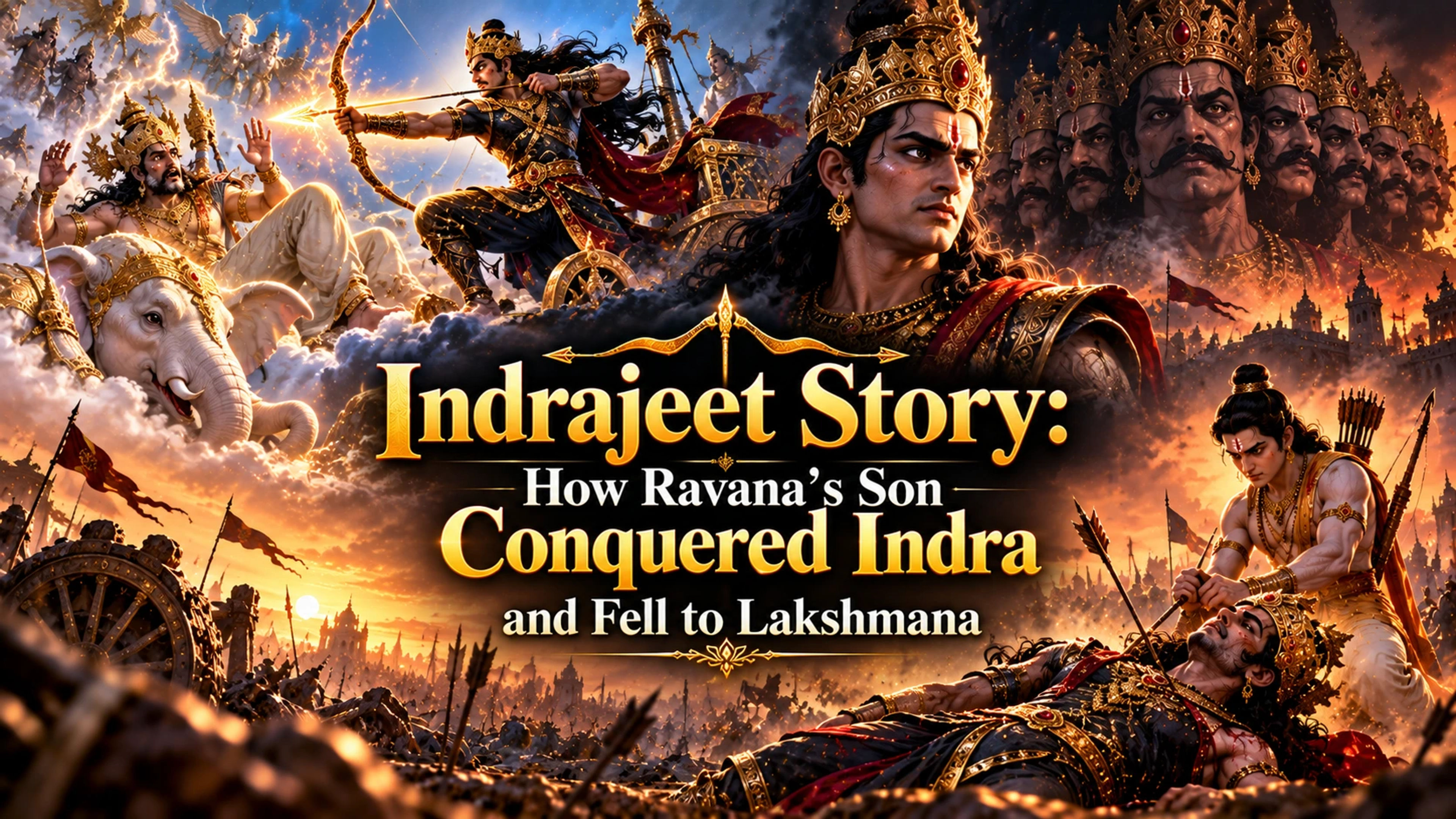
Twice in the war of Lanka, Lord Rama and Lakshmana lay helpless on the battlefield. Both times, the same warrior put them there. He fought from inside the clouds, unseen, and his arrows seemed to come from everywhere at once. His name was Meghanada, but the world knew him by a title no one else in the Ramayana could claim: Indrajeet, the one who conquered Indra.
The Indrajeet story is usually told in a single line: Ravana's son, killed by Lakshmana. But that line skips almost everything interesting. How did a rakshasa prince capture the king of the gods? What exactly was the ritual at Nikumbhila, and why did Vibhishana treat it as an emergency? And how does a warrior this gifted end up on the losing side?
Let us go through it the way the Valmiki Ramayana tells it, and then see how Tulsidas and later storytellers changed the picture.
Table of contents
Key takeaways
- Indrajeet was born Meghanada, the son of Ravana and Mandodari. The Uttara Kanda says he captured Indra through illusion, and Brahma gave him the name Indrajit when asking for Indra's release.
- In the Valmiki Ramayana he brings down Rama and Lakshmana twice: once with serpent arrows, freed by Garuda, and once with a Brahma weapon, after which Hanuman brings the healing herbs. Neither defeat was permanent.
- Vibhishana revealed that a boon from Brahma carried a condition: an enemy who struck Indrajeet before he completed his rite at Nikumbhila could kill him.
- Lakshmana killed Indrajeet with the Aindra astra, after declaring that if Rama was righteous and truthful, the weapon should strike its mark.
- Indrajeet's death left Ravana grieving and enraged, and it removed Lanka's most dangerous remaining warrior before the final battle.
- His wife Sulochana and the idea that only a man who had not slept for fourteen years could kill him come from later traditions, not from Valmiki.
The Warrior Who Stood Between Lanka and Defeat
Think about where Ravana stood in the second half of the war. His brother Kumbhakarna was dead. Several of his sons, including Atikaya, had fallen to Lakshmana. Generals he had trusted for years were gone. Each time the news reached the palace, there was one person Ravana turned to: Indrajeet.
And each time, Indrajeet delivered. He was not just a strong fighter. He was a strategist who understood fear, illusion and timing better than anyone on either side. That is what makes his story worth reading closely. He did not lose because he was weak. He lost for reasons that are far more interesting.
Who Was Indrajeet?
Indrajeet was the eldest son of Ravana and his chief queen Mandodari, and grandson, through his mother, of Maya, the great architect of the asuras. His birth name was Meghanada, often said as Meghnad. 'Megha' means cloud and 'nada' means sound or roar, and tradition explains that as a newborn he cried out with a sound like thunder. It is a fitting name for a warrior who would later fight from within the clouds.
The texts do not give us much about his childhood. What the Uttara Kanda does describe is how seriously he pursued power. While Ravana was away on his campaigns, Meghanada performed a series of great sacrifices at Nikumbhila, the sacred grove of Lanka, with Shukracharya, the guru of the asuras, guiding him. Through them, the Uttara Kanda says, he won boons from Shiva, including a chariot that could travel wherever he wished and the power of a deep, darkening illusion. Devotion to Shiva ran in the family; if you are curious about the father's side of that relationship, we have written about Ravana's devotion to Lord Shiva.
How Meghanada Became Indrajeet
The story behind his famous name comes from the Uttara Kanda, the final book of the Valmiki Ramayana. Ravana had marched on the heavens, and the gods fought back hard. Indra's son Jayanta faced Meghanada in battle, and at one point Ravana himself was in serious trouble.
Meghanada then did what he did best. He told his father to step back, made himself invisible through his power of illusion, and captured Indra. The king of the gods was bound and carried off to Lanka.
Imagine the panic in the heavens. Brahma himself had to come to Lanka to ask for Indra's release. It was Brahma who gave Meghanada his new name, Indrajit, the conqueror of Indra. In return for freeing Indra, Meghanada asked for immortality. Brahma refused, because no created being can have that. Instead he granted a boon tied to the sacred fire: if Meghanada completed his fire offerings before a battle, a chariot would rise from the flames, and while fighting from it he could not be killed. But if he went to war without completing the rite, he would die.
Hold on to that condition. It becomes the key to the entire Nikumbhila episode. The Uttara Kanda also adds a twist about Indra: his humiliation is linked to his old wrong against Ahalya, so the defeat is presented partly as the consequence of his own conduct.
Same name, different tellings
Later and popular versions often add details not found in Valmiki, such as Indrajeet's ritual being dedicated to a particular goddess, or a condition that only someone who had not slept for fourteen years could kill him. The sleep condition belongs to the folk story of Urmila and Lakshmana. In Valmiki, Indrajeet's weakness lies entirely in the unfinished fire rite.
What Made Indrajeet So Powerful?
If you read the Yuddha Kanda carefully, a pattern emerges. Indrajeet rarely fights in the open. He prepares first, often with a fire ritual, and then he disappears. Valmiki describes him rising into the sky in a chariot that cannot be seen, filling the air with arrows, darkness and mist, so that the vanaras cannot tell where the attacks are coming from. His enemies cannot even hear the wheels of his chariot or see his bow.
That is his real genius. Strength wins duels. Invisibility wins wars, because it destroys an army's confidence. A soldier can face a giant. It is much harder to face arrows from nowhere.
He also carried weapons of enormous power. The serpent arrows, the Brahma weapon and more. But notice how he uses them. Almost always, he holds them back until the enemy is confused and exposed. He is a tactician first and a strongman second.
The Warrior Who Twice Brought Rama Down
First Encounter: The Serpent Arrows
Indrajeet's first big moment in the war actually begins with a setback. In a night battle, Angada leaps onto his chariot, smashes it, and kills his horses and charioteer. Indrajeet is humiliated. His answer is to vanish.
From the sky, unseen, he releases arrows that become serpents and bind Rama and Lakshmana completely. The brothers fall, covered in wounds, and the vanara army is thrown into despair. Back in the palace, Ravana is overjoyed and believes the war is won. He even has Sita flown over the battlefield in the Pushpaka so she can see the brothers lying there.
But it was not the end. Garuda, the great eagle and natural enemy of serpents, arrives, and at his touch the snakes flee. Rama and Lakshmana rise, their wounds healed. Indrajeet's victory lasted only as long as the binding.
Second Encounter: The Brahma Weapon
Much later, after Kumbhakarna, Atikaya and others have fallen, Ravana sinks into grief. Seeing his father like that, Indrajeet vows to finish Rama and Lakshmana that very day. He performs his fire ritual, invokes the Brahma weapon, and rains it down from the sky on the vanara army. Leader after leader falls: Sugriva, Angada, Nila, Jambavan and countless others.
Then he turns it on Rama and Lakshmana. Here Valmiki shows us something lovely. Rama recognises the weapon as presided over by Brahma and tells Lakshmana to bear it calmly. They do not fight the Creator's weapon. They fall, and Indrajeet returns to Lanka in triumph.
That night, Vibhishana and Hanuman walk through the battlefield with torches, searching for survivors. They find the old bear-king Jambavan, barely alive, who asks one question first: is Hanuman alive? If he is, Jambavan says, the army is not lost. He sends Hanuman to the Himalaya for the healing herbs, and when Hanuman can't identify the right ones, he brings the whole peak back. The scent of the herbs revives Rama, Lakshmana and the army.
So did Indrajeet defeat Rama and Lakshmana? He incapacitated them twice. He never finished them. Both times, help came from beyond the battlefield, from Garuda and from Hanuman.
The Illusion of Sita
Indrajeet's next move is his most chilling. He fights on, invisible again. Lakshmana, furious, wants to use a Brahma weapon to wipe out all the rakshasas at once. Rama stops him. It is not right, he says, to destroy a whole race for the sake of one man, and those who are not fighting, who are fleeing or who have surrendered must not be harmed.
Then Indrajeet creates an illusory Sita, carries her in his chariot in full view of Hanuman and the vanaras, and kills her before their eyes. The news reaches Rama, and he collapses in grief. It is a masterstroke of psychological warfare. And while everyone mourns, Indrajeet quietly slips away to Nikumbhila.
The Mystery of Nikumbhila
Vibhishana is the one who sees through it all. He knows his nephew well. Sita is not dead, he tells Rama. Ravana would never allow her to be killed. The illusion is a distraction, and Indrajeet has gone to Nikumbhila to complete his sacrifice.
Then he explains why that matters so much. Brahma's boon, he says, came with a condition. If Indrajeet completes his rite at Nikumbhila and enters battle, he will be extremely hard to overcome. But an enemy who strikes him before the offering is finished can kill him. There is no time to grieve. Lakshmana must go now.
Why the ritual mattered
It is tempting to say the ritual would have made Indrajeet invincible. The text is more careful than that. What Vibhishana describes is a window of vulnerability set by Brahma's boon. Strike before the rite is complete, and Indrajeet can be killed. That is why Nikumbhila became the decisive battleground of the war.
Why Lakshmana Was Sent
Rama sends Lakshmana, along with Vibhishana, Hanuman, Angada, Jambavan and a large force. Lakshmana had already brought down Atikaya, whose armour no ordinary arrow could pierce, and he had stood beside Rama through every encounter with Indrajeet so far. If you want to know more about him as a warrior, you can read about Lakshmana's strength and abilities in our earlier article.
At Nikumbhila, Vibhishana guides Lakshmana to attack Indrajeet's army and break the sacrifice before it is complete. He points out the banyan tree where Indrajeet makes his offerings. The rite is interrupted, and an enraged Indrajeet comes out to fight.
What follows includes one of the most bitter family exchanges in the Ramayana. Indrajeet sees his uncle on the enemy's side and accuses him of betraying his own blood. Vibhishana answers that though he was born a rakshasa, he does not share Ravana's cruelty, and that he has abandoned a family that chose sin. It is two people who once lived in the same palace, now standing on opposite sides of dharma.
How Indrajeet Died
The duel between Lakshmana and Indrajeet is one of the longest in the epic. They counter each other's divine weapons again and again. Lakshmana kills Indrajeet's charioteer; Indrajeet drives on himself. Vanara warriors crush his horses and chariot. He returns to Lanka for a fresh chariot and comes back to fight. Neither gives way.
Finally, Lakshmana fits the Aindra astra, Indra's own weapon, to his bow. Before releasing it, he makes a solemn declaration: if Rama, son of Dasharatha, is righteous, devoted to truth and unmatched in valour, let this weapon slay the son of Ravana. The arrow severs Indrajeet's head.
There is a quiet poetry here. The man who earned his name by conquering Indra is brought down by Indra's own weapon. And Lakshmana's final blow does not rest on his own pride, but on his brother's truthfulness.
The gods rejoice. The vanaras celebrate. When Lakshmana returns, wounded and exhausted, Rama embraces him and says that with Indrajeet gone, the war is as good as won.
Ravana's Grief
In Lanka, the news devastates Ravana. Valmiki shows a father collapsing in grief and then exploding in rage. He seizes a sword and rushes to kill Sita, blaming her for everything, and is stopped only when his minister Suparshva reminds him that killing a woman would be unworthy of him, and that his anger should be turned on Rama instead. It is one of the most revealing scenes about Ravana: even after losing his son, he cannot see that his own choice started it all.
How Other Ramayanas Tell the Indrajeet Story
In the Ramcharitmanas, the most famous blow belongs to Meghnad. It is he who strikes Lakshmana down with the Shakti weapon, leading to Hanuman's journey for the Sanjeevani. Later, the vanaras break up his sacrifice, and Lakshmana kills him in battle. Tulsidas gives his death a devotional touch: as he dies, Meghnad drops all deceit and calls out for Lakshmana and Rama, and Angada and Hanuman remark that his mother is blessed.
Regional and later traditions add more. Many tellings give him a devoted wife, Sulochana, often described as the daughter of Shesha, who goes to Rama's camp to ask for her husband's head and then performs sati. She does not appear in Valmiki. In Bengal, Michael Madhusudan Dutt's nineteenth-century epic poem Meghnad Badh Kavya famously reimagined Meghnad as a tragic hero, killed unarmed in the sacrificial chamber, with Vibhishana as the one who opened the way. That poem is a modern literary work and deliberately turns the moral lens around.
| Episode | Valmiki Ramayana | Later tellings |
|---|---|---|
| Name Indrajit | Given by Brahma after Meghanada captures Indra (Uttara Kanda) | Same core story, often with extra details about the ritual's goddess |
| Strike on Lakshmana | Serpent arrows and the Brahma weapon fell both brothers | Ramcharitmanas: Meghnad's Shakti strikes Lakshmana |
| Nikumbhila | A rite that had to be stopped before completion, per Brahma's boon | Vanaras disrupt it (Ramcharitmanas); killed unarmed inside it (Meghnad Badh Kavya) |
| Death | Lakshmana's Aindra astra, released with an oath on Rama's truth | Ramcharitmanas: dies calling on Rama and Lakshmana |
| Wife | Not named | Sulochana, in many later and regional tellings |
Was Indrajeet a Villain or a Loyal Son?
Here is the uncomfortable part. Valmiki gives us almost no sign that Indrajeet questioned his father. At the war council before the battle, when Vibhishana urges Ravana to return Sita, it is Indrajeet who mocks his uncle as a coward and insists that Lanka needs no such advice. Vibhishana replies that the prince is too young to see the danger he is leading his father into.
So Indrajeet is not a secret rebel. He is a son who believed in his father completely, fought for him with everything he had, and went to war every time Ravana was in grief. In that sense, his loyalty is genuine and even moving.
But loyalty is not the same as righteousness. Indrajeet used his gifts to defend an abduction. He killed an illusory Sita to break the spirit of an army. He lured his enemies into despair through deceit. A great warrior can still fight for a wrong cause, and the Ramayana never pretends otherwise. Vibhishana, standing opposite him at Nikumbhila, is the living contrast: the family member who chose dharma over blood.
What Indrajeet's Story Reveals About Power
So why did Ravana's most brilliant warrior lose? Not because his power failed. His weapons worked every time. They felled the vanaras, bound the brothers and nearly ended the war twice.
He lost because every advantage he had depended on something outside himself. His safety depended on a ritual being completed. His victories depended on the enemy not knowing his secrets. And the one person who knew those secrets, his uncle, had already chosen the other side because of the cause Indrajeet was fighting for. In the end, Ravana's wrong choice did not just doom Ravana. It turned Lanka's own family against it.
There is also the contrast at the moment of death. Indrajeet built his power on boons, illusions and rituals. Lakshmana's final arrow rested on something simpler: the truth and righteousness of his brother. The epic does not say strength does not matter. It says strength alone is not enough.
Remembering Indrajeet
It would be easy to remember Indrajeet only as the man Lakshmana killed. But his story deserves more than that. He was the one warrior who captured the king of the gods, the only one who brought Rama down twice, and the strategist who understood that the deepest wounds in war are made in the mind.
And yet the Ramayana places him exactly where his choices led. A loyal son, a brilliant fighter, standing on the wrong side of dharma with his uncle facing him across the sacred grove. Perhaps that is why his story stays with us. It shows what it costs when extraordinary gifts serve a cause that cannot be defended.
Who was Indrajeet in the Ramayana?
Indrajeet, born Meghanada or Meghnad, was the eldest son of Ravana and Mandodari. He was Lanka's most formidable warrior in the war against Rama, known for fighting invisibly, using illusion and wielding divine weapons.
Why was Meghanada called Indrajeet?
According to the Uttara Kanda of the Valmiki Ramayana, Meghanada captured Indra through illusion during Ravana's war with the gods and took him to Lanka. Brahma came to secure Indra's release and gave Meghanada the name Indrajit, meaning conqueror of Indra.
Did Indrajeet defeat Rama and Lakshmana?
Only temporarily. In the Valmiki Ramayana he struck them down twice, once with serpent arrows and once with a Brahma weapon. Garuda freed them the first time, and the herbs Hanuman brought from the Himalaya revived them the second time.
What was the Nikumbhila ritual?
Nikumbhila was the sacred grove in Lanka where Indrajeet performed his fire sacrifices before battle. Vibhishana explained that, according to a boon from Brahma, an enemy who struck Indrajeet before he completed the rite there could kill him. That is why Lakshmana was sent to stop it.
Who killed Indrajeet and how?
Lakshmana killed Indrajeet. After a long duel near Nikumbhila, he released the Aindra astra, declaring that if Rama was righteous and truthful the weapon should slay Ravana's son, and the arrow severed Indrajeet's head.
Was Indrajeet stronger than Lakshmana?
The Ramayana does not rank them. Indrajeet had incapacitated Lakshmana earlier through illusion and divine weapons, but in their final open duel Lakshmana prevailed. The outcome turned as much on Vibhishana's knowledge and the timing at Nikumbhila as on raw strength.
Who was Indrajeet's wife?
The Valmiki Ramayana does not name her. Many later and regional traditions call her Sulochana, often described as the daughter of Shesha, who comes to Rama's camp for her husband's head after his death.
Begin your Naam Jaap today
Offline-first and built entirely around one purpose — helping you show up for your practice, every single day.
- Free, always
- Works offline
- No ads